

Skip navigation

Joseph: Authentic Leadership Forged in the Crucible


Authentic leadership, a relatively new leadership theory, helps fill the need for principled and trustworthy leaders. Issues of integrity, values, and care for others are emphasized, aligning well with biblical foundations for Christian leaders. Of special note is the role of major life events or crucibles, referring to some transformative experience or hardship which tests a person’s limits, but also provides the means of personal growth, empathy, self-knowledge, and deeper reliance upon God. Joseph exemplified authentic leadership in practice and through years of life-changing hardship. Through his own values, self-control, compassion, and sense of purpose, he earned the trust of high officials, and even more importantly, he was found trustworthy by God, who was consistently blessed his leadership. 


Introduction

On December 5, 2018, Jon Meacham, Pulitzer Prize-winning biographer of George H. W. Bush, provided a eulogy at President G. H. W. Bush’s funeral (Foussianes, 2018, para. 1). He eloquently spoke of President Bush’s character: “His life code, as he said, was: ‘Tell the truth. Don’t blame people. Be strong. Do your best. Try hard. Forgive. Stay the course.’ And that was, and is, the most American of creeds” (Foussianes, 2018, para. 12). 

Such life codes speak of integrity. They speak of those vital internal character qualities of trustworthy leaders. According to Meacham (2015), President Bush might justify political compromise during campaigns, but always aimed to be “principled and selfless once in command” (Meacham, 2015, p. xxv). Meacham continued, “And as president of the United States, Bush was often both” (Meacham, 2015, p. xxv). President Bush’s personal principles were echoed in his prayer, penned by himself, and given at his 1989 inauguration, a prayer befitting any Christian leader’s mindset: “….For we are given power not to advance our own purposes, nor to make a great show in the world, nor a name. There is but one just use of power, and it is to serve people” (Meacham, 2015, p. 552). For the Christian leader, these values of integrity, humble service, and perseverance are not optional; they reflect God’s plan for leadership (1 Tim. 3:1-12, 2 Tim. 2:15, 22-24, Acts 20:28-31, Mark 10:42-45, Josh. 1:5-7).  

Still a relatively new theory, authentic leadership helps fill the need for such principled leaders (Northouse, 2016, p. 206). Issues of integrity, values, and care for others are emphasized: “Authentic leaders understand their own values, place followers’ needs above their own, and work with followers to align the interests in order to create a greater common good” (Northouse, 2016, pp. 206-207). These traits develop over a lifetime (Northouse, 2016, p. 196). Of special note is the factor of critical life events (Northouse, 2016, p. 205) or crucibles (Bennis & Thomas, 2002a, p.3). A crucible refers to a significant life-changing event or crisis which forces people to examine their own values and ultimately, emerge stronger, more confident in themselves and in their purpose (Bennis & Thomas, 2002a, p. 3). These events can be either positive or negative, simple or crisis-level, but serve as catalysts for change and growth (Northouse, 2016, p. 205). 

President Bush’s life codes would apply to Joseph’s parallel role as a national leader. In the Genesis account, he told the truth. He didn’t blame people. He forgave. He stayed the course, even when it was long and difficult (Gen. 41:28, 45:8-9, 50:1921). Through extreme and lengthy crises, he consistently honored God by his character. Through his trials, God “was with Joseph” (Gen. 39:2, New International Version). This article will explore how the behavior, character, and life events of Joseph exemplify authentic leadership and how authentic leadership informs today’s Christian leaders

Authentic Leadership Theory

Self-Knowledge

A key characteristic of authentic leadership is self-knowledge (Avolio & Gardner, 2005, p. 329). Authentic leaders are aware of their values and beliefs, and this deep understanding helps them stay true to themselves and also communicate their principles and ethics to others (Avolio & Gardner, 2005, pp. 329-330). They strengthen organizations by helping its members “find meaning and connection at work through greater self-awareness; by restoring and building optimism, confidence and hope; by promoting transparent relationships and decision-making that builds trust and commitment among followers; and by fostering inclusive structures and positive ethical climates” (Avolio & Gardner, 2005, p. 331).

Model of Bill George

There are various perspectives on authentic leadership. This article will focus on the approach of Bill George, devised from his own experience in the corporate world and from interviews with over 125 successful leaders (Northouse, 2016, p. 197). In George’s (2003) practical approach to authentic leadership, he identifies five essential elements: values/behavior, self-discipline/consistency, relationships/connectedness, heart/compassion, and purpose/passion (p. 36). These qualities are not sequential; rather, they represent life-long developmental growth (George, 2003, p. 18).  

Values and Behavior. Values and behavior refer to leaders’ innate sense of self: their character, what they value, and what they believe (George, 2003, p. 20). Valuedriven leaders “have a clear idea of who they are, where they are going, and what the right thing is to do” (Northouse, 2016, pp. 198-199). According to Avolio, Walumbwa, and Weber (2009), authentic leadership encompasses internalized moral perspective, transparency within relationships, self-awareness, and balanced processing (p. 424).

Deeply-held morality is a guiding force (George, 2003, p. 20). 

Self-Discipline and Consistency. As important as values are, self-discipline is necessary in order to convert one’s core values into actual behavior (George, 2003, p. 24). Stress can impede sound judgment, but authentic leaders have learned to stay calm during times of pressure (George, 2003, p. 41). 

Relationships and Connectedness. Authentic leaders are able to establish strong relationships (Northouse, 2016, p. 199). With a genuine tendency toward openness toward others, they share their own stories and take an interest in the stories of others. Through this exchange, bonds of trust and closeness are formed (2016, p. 199). Leaders build connection and commitment within their teams by their openness, even if the dialogue includes constructive feedback or bad news (George, 2003, pp. 40-41). 

Heart and Compassion. With a heart of compassion, authentic leaders intentionally care for others (Northouse, 2016, p. 200). They open themselves to people’s personal lives and problems and, in turn, team members are inspired to believe in their leader (George, 2003, pp. 39-40). 

Purpose and Passion. Lastly, those who hold a passionate purpose not only know their mission, but are inspired and driven by it (George, 2003, p. 19). Their work deeply matters to them (George, 2003, p. 19). They may grow and learn while working toward someone else’s purpose for a time, but ultimately an authentic leader must discover and commit to her own purpose (George, 2003, p. 19).

The Transformative Power of the Crucible Events

George (2003) describes the metaphorical crucible as some transformative life event which tests one’s limits but also reveals the self-knowledge about how the person has inwardly changed and grown from the difficulty (p. 27). In the Middle Ages, crucibles – heat-proof vessels used for high-temperature chemical reactions – were used to by alchemists attempting to turn metals into gold (Thomas, 2009, p. 21). Used for leadership contexts, a crucible describes a “transformative experience from which a person extracts his or her ‘gold’: a new or an altered sense of identity” (Thomas, 2009, p. 21). Unlike typical life events which may be stressful but predictable, crucibles incite one to find meaning; they are “more like trials or tests that corner individuals and force them to answer questions about who they are and what is really important to them” (Thomas, 2009, p. 21). Crucible events serve to validate the authentic leader’s values through stress-testing:

It is relatively easy to list your values and to live by them when things are going well. When your success, your career, or even your life hangs in the balance, you learn what is most important, what you are prepared to sacrifice, and what tradeoffs you are willing to make (George, Sims, McLean, & Mayer, 2007, p. 134).

The term crucible, as used in authentic leadership theory, originated from a study conducted by Warren Bennis and Robert Thomas, and the resultant book, Geeks and Geezers (2002). They intended to explore the influence of eras on leaders using two age groups (people over seventy and people under thirty-five), but the study produced something unexpected (Bennis & Thomas, 2002b). From their findings, they developed a theory to explain how some people can find meaning through times of testing and “emerge, not just stronger, but equipped with the tools he or she needs both to lead and to learn” (Bennis & Thomas, 2002b, p. 4). Their model explains how people find meaning in their difficulties “and how that process of ‘meaning-making’ both galvanizes individuals and gives them their distinctive voice” (Bennis & Thomas, 2002b, p. 3).  

Three Types of Crucible Events

From his work studying nearly 200 crucible-level experiences, Thomas (2009) has categorized them into three types (p. 21). The New Territory category refers to situations in which a person experiences an unexpected turn of events, such as a new position at work or a major change within the family (Thomas, 2009). One must overcome the disorientation and confusion, but gains a new alertness and sensemaking skills (Thomas, 2009, pp. 21-22). The Reversal category describes a disruptive loss of some kind (Thomas, 2009, p. 24). Something that was assumed to be permanent is suddenly lost, or something assumed to be true is revealed as false (Thomas, 2009). A reversal can provide a leader with new and broader understanding of a situation (Thomas, 2009, p. 24). The Suspension category involves a hiatus, sometimes unplanned, in which some set of routine behaviors are removed, possibly by force, and replaced by a heavily structured routine, such as the military or prison, or with no routine (Thomas, 2009, p. 25). Such leaders need to refocus their purpose and strengthen their personal set of beliefs and values (Thomas, 2009, p. 25). All three types involve “a kind of potential energy, that demanded a behavior or maybe an answer that either did not exist previously or went unrecognized” (Thomas, 2009, p. 26). 

The Crucibles of George H. W. Bush

Incident as a WWII Navy Pilot. Lending credibility to the crucible element of authentic leadership theory are two particular critical life events of President Bush, noted to have impacted him as a leader (Meacham, 2015, pp. 89-95, 147-150). The first occurred during WWII while Bush served as a Navy pilot (Meacham, 2015). In the early morning of September 2, 1944, at the young age of twenty, this young pilot, accompanied by two soldiers, took off on a mission to bomb a radio tower on the Japanese island of Chichi-Jima (Meacham, 2015, p. 89). With the target in view, his plane was hit by enemy fire (Meacham, 2015). As the plane immediately filled with smoke, Bush maintained control of the plane long enough to hit the target, then parachuted to the water below (Meacham, 2015). As a Japanese boat began its approach toward him, Bush, stranded in a tiny raft with no oars, could not help fearing for his life or at least being taken as a prisoner of war. (Meacham, 2015). That threat was removed by a nearby U.S. fighter plane, and, after two hours of waiting, Bush was rescued, but not without the painful realization that his two fellow servicemen had not survived (Meacham, 2015). During those hours, “he sat in the raft in tears” (Meacham, 2015, p. 93).

Bush later reminisced of the event, explaining its impact: “It was transforming. Transforming in the sense that you realize how close death can be. You realize, painstakingly so, the responsibility you had for the life of somebody else” (Meacham, 2015, p. 95). He pondered, “I’ll always wonder, ‘Why me? Why was I spared?’” (Meacham, 2015, p. 105). According to Meacham (2015), Bush “spent the rest of his life striving to prove that he was worthy of being saved when others were doomed” (p. 105).  

Family Loss. President Bush endured an even deeper life-altering event, evident from his own answer to a journalist during the 1980 presidential campaign (Bush, 2014, p. 57). Probing to see if Mr. Bush could relate to average people, the journalist asked him if he had ever lived through a “personal difficulty” (Bush, 2014, p. 57). Staring at the reporter, Bush asked, “Have you ever sat and watched your child die?” (Bush, 2014, p. 57). To the journalist’s answer in the negative, Bush replied, “I did, for six months” (Bush, 2014, p. 57). Just before she turned four years old, the Bush’s daughter Robin died of leukemia (Meacham, 2015). Mrs. Bush recollected on this difficult time: “We awakened night after night in great physical pain – it hurt that much” (Meacham, 2015, p. 148).  

Influence of Crucibles on Leadership. For President Bush, the search for meaning in that loss continued throughout his life (Meacham, 2015). He expressed one particular realization: “It taught me that life is unpredictable and fragile” (Meacham, 2015, p. 150). Visiting Poland during his years as vice president, and thirty-five years after Robin’s death, Bush visited a hospital ward for children with leukemia. Upon meeting one young boy, sick with the same disease which stole his daughter, Bush felt a wave of empathy (Meacham, 2015). Not wanting to be seen crying in front of the many television cameras, he quietly focused on the child: “So I stood there looking at this little guy, tears running down my cheek, but able to talk to him pleasantly… hoping he didn’t see but, if he did, hoping he’d feel that I loved him” (Meacham, 2015, p. xxix). Empathy gained from heartache is evident.  

The WWII experience at Chichi-Jima also proved to be instrumental in Bush’s later leadership responsibilities (Meacham, 2015, p. 422). In 1981, while serving as the U.S. vice president, Bush faced unexpected pressure after President Reagan was shot, yet Bush was observed to appear surprisingly calm (Meacham, 2015). Meacham observed, “In a way, Bush had been here before. Long ago he had been charged with life-and-death responsibilities on an airborne mission” (Meacham, 2015, p.422). Meacham (2015) records that Bush’s experience near Japan as a twenty-year-old gave him strength to lead now as a middle-aged statesman: “Now, amid uncertainty and doubt, he was determined to do his duty, which, as he saw it, was to lead quietly and with dignity” (p. 422).  

The Crucibles of Joseph

Family Betrayal. In the Bible, Joseph experienced multiple crucible experiences which spanned thirteen years (Gen. 37:2, 41:41). While still just a teenager (Gen. 37:2), his brothers mistreated him terribly; they even considered murder when the opportunity arose (Gen. 37:20). Instead, they threw Joseph in an empty well and then sold him to traders bound for the foreign land of Egypt (Gen. 37:24, 28). Besides the psychological trauma of being helpless and physically trapped in a dark, confining well, he also endured the emotional anguish of family betrayal; after the brothers forced him into the well, they callously sat down to enjoy a meal together (Gen. 37:25). The depth of pain Joseph suffered is revealed in the brothers’ confession years later: “Surely we are being punished because of our brother. We saw how distressed he was when he pleaded with us for his life, but we would not listen” (Gen. 42:21). 

Mistreatment in Egypt. No longer enjoying the status as his father’s favored son, Joseph lived as a slave in Egypt, serving in the home of Potiphar, Pharaoh’s captain of the guard (Gen. 37:36). There, he suffered further demoralization after being falsely accused of sexual misconduct by his master’s wife (Gen. 39:14-18), when in fact, he resisted her advancements out of respect for God and her husband (39:8-10). For this, he was imprisoned (Gen. 39:20). During that time, he cared for two fellow prisoners, Pharaoh’s cupbearer and baker (Gen. 40:2-4). After interpreting their troublesome dreams, Joseph pleaded for the cupbearer’s help:  

But when all goes well with you, remember me and show me kindness; mention me to Pharaoh and get me out of this prison. I was forcibly carried off from the land of the Hebrews, and even here I have done nothing to deserve being put in a dungeon (Gen. 40:14-15). 

Joseph’s crucible continued, however, and he was forgotten for two more years (Gen. 40:23).   

According to C. S. Lewis (1952), pride is “the essential vice of mankind, the utmost evil” (p. 121). Lewis continues: “Unchastity, anger, greed, drunkenness, and all that, are mere fleabites in comparison: it was through Pride that the devil became the devil: Pride leads to every other vice: it is the complete anti-God state of mind” (Lewis, 1952, p. 122). If pride is the “anti-God” mindset as Lewis asserts, Joseph’s state of mind reveals the opposite. More than his other admirable character traits, Joseph’s humility is deeply connected to his close and reverent relationship with God. From his earliest days in Egypt, it is recorded that “the LORD was with Joseph” (Gen. 39:2) and brought him success in everything (Gen. 39:2-3, 21-23). In the midst of trials and unjust treatment, God consistently elevated Joseph to leadership positions, yet at every opportunity, Joseph humbly credited God when he could have taken credit himself (Gen. 40:8, 41:16, 50:19).

Character Growth through Hardship. Joseph’s admirable character traits, however, developed over time through endurance cultivated by hardship (Rom. 5:3-4). Such endurance gained through suffering can be likened to physical endurance gained through painful exercise (Cloud & Townsend, 2001, p. 206). Muscles are strained past their natural ability, explains Henry Cloud (2001): “After my workout they recreate and rejuvenate and grow back to a higher level of development than before. I tear down to rebuild. And through the process of pain, growth happens” (Cloud & Townsend, 2001, pp. 206-207). Toward the same end, God often “stretches our souls” (Cloud & Townsend, 2001, p. 207). Suffering “can take us to places where one more season of ‘comfort’ cannot” (Cloud & Townsend, 2001, p. 206). In the Joseph account, rising to power so abruptly and in such a drastic reversal could ruin a young leader, but for Joseph, “his sufferings nurtured a meek spirit” (Howell, 2003, p. 24).  

In the biblical epic of Joseph, he is introduced as an immature tattle-tale, blatantly favored by his father, and the source of his brothers’ envy (Gen. 37:2-11). Throughout the thirteen years of brokenness, however, Joseph’s suffering strengthened his ability to humbly depend on God (Gen. 40:8, 41:16, 28), to practice self-control (Gen. 39:9), and to treat others compassionately (Gen. 40:7, 45:4-15). Of particular significance was Joseph’s reverent acknowledgement of God’s specific purpose in his life: 

…because it was to save lives that God sent me ahead of you. For two years now there has been famine in the land, and for the next five years there will be no plowing and reaping. But God sent me ahead of you to preserve for you a remnant on earth and to save your lives by a great deliverance (Gen. 45:5b-7).  

Joseph’s Example of Authentic Leadership

In the Genesis account, God repeatedly elevated Joseph as a leader by helping him earn the trust of high government officials: Potiphar (Gen. 39:4), the prison warden (Gen. 39:22-23), and Pharaoh (Gen. 41:39-44). He also earned the trust of the people (Gen. 47:25). In his leadership, Joseph consistently honored God by his character. Throughout these roles, Joseph exemplified all five traits of George’s (2003) model of authentic leadership: values and behavior, self-discipline and consistency, relationships through connectedness, heart of compassion, and passionate purpose (p. 36). 

Values and Behavior

One aspect of Joseph’s integrity often overlooked is his honesty. George (2003) asserts, “Integrity is the one value that is required in every authentic leader. Integrity not just the absence of lying, but telling the whole truth, as painful as it may be” (p. 20). Joseph spoke honestly even when the news was bad. In prison, Joseph revealed the positive fate of the cupbearer and sadly, the imminent death of the baker (Gen. 40:8). To both men, Joseph straightforwardly began his interpretation with the phrase, “This is what it means” (Gen. 40:12, 18). Acting on God’s behalf (40:8), Joseph stated the truth to these two men in a direct manner.  

After two years, the need for painful truth arose again. Joseph was summoned to interpret another set of dreams, this time for Pharaoh himself. Since the Pharaoh was considered a god himself (Walton, 2001, p. 674), Joseph’s honesty put him at risk as he claimed emphatically that the interpretation would come from God: “Then Joseph said to Pharaoh, “The dreams of Pharaoh are one and the same. God has revealed to Pharaoh what he is about to do” (Gen. 41:25). Emphasizing this fact, Joseph repeated it at the close of the interpretation: “It is just as I said to Pharaoh: God has shown Pharaoh what he is about to do” (Gen. 41:28). Joseph’s character trait of honesty exalted God even at Joseph’s own risk.  

Value-guided behavior marked Joseph’s business practices. He had authority to control the entire supply of grain for Egypt and all outlying areas (Gen. 41:54) as well as access to a vast treasury: “Joseph collected all the money that was to be found in Egypt and Canaan in payment for the grain…and he brought it to Pharaoh’s palace” (Gen. 47:14). Though he could have secretly yielded to the temptation of extortion, the biblical account indicates he acted with integrity. 

Lastly, Joseph exemplified integrity by honoring his word given to his father concerning his request to be buried in Canaan. Jacob asked for Joseph’s “faithfulness” in this (Gen. 47:29) and Joseph answered, “I will do as you say” (Gen. 47:30). Jacob could rest in Joseph’s promise, and “worshipped as he leaned on the top of his staff” (Gen. 47:31). Joseph buried Jacob as requested, keeping his word (Gen. 50:6-7).  

Self-Discipline and Consistency

While in Egypt, Joseph had opportunity to relinquish self-control in at least four areas: sexual sin, revenge, self-advancement, and extortion. In each area of temptation, he refused to yield. 

Opportunity for Sexual Sin.Potiphar’s wife took notice of young, handsome Joseph (Gen. 39:6-7) and made sexual advances toward him. Her direct and brazen demands continued “day after day” (39:10). In that situation, most people would have been caught off guard by such boldness but not Joseph. Swindoll (1998) notes, “Without hesitation and being absolutely secure in himself and his God, he responded with equal boldness” (p. 27). Twice in the passage, it is recorded, “Joseph refused” (Gen 39:8, 10). He refused her demands and refused “even to be with her” (39:10). 

George (2003) asserts that the strength gained from enduring a crucible can provide the discipline for success later in life (p. 27). The opposite holds true as well: “Without the wisdom of the crucible, [untested people] cannot cope and are prone to do bizarre things on their way to self-destruction” (George, 2003, p. 29). Joseph’s testing strengthened his self-discipline and, unlike his brother Judah with Tamar (Gen 38:1518), enabled him to withstand strong temptation and stay true to God.

Opportunity for Revenge.In a total reversal of prior events, Joseph became the “governor of the land” (Gen. 42:6) and his brothers were vulnerable before him. They needed food, and they had been living in bondage to their guilt (Gen. 42:21-22, 28). After more than twenty years, Joseph encountered his brothers (Gen. 42:7). At this point, Joseph displayed self-disciplined emotions. Seeing his brothers, fierce memories and emotions would have naturally arisen internally with no advantage of forewarning. During these interactions, he held power to retaliate. At their second arrival, they even feared, “He wants to attack us and overpower us seize us as slaves” (Gen. 43:18). Yet, Joseph’s self-control stabilized him. 

Two mistakes were possible. He could have taken quick, reactionary revenge, overstepping God’s place of judgment. He also could have unwisely rushed to reveal himself before knowing if their hearts had changed. Joseph did neither. Instead he tested them while retaining his anonymity. It was not until the brothers had proved themselves as repentant that Joseph “could no longer control himself before all his attendants” (Gen. 45:1). His intense emotional display at his revelation was a natural, human response of love and relief. 

By this time, Joseph had already faced prior opportunities for revenge. After being freed from prison and appointed second-in-command (Gen. 41:40), Joseph could have summoned the cupbearer who had so easily forgotten him, costing him two more full years of undeserved imprisonment (Gen. 40:14, 23, 41:1). He could have also invoked revenge on Potiphar and his wife. Instead, Joseph allowed these past crucibles to strengthen his character as well as to soften his heart. 

As opposed to living a life of bitterness born of his mistreatment, Joseph chose gratitude to God, evident in the names chosen for his sons born to him in Egypt (Schaeffer, 1974, p. 100). Joseph named his first son Manasseh, possibly from a Hebrew root meaning “to forget”(NIV note): “Joseph named his firstborn Manasseh and said, ‘It is because God has made me forget all my trouble and all my father’s household’” (Gen. 41:51). Joseph named his second son Ephraim, which sounds like the Hebrew for “twice fruitful” (NIV note). Joseph explained, “It is because God has made me fruitful in the land of my suffering” (Gen. 41:52). With these names, Joseph expressed thankfulness to God for his goodness, for removing the sting of pain from his memory, and replacing it with daily reminders, in the names of his boys, of God’s active work in his life (Swindoll, 1998, p. 82). Though in a position of authority and power, Joseph took no revenge. Instead, he acknowledged God’s reality in all of life. Even when surrounded by injustice and others’ wickedness, he gave God glory (Schaeffer, 1974, p. 100).  

Opportunity for Self-Advancement. Pharaoh had a need for a dream interpreter and Joseph, still imprisoned, had the ability to fill this need (Gen. 41:8-14). At their initial meeting, Joseph’s first recorded response was, “I cannot do it” (Gen. 41:16). Only after that admission did he affirm that God would provide the interpretation. He pointed Pharaoh to the living God for the answer to his problem. Joseph’s character traits of humility and honesty worked together in this moment as Joseph’s interpretation “was at one and the same time a refutation of Pharaoh and his worldview and an undeniable confirmation of the truth of Joseph’s” (Arnold, 1998, p. 153). Egyptian kings were considered divine, with power to meet people’s needs (Arnold, 1998, p. 153). Joseph countered this belief, showing Pharaoh that God alone had that power and he cared enough to give Pharaoh forewarning before he took action (Arnold, 1998, p. 153).   

After issuing the prophetic bad news, Joseph recommended that Pharaoh find a “discerning and wise man” (Gen. 41:33) to handle the impending food shortage. At no point did Joseph say, “I’d like the job. I’ve interpreted your dreams; I deserve the position” (Swindoll, 1998, p. 64). Instead, he showed restraint: “Refusing to manipulate the moment or drop hints, he simply stood there and waited. Somehow in the loneliness of his recent years, abandoned and forgotten in prison, he had learned to let the Lord have his way, in his time, for his purposes” (Swindoll, 1998, p. 65). 

Opportunity for Extortion.In one day, Joseph experienced a drastic rise to power. After being a slave or prisoner for thirteen years, he was put “in charge of the whole land of Egypt” (Gen. 41:41), was dressed in fine clothes and jewelry, and was paraded throughout the streets in a chariot while people deferentially proclaimed, “Make way” (Gen. 41:42-43). Of particular significance was the signet ring which Pharaoh removed from his own finger and placed on Joseph’s (Gen. 41:42). This ring was “the platinum charge card of the day” (Swindoll, 1998, p. 66). Yet with access to all of Egypt’s food supply and finances, he proved himself a disciplined leader, focused on transcendent aims of caring for others rather than on temporal monetary gain for himself (Gen. 41:4749). Again, suffering can be credited with the development of Joseph’s self-control, this time with handling large-scale monetary resources: “Suffering provides an opportunity to develop a long-term perspective that is not rooted in our temporal surroundings. Through this change in perspective, we are able to endure that which is unpleasant or painful at the time” (Kisling, 2008, p. 144). 

Relationships through Connectedness, and Heart of Compassion

During his imprisonment, Joseph’s sense of compassion and connectedness was evident in his interactions with the king’s cupbearer and baker, imprisoned like himself, and assigned to his supervision (Gen. 40:1-15). After their disturbing dreams, Joseph sensitively noticed the cupbearer and baker, and “saw that they were dejected” (Gen 40:6). These two men, along with Joseph, had previously held important positions but were now in prison. The author uses repetition to emphasize this fact: “each of the two men—the cupbearer and the baker of the king of Egypt, who were being held in prison…” (Gen. 40:5) and again, “So [Joseph] asked Pharaoh’s officials who were in custody with him…” (Gen. 40:6). Looking dejected would not be so out of the ordinary considering these factors. Joseph was empathetic enough to discern that something was different about them that morning. As a caring leader, connected to those under his care, he did not ignore the issue, but asked them, “Why are your faces so sad today?” (Gen. 40:7). 

Another scene depicting Joseph’s compassion and connection as a leader is that of his steward’s kind words and behavior toward Joseph’s brothers (Gen. 43:16-25). On their second journey to Egypt, Joseph’s brothers were terrified as they were escorted to Joseph’s home by the house steward (Gen. 43:16-18). They fearfully assumed, “We were brought here because of the silver that was put back into our sacks the first time. He wants to attack us and overpower us and seize us as slaves and take our donkeys” (Gen. 43:18).  

Even in Joseph’s absence, and despite Egyptians’ low view of Hebrews (Gen. 43:32), the steward spoke to the brothers with kindness and comfort in their time of distress: “‘It’s all right,’ he said, ‘Don’t be afraid’” (Gen. 43:23). The steward provided them with refreshing water to wash their feet (Gen. 43:24). The brothers had feared slavery as well as losing their donkeys, but the steward even cared for their animals: he “provided fodder for their donkeys” (Gen. 43:24). For these acts of kindness, there is no indication that they were the result of Joseph’s orders. Rather, it appears that Joseph’s subordinates had learned grace and compassion from him. Not only did this steward obey Joseph’s orders, but he treated these undeserving (and Hebrew) men graciously even in Joseph’s absence.

A third example of Joseph’s compassion concerned the forgiveness granted his brothers (Gen. 45:1-24). With clear evidence that his brothers’ hearts had changed, Joseph revealed his identity (Gen. 45:3). His brothers were naturally shocked and terrified (Gen. 45:3). Love, however, ruled the moment. Joseph called them tenderly, “Come close to me” (Gen. 45:4). The reader can almost hear his voice soften. Acknowledging their feelings, he immediately tried to put their minds at ease: “Don’t be distressed…. Don’t be angry with yourselves” (Gen. 45:5). Three times he repeated the fact that “God sent me” (Gen. 45:5, 7, 8). Twice repeated was his explanation that God sent him ahead of them “to save lives” (Gen. 45:5), and then, narrowing the focus to his brothers, “to save your lives” (Gen. 45:7). Joseph compassionately released his brothers from all guilt. A wall of hostility, over twenty years old, dissolved and connection was made. They wept, kissed, and “afterward, his brothers talked with him” (Gen. 45:15), probably the first sincere conversation they ever enjoyed.

Passionate Purpose

Joseph’s clear and passionate purpose is discovered through the story’s climactic point. Joseph reveals the truth to his brothers, specifically replacing their actions with God’s: “So then, it was not you who sent me here, but God. He made me father to Pharaoh, lord of his entire household and ruler of all Egypt…. [tell my father] this is what your son Joseph says: God has made me lord of all Egypt” (Gen. 45:8-9, emphasis added). Howell (2003) believes Joseph’s resiliency, his willingness to forgive, and his faithfulness in stewardship stemmed from “his profound belief in a God who was working through him to accomplish the deliverance of the chosen family” (p. 26).

 Authentic Christian Leadership

Authentic leaders are driven by noble motivations: they want to serve people, they are more concerned about empowering others than in power or personal status, and they are moved by compassion as much as by skill or knowledge (George, 2003, p. 12). Integrity is valued (George, 2003, p. 20). Foundational to George’s (2003) model is the concept of being true to who one was created to be (p. 12). The authentic leader does not bend to pressure from others even if it means standing alone (George, 2003, p. 12).   

Since these motivations – serving, empowering, caring, doing what is right, and standing firm – align with biblical instruction for leaders, authentic leadership theory can be used to enhance Christian leadership. Jesus taught his leadership trainees to humbly serve others (John 13:14-15). According to Paul, gifts of spiritual leadership are given “to equip his people for works of service, so that the body of Christ may be built up until we all reach unity in the faith and in the knowledge of the Son of God and become mature, attaining to the whole measure of the fullness of Christ” (Eph. 4:12-13). Jesus’ prayerful call for Christian leaders was motivated by compassion: When he saw the crowds, he had compassion on them, because they were harassed and helpless, like sheep without a shepherd” (Matt. 9:36). Paul exhorted Christian workers to stand firm: “Therefore, my dear brothers and sisters, stand firm. Let nothing move you. Always give yourselves fully to the work of the Lord, because you know that your labor in the Lord is not in vain” (1 Cor. 15:58).

Values and Behavior in Christian Leadership

 Integrity is mandatory for authentic leadership (George, 2003, p. 20). Authentic leaders are guided by the “true north” (George, 2003, p. 20) of their moral compass, giving them a strong sense of right and wrong (p. 20). For the Christian leader, integrity is the ongoing result of the Holy Spirit’s work of transformation (Rom. 12:2). 

Honesty is a prime component of integrity. More than a moral virtue, honesty is deeply spiritual. God cannot lie (Num. 23:19). Jesus is “the Truth” (John 14:6), while Satan is deemed the “father of lies” (John 8:44). Honesty is a mark of those belonging to the body of Christ, reflected in Paul’s letter to the Ephesians, “Each of you must put off falsehood and speak truthfully to your neighbor, for we are all members of one body” (Eph. 4:25). To the Corinthian church, Paul wrote of the pursuit of truth and the rejection of falsehood: “We have renounced secret and shameful ways; we do not use deception, nor do we distort the word of God. On the contrary, by setting forth the truth plainly we commend ourselves to everyone’s conscience in the sight of God” (2 Cor. 4:2).

In a study covering six time periods between 1987 and 2017, researchers Kouzes and Posner (2017) found that the character trait most desired in leaders from willing followers was honesty. This trait topped all others by a large margin: a range of 83 – 89% compared to only 58 – 69% for the next highest quality (Kouzes & Posner, 2017, p. 30). The study showed that people desired to know for certain that the person they follow was worthy of their trust; a person’s own reputation is at risk when following someone untrustworthy (Kouzes & Posner, 2017, p. 32). 

Mirroring the biblical importance given to integrity and honesty, DeVries’ (2018) model of “TNT” leadership (“Three Nightmare Traits”) indicated that leader dishonesty stood as the first of these dangerous traits. Dishonesty was found to encourage “unethical organizational culture with low trust, low satisfaction, and high turnover” (DeVries, 2018, p. 4). In contrast, honesty was the focus of Joseph’s testing of his brothers for signs of contrition and repentance. Five times the phrase “honest men” is used, emphasizing the importance of this trait in evaluating character (Gen. 42:11, 19, 31, 33-34).

In ministry and work settings, embellishing the truth or leaving out certain details in communication can have disastrous results. Trust is lost. According to Blackaby and Blackaby (2011), “When people see their leaders stretching the truth, they lose confidence in them. Followers cannot expect their leaders to be perfect, but they want them to be honest” (p. 164). Even when leaders have great and worthwhile ideas, dishonesty will hinder the loyalty of their followers needed to carry it through (Blackaby & Blackaby, 2011, p. 165). Similarly, leaders must practice care when making promises lest it become impossible to keep them (Lawson, 2009, p. 40). In contrast, “when a leader is always honest, followers quickly learn to trust and respect the leader” (Lawson, 2009,  p. 40). 

Self-discipline and Consistency in Christian Leadership 

  In his pastoral epistle to Titus, Paul emphasized self-control as criteria for leadership: “He must be blameless—not overbearing, not quick-tempered, not given to drunkenness, not violent, not pursuing dishonest gain. Rather, he must be hospitable, one who loves what is good, who is self-controlled, upright, holy and disciplined” (Titus 1:7-8). Paul continues, his words resembling Joseph’s own choice to say “No” when encountering opportunities for sin: “For the grace of God has appeared that offers salvation to all people. It teaches us to say ‘No’ to ungodliness and worldly passions, and to live self-controlled, upright and godly lives in this present age” (Titus 2:11-12). The Holy Spirit holds the key to the human battle for self-control: 

But I say, walk by the Spirit, and you will not gratify the desires of the flesh. For the desires of the flesh are against the Spirit, and the desires of the Spirit are against the flesh, for these are opposed to each other, to keep you from doing the things you want to do (Gal. 5:16-17).

            George (2003) notes that stress is a deterrent to self-control: “To be authentic, leaders must behave with consistency and self-discipline, not letting stress get in the way of their judgment” (p. 41). This insight aligns with Jesus’ own example of making rest and retreat a priority, for himself and for his team (Luke 5:16, Mark 6:31).  

Relational Connectedness and Compassion in Christian Leadership

Joseph compassionately took notice of his fellow prisoners’ sadness, and rather than ignoring it, he acted (Gen. 40:6-8). Connection was made. According to Cloud  (2013) regarding team leadership, “The first requirement to build trust is to connect through understanding the other person. People do not trust us when we understand them. They trust us when they understand that we understand them” (p. 173).  

In all groups of people, including Christian teams, disagreements, conflicts, and even anger are unavoidable. Authentic leadership calls for compassion and mutual trust gained through open, intimate connections (George, 2003, p. 39). Authentic leaders share their life experiences as opposed to shutting themselves off from others. Such compassionate connections help people believe in and follow leaders (George, 2003, p. 40). Paul’s exhortation to the Ephesians is pertinent: “Get rid of all bitterness, rage and anger, brawling and slander, along with every form of malice. Be kind and compassionate to one another, forgiving each other, just as in Christ God forgave you” (Eph. 4:31-32). 

Forgiveness was a prominent theme in Joseph’s story. His son Manasseh was named to reflect God’s role in helping Joseph relinquish heartache over his family: “It is because God has made me forget all my trouble and all my father’s household” (Gen. 41:51). His sons’ births were a point of celebration for God’s blessing and the ability to relinquish the pain and betrayal he suffered (Howell, 2003, p. 24). Joseph offered unconditional forgiveness to his brothers while also refusing to be victimized by past mistreatment (Howell, 2003, pp. 24-25). 

Passionate Purpose and Christian Leadership

Finding purpose, according to George (2003), stems from understanding one’s own passions and motivations (p. 19). George asserts that the most essential quality of a leader is to “be your own person, authentic in every regard” (p.12). Effective leaders maintain their autonomy and are not easily swayed to the whims of others regardless of outside pressure (p. 12). They stay true to their own purpose: “There is no way you can adopt someone else’s purpose and still be an authentic leader… The purpose for your leadership must be uniquely yours” (p. 19). George cautions that leadership experts tend to focus on characteristics to be emulated, a trend which results in only a persona of a leader, the actual opposite of authentic leadership (p. 11). 

Similarly, Kouzes and Posner (2017) encourage leaders to self-reflect about their own passions and “deepest feelings” (p. 104) and then clearly communicate them (p. 104). This inspires others to join them in the process, to “walk alongside their leaders… to dream with them, invent with them, and be involved in creating their futures” (Kouzes & Posner, 2017, p. 107). People want to work for more than money; they want purpose (Kouzes and Posner, 2017). Similar emphasis is urged by Hartwig and Bird (2015) who assert that all efforts put forth by a team hinge on purpose (p. 116). Purpose is “the invisible leader of exceptional teams” (Hartwig & Bird, 2015, p. 116). 

Though a general undertone for conformity can exist in Christian ministry circles, Christian leaders can be authentic; they can be themselves. A passionate purpose – for Christian leaders, worldwide Kingdom-building (Matt 28:18-20) – serves as the focusing agent. From their research on authentic leadership and ministerial effectiveness, Puls, Ludden, and Freemyer (2014) find that “when leaders and followers enthusiastically and trustingly gather around one organization’s cause or mission, exciting ministry opportunities abound” (p. 66). 

Value of Crucibles for Christian Leaders

For leaders, hardship provides powerful lessons “about adapting and growing, about discovering new ways to engage or enroll others in a shared pursuit, and about recognizing the right thing to do and summoning the courage to do it” (Thomas, 2009, p. 22). The lessons from hardship and suffering are evident in Scripture. Paul was a leader who understood the transforming power of suffering:

But we also glory in our sufferings, because we know that suffering produces perseverance; perseverance, character; and character, hope. And hope does not put us to shame, because God’s love has been poured out into our hearts through the Holy Spirit, who has been given to us (Rom. 5:3-5). 

Understanding of Personal Identity. Rather than a skill to be learned, authenticity comes about through God’s own means to transform a leader’s heart through experiences of life, including hardship: 

God works in our lives to mold and strengthen us, to prepare us to be his leaders. [Some experiences] are excruciatingly painful… He orchestrates our experiences as challenges to mold our heart, to jar us out of our comfort zones, to shake up our complacency, to make us look inward, deep into our heart, until some crisis shows who we have become (Seidel, 2008, p. 180). 

In crucible-type experiences, one’s limits are tested (George, 2003). It is in such times of testing, however, that people often discover a deep purpose, including who they are and who they want to become: “Having survived, you will know that indeed you can take on any challenge and come out of it a better person for the experience (George, 2003, p. 27). It is through difficult experiences that a Christian leader learns to depend on Christ, including the need to develop one’s own sense of secure authentic identity (Seidel, 2008, p. 181).

Compassion through an Understanding of Limitations. In their research on lessons of experience for the Center for Creative Leadership, Moxley and Pulley (2003) found, to their surprise, that participating leaders named hardship as the most significant factor to their leadership development (p. 14). Hardships provided “lessons about self-knowledge, sensitivity, control, and flexibility” (Moxley & Pulley, 2003, p. 14). Through hardship, leaders learn that they have limits (Moxley & Pulley, 2003, p. 15). As leaders come to recognize their own limitation in controlling events, they also compassionately understand the limited control others hold (Moxley & Pulley, 2003, p.15). 

For the Christian leader, the realization of limitation can draw her to God and his sufficiency. Paul wrote to the Corinthian Christians concerning this same connection: 

We do not want you to be uninformed, brothers and sisters, about the troubles we experienced in the province of Asia. We were under great pressure, far beyond our ability to endure, so that we despaired of life itself. Indeed, we felt we had received the sentence of death. But this happened that we might not rely on ourselves but on God, who raises the dead (2 Cor. 1:8-9).  

The corporate context of Paul’s message provides a fitting model for Christian leadership teams. Paul and Timothy (2 Cor. 1:1) experienced this crucible together: “we despaired of life itself” (2 Cor. 1:8, italics added). In the troubles of their ministry work however, they found connection with each other and together, they learned to depend on God: “But this happened that we might not rely on ourselves but on God” (2 Cor.1:9).  

Balanced Family Life. From their research, Moxley and Pulley (2003) assert that hardship helps move people toward an improved balance between work and family (p. 15). Facing a difficult trial tends to clarify what actually matters thereby helping to set priorities (Moxley & Pulley, 2003, p. 15). This focus aligns with Paul’s admonition to Timothy regarding the Christian leader’s imperative to maintain a healthy, balanced family life (1 Tim. 3:2-5, 12). 

Refusal of Victimization. When one encounters a crucible of life or leadership, something “far beyond our ability to endure” (2 Cor. 1:8), the Christian leader can allow the situation to deepen his faith and his self-understanding, and strengthen his character. A key factor is the refusal of victimization (Thomas, 2009, p. 24). Leaders find meaning, strength, and purpose in adversity where non-leaders will feel powerless and victimized (Thomas, 2009, p. 24). A Christian leader himself who dealt with tragedy, George (2003) reveals an understanding of God’s grace in times of pain and loss: “I could have easily become bitter, depressed, and even lost my faith. In times of personal crisis, the grace of God and the power of faith can provide the basis for healing” (p. 32). 

Conclusion

Authentic leadership offers a framework of elements beneficial to Christian leaders. These elements include values, compassion, relationships, self-discipline, and purpose (George, 2003, p. 36). Above all is integrity, the basis of trust (George, 2003, p. 20). These elements align well with biblical mandates for leaders such as the pursuit of righteousness, love, self-control, and God’s purpose of making disciples. Of special prominence in authentic leadership theory are crucibles, life-transforming events, usually of extreme difficulty, which test a person’s limits but can be the means of character formation, new insights about oneself, and for the Christian, a deeper relationship with God. The account of Joseph well illustrates a picture of an authentic leader. Joseph was a leader committed to God and a life of integrity, but one who also allowed crucible events to mold him into an exemplary leader God used greatly. 

For the Christian leader, authentic leadership provides Christian leaders license for self-discovery and self-expression. Rather than simply adopt the latest ministry trend, the authentic Christian leader is more apt to creatively and prayerfully formulate his own methods and personal objectives, as befitting his own context. 

The freedom of authenticity, however, is bounded by the biblical call to righteousness and self-control. Holding to the emphasis on values and behavior, the authentic Christian leader has “renounced secret and shameful ways” (2 Cor. 4:2a) and has committed his personal and professional life to “everyone’s conscience in the sight of God” (2 Cor. 4:2b). 

Authentic leadership’s emphasis on compassion and connectedness helps the Christian leader balance ministerial authority with love: “Authority without compassion leads to harsh authoritarianism. Compassion without authority leads to social chaos” (Laniak, 2006, p. 247). Jesus’ leadership example portrays a mutual relationship of love and connection between a leader and followers. Jesus cared for disciples and also looked to them for his own emotional support (Mark 6:31-32, Matt. 26:37-38). 

Lastly, authentic leadership offers wisdom and encouragement for life’s unexpected crucible events. Those heart-wrenching experiences can be viewed through models such as Joseph’s. Self-control is strengthened. Compassion and empathy are deepened. Human limitations are humbly understood and forgiveness is more easily offered. Finally, a commitment to God during difficult circumstances can open one’s spiritual eyes to His otherwise unseen purpose, just as Joseph realized: “…but God intended it for good to accomplish what is now being done, the saving of many lives” (Gen. 50:20).


References

Arnold, B. T. (1998). Encountering the book of Genesis. Grand Rapids, MI: Baker Books. 

Avolio, B. J., & Gardner, W. L. (2005). Authentic leadership development: Getting to the root of positive forms of leadership. The Leadership Quarterly, 16(3), 315-338. doi:10.1016/j.leaqua.2005.03.001

Avolio, B. J., Walumbwa, F. O., & Weber, T. J. (2009). Leadership: Current theories, research, and future directions. Annual Review of Psychology, 60, 421-449. Retrieved from https:// digitalcommons.unl.edu/cgi/viewcontent.cgi?article=1036& context=managementfacpub

Bennis, W. G., & Thomas, R. J. (2002a). Crucibles of leadership. Harvard Business Review, 80, 62-68. Retrieved from https://www.contracostalocalgovt academy.com/uploads /3/8/1/3/38138031/hbr-crucibles_of_leadership.pdf

Bennis, W. G., & Thomas, R. J. (2002b). Geeks and geezers: How era, values, and defining moments shape leaders. Boston, MA: Harvard Business School Press.

Blackaby, H., & Blackaby, R. (2011). Spiritual leadership: Moving people on to God’s agenda (Rev. ed.). Nashville, TN: B&H Publishing Group. 

Bush, G. W. (2014). 41: A portrait of my father. New York, NY: Crown Publishers. 

Cloud, H. (2013). Boundaries for leaders: Results, relationships, and being ridiculously in charge [Kindle version]. New York, NY: Harper Collins Publishers, Inc.

Cloud, H., & Townsend, J. (2001). How people grow: What the Bible reveals about personal growth [Kindle version]. Grand Rapids, MI: Zondervan. 

deVries, R. E. (2018). Three nightmare traits in leaders. Frontiers in Psychology, 9, 871. doi:10.3389/fpsyg.2018.00871

Foussianes, C. (2018, December). George H. W. Bush’s state funeral Is held at the Washington National Cathedral. Town and Country [Digital edition]. Retrieved from https://www.townandcountrymag.com/society/politics/a25412042/jonmeacham-george-hw-bush-funeral-eulogy-transcript/

George, B. (2003). Authentic leadership: Rediscovering the secrets to creating lasting value. San Francisco, CA: Jossey-Bass. 

George, B., Sims, P., McLean, A. N., & Mayer, D. (2007). Discovering Your Authentic Leadership. Harvard Business Review, 85(2), 129–138. Retrieved from http://search.ebscohost.com.ezproxy.liberty.edu/login.aspx?direct=true&db=bth& AN=23691179&site=ehost-live&scope=site

Hartwig, R. T., & Bird, W. (2015). Teams that thrive: Five disciplines of collaborative church leadership [Kindle version]. Downers Grove, IL: InterVarsity Press. 

Howell, D. N., Jr. (2003). Servants of the Servant: A biblical theology of leadership. Eugene, OR: Wipf & Stock Publishers. 

Kisling, R. (2008). Character and spiritual formation. In P. Pettit (Ed.), Foundations for spiritual foundation: A community approach to becoming like Christ (pp. 143161). Grand Rapids, MI: Kregel Publications. 

Kouzes, J. M., & Posner, B. Z. (2017). The leadership challenge: How to make extraordinary things happen in organizations (6th ed.) [Kindle version]. Hoboken, NJ: John Wiley & Sons, Inc. 

Laniak, T. S. (2006). Shepherds after my own heart: Pastoral traditions and leadership in the Bible. Downers Grove, IL: IVP Academic. 

Lawson, D. (2009). Transforming initiatives: leadership ethics from the sermon on the mount. The Journal of Applied Christian Leadership, 3(1), 29-46. Retrieved from http://ezproxy.liberty.edu/login?url=https://search-proquestcom.ezproxy.liberty.edu/ docview/755473827?accountid=12085

Lewis, C. S. (1952). Mere Christianity (Rev. ed.). New York, NY: Harper Collins Publishers.

Meacham, J. (2015). Destiny and power: The American odyssey of George Herbert Walker Bush (Large print ed.). New York, NY: Random House. 

Moxley, R. S., & Pulley, M. L. (2003). Tough going: Learning from experience the hard way. Leadership in Action, 23(2), 14–18. https://doi-org.ezproxy.liberty.edu /10.1002/lia.1015

Northouse, P. G. (2016). Leadership: Theory and practice (7th ed.). Los Angeles, CA: Sage Publications, Inc. 

Puls, T. R., Ludden, L. L., & Freemyer, J. (2014). Authentic leadership and its relationship to ministerial effectiveness. The Journal of Applied Christian Leadership, 8(1), 55-75. Retrieved from http://ezproxy.liberty.edu/login?url=https: //search-proquest-com.ezproxy.liberty.edu/docview/1754574026?

accountid=12085

Schaeffer, F. A. (1974). No little people [Kindle version]. Wheaton, IL: Crossway Books.

Seidel, A. (2008). Leadership and spiritual formation. In P. Pettit (Ed.), Foundations for spiritual foundation: A community approach to becoming like Christ (pp. 177194). Grand Rapids, MI: Kregel Publications. 

Swindoll, C. R. (1998). Joseph: A man of integrity and forgiveness [Kindle version]. Nashville, TN: Thomas Nelson. 

Thomas, R. J. (2009). The leadership lessons of crucible experiences. The Journal of Business Strategy, 30(1), 21-26. Retrieved from https://www.emerald.com/ insight/content/doi/10.1108/02756660910926939/full/pdf?title=the-leadershiplessons-of-crucible-experiences

Walton, J. H. (2001). The NIV application commentary, Genesis: From biblical text…to   contemporary life. Grand Rapids, MI: Zondervan.          


About the Author

Melody Smith is currently a doctoral candidate in Liberty University’s Ed.D. in Christian Leadership program. She holds an M.Div. degree from Liberty University, a B.S. in Bible from the University of Valley Forge, and is an ordained Assemblies of God minister. She serves as an associate pastor at Harvest Ridge Church, in St. John, Indiana. 

Email address: pastormelody2@gmail.com 


About Regent

Founded in 1977, Regent University is America’s premier Christian university with more than 11,000 students studying on its 70-acre campus in Virginia Beach, Virginia, and online around the world. The university offers associate, bachelor’s, master’s, and doctoral degrees in more than 150 areas of study including business, communication and the arts, counseling, cybersecurity, divinity, education, government, law, leadership, nursing, healthcare, and psychology. Regent University is ranked the #1 Best Accredited Online College in the United States (Study.com, 2020), the #1 Safest College Campus in Virginia (YourLocalSecurity, 2021), and the #1 Best Online Bachelor’s Program in Virginia for 13 years in a row (U.S. News & World Report, 2025).


About the School of Business & Leadership

The School of Business & Leadership is a Gold Winner – Best Business School and Best MBA Program by Coastal Virginia Magazine. The school also has earned a top-five ranking by U.S. News & World Report for its online MBA and online graduate business (non-MBA) programs. The school offers both online and on-campus degrees including Master of Business Administration, M.S. in Accounting (Tax or Financial Reporting & Assurance), M.S. in Business Analytics, M.A. in Organizational Leadership, Ph.D. in Organizational Leadership, and Doctor of Strategic Leadership.

Design Thinking: The Collaborative, Creative, and Human-Centered Approach to Problem-Solving


Abstract 

Design thinking maximizes the likelihood of success with products and services by first observing people’s needs, brainstorming out-of-the-box ideas, prototyping the best idea, and asking people for their input. While this process may seem slower in moving the idea from the drawing board into production, it will yield more insight and gain customer buy-in before it moves into the marketplace. Design thinking is a collaborative, creative, and human-centered approach to producing products and services that will achieve better results.


The key to getting good results, in any field, is to have a clear idea of the results one wishes to achieve. Focusing on the result is critical to success. In the past, companies have tried to guess what kind of product or service people want and then blindly create or manufacture the product and to sell in the marketplace. This approach yields a mixture of success and failure depending on many variables, including the time of release, type of product or service, and its marketing plan. The uncertainty of success with this approach does not prove to be efficient or effective. However, there is another solution. Design thinking reverses the traditional strategy of creating what the company thinks people want and starts with observing people’s needs, brainstorming out of the box ideas, prototyping the best idea, and asking people for their input. In some cases, the process may take longer to move into production, yet it yields more insight and gains customer buy-in before bringing the product or service into the marketplace. Design thinking is a collaborative, creative, and human-centered approach to producing products and services that will achieve better results.

Tim Brown, a leader in design thinking and current CEO of IDEO, explained that design thinking involves moving beyond “making things more attractive” to creating things that will make a greater impact. Brown asserted that this approach emphasizes participation instead of consumption. In other words, design thinking requires a collaborative approach involving participants with a wide range of specialties which even includes the consumer. In his TED talk, designer Yves Behar commented that “it’s not about slapping skins, anymore, on a technology. It’s really about designing from the inside out.” Behar added that designing in this fashion creates a conversation which is one of the foundational principles of design thinking.

Collaboration and creativity generate ideas from which prototypes are made that, when shown to the consumer, will start a conversation. Michael Schrage, in his book Serious Play, stressed that the value of prototypes lies in the interactions they create, specifically the conversations, arguments, consultations, and collaborations. Although Schrage indicates that the feedback may not always be positive it is important. This interaction provides valuable insight for the next iteration of the prototype. The insights are applied either through enhancements or removal of distracting elements and a new prototype is generated. The process continues until the prototype is complete and ready for production.

What are the Origins of Design Thinking?

Although design thinking has gained attention and traction over the last decade or two, it is not a new concept. Buckminster Fuller, Horst Rittel, Herbert Simon, and David Kelley have all been influential in the formation of what is now known as design thinking. Buckminster Fuller, an architect, and designer believed that applying design principles to machines, architecture, engineering, and even philosophy would bring efficiency to all areas of life. Fuller broadened the base of design to include a variety of disciplines. This collaborative approach is a core characteristic of design thinking. The design is not limited to just “designers,” but rather, design thinking draws insight from as many disciplines as possible. Allowing a wide range of ideas increases the number of available options which in turn leads to the best possible solution to a problem. 

Horst Rittel, a mathematician, and designer, coined the phrase “wicked problems.” According to Rittel, a wicked problem is one that is difficult or impossible to solve. Rittel explained that the main reasons for the difficulty stem from a lack of complete knowledge, a multitude of differing opinions, a large economic burden, and the interconnection of these problems with others. Wicked problems include poverty, sustainability, and disease. Rittel discovered that although these problems cannot be fixed, design thinking can mitigate these issues. Through the collaboration of individuals from many disciplines, ideas are generated which then can be tested through rapid prototyping. Rapid prototypes are not finished goods, but rather quick and cheap models that illustrate a potential solution to a problem. Schrage indicated that prototypes “externalize thoughts and spark conversation.” Once insights are gained from the rapid prototype the designer makes the necessary changes and produces a new iteration of the prototype. The process continues until a solution to mitigate the problem is discovered.

Schrage noted that economist and Nobel laureate, Herbert Simon, made an important contribution to design thinking through his observation that using “digital media [could] radically reduce the cost of searching for a solution to a problem.” Simon introduced the word

“satisficing,” which is a combination of the words satisfy and suffice, that described the process of aiming at realistic goals instead of aiming for a greater profit. Gary Oster, professor of Innovation & Entrepreneurship at Regent University, explained that according to the idea of satisficing, if quick solutions cannot be easily obtained, then one often settles for a “good enough” solution. However, Oster asserted that design thinking seeks an elegant solution as an end result. Oster stated, “elegance requires the use of creativity and design thinking to maximize the result with the minimum amount of effort and expense.” Prototyping with digital media allows companies to provide elegant solutions with limited effort and expense.

David Kelley, a Stanford professor and leading design innovator, is credited with the term “design thinking.” According to Brown, when Kelley was asked about the field of design he always added the word “thinking” to the explanation. The term “design thinking” stuck. Kelley founded the global design firm, IDEO, that is “a community of designers, entrepreneurs, engineers, teachers, researchers, and more.” IDEO has intentionally created a company that is filled with individuals from a variety of disciplines, so they can focus on building to learn, and learning as they build, through inspiration, ideation, and implementation. In addition to his work  at IDEO, Kelley led the creation of the Hasso Plattner Institute of Design at Stanford University, known as the “d.school.”

What is Design Thinking?

A major consideration for innovation design has been efficiency thinking. According to Michael Mankins, a global management leader, efficiency focuses on doing the same thing but with less. Mankins asserted that companies desiring efficiency will make changes to reduce labor costs while still maintaining the same output. Efficiency thinking requires hard work. By operating within budget constraints and reducing the unnecessary waste of resources, efficiency thinking provides a reliable and defined structure for innovation.

Conversely, design thinking offers a strategy to work differently. Instead of focusing on making money and taking a reductionist stance, design thinking attempts to solve customer problems. Design thinking is a human-centered approach. It focuses on what the consumer wants or needs. Brown explained that this approach requires empathy which is a “thorough understanding, through direct observation, of what people want and need in their lives.” Empathy is a key component that distinguishes design thinking from other types of thinking. For

Brown, “the mission of design thinking is to translate observations into insights and insights into products and services that will improve lives.” Not unlike efficiency thinking, design thinking uses both deductive and inductive reasoning in determining a solution. However, design thinking also uses abductive reasoning which begins with observation and then seeks to find the simplest, most likely and best explanation.

Once an observation has been made, design thinking begins with a brainstorming session with a variety of participants. Building a team that represents different specialties provides a broader base to draw ideas from. Often psychologists, medical personnel, economists, engineers, communicators, architects, graphic designers, and others are involved in the brainstorming process. 

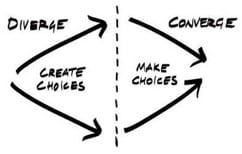
Design thinking is comprised of both divergent and convergent thinking. (See Figure 1). Brown explained that divergent thinking multiplies options to create choices. These choices are most often created through brainstorming activities. According to Michael Michalko, in his book Thinkertoys, brainstorming encourages individuals in a group to express a variety of ideas while deferring judgment until later. Brown encourages individuals to avoid simply thinking about a solution and instead to be “visual” which allows the opportunity to see a problem from a new perspective. Michalko indicated that once ideas are revealed, they are combined, improved, and changed into other ideas providing a larger pool of ideas to draw from. Once all the ideas have been conveyed, convergent thinking begins. It is at this point that the best ideas are narrowed down, and a choice is made for a potential solution. 

Hand-drawn diagram illustrating the design thinking process: the left side labeled 'Diverge' with arrows pointing outward and the phrase 'Create Choices'; the right side labeled 'Converge' with arrows pointing inward and the phrase 'Make Choices'.
Figure 1: Divergent and Convergent Thinking

When a potential solution is agreed upon, the idea then moves into the prototype phase. A quick and cheap model is created that provides a visual representation of the solution. The prototype is then shown to a variety of consumers and others inside the company. The goal of prototyping is to begin a conversation about the idea and gain insight from the feedback that is given. The feedback is then used to create a second iteration of the prototype. The prototype is then put in front of consumers to see how the changes are received. The feedback is then used to create another iteration of the prototype. This process will continue until the testing is complete and the prototype is ready to move into production. The investment of time and resources into prototyping will prove worthwhile when the product or service moves into the marketplace.

How Has Design Thinking Made A Significant Impact?

Brown offers examples of how design thinking has made an impact across the globe. In one instance, Brown recounted how Aravind was created in the 1970s to explore different ways to provide medical care to those in developing countries. Aravind encountered difficulties in travel and getting the needed resources to the people. However, through the collaboration of several doctors and companies, they hypothesized that using a small-scale technology could provide lenses locally without the need to import them. This, in turn, would lower the cost and make them available to more people. They were able to set up a unit in the basement of a hospital and create plastic lenses. The solution was a great success. This lab is now the lead exporter of lenses in the developing world. 

The greatest takeaway concerning design thinking is that it is not limited to a single industry. Design thinking is a problem-solving process for products and services everywhere. In hospitals, design thinking has been used to create a better patient experience in the emergency room. Design thinking is used in the primary school system to promote creative thinking, teamwork, and student involvement. The process can be used to create customer-friendly bills or user-friendly displays for using public transportation. The principles of design thinking can be used in any industry, for products or services, in person or virtually. Design thinking involves observing people’s needs, brainstorming out of the box ideas, prototyping the best idea, and asking people for their input. The end result of this process will be a more effective and impacting design that will meet the needs and wants of the consumer.

Conclusion

Design thinking takes a human-centered approach to innovation. Observing the wants and needs of the consumer allows innovation to be customized to meet the needs and have a greater impact on individuals. Collaboration is essential to the success of design thinking. No longer is innovation isolated to designers only. Design thinking requires everyone to act as a part of the design team. Each member of the team has a voice and adds value to the process. The more ideas that are present, the more options available to determine the best solution for the problem.

Prototypes are a key component of design thinking. Quick and cheap prototypes are the spark for conversations and allow thoughts to be externalized. Prototypes never become the final product on the first try. Prototypes must be created and then adjusted and adapted for each iteration until finally there are no longer any issues to be fixed or adjustments that need to be made. 

After considering the foundation and process of design thinking, there are definite strengths that indicate design thinking be considered for all forms of innovation. Design thinking is a collaborative, creative, and human-centered approach to producing products and services that will achieve better results.


About the Author

Anne K. Bates is a leadership and career coach. Her passion is to help people see their potential and achieve all their goals and aspirations. By focusing on the end result and working backward, Anne guides individuals, teams, and organizations through the process of achieving their goals and getting the results they desire. Anne is a final-year doctoral student in the Regent University Doctor of Strategic Leadership Program. Please contact the author at annebat@mail.regent.edu.


About Regent

Founded in 1977, Regent University is America’s premier Christian university with more than 11,000 students studying on its 70-acre campus in Virginia Beach, Virginia, and online around the world. The university offers associate, bachelor’s, master’s, and doctoral degrees in more than 150 areas of study including business, communication and the arts, counseling, cybersecurity, divinity, education, government, law, leadership, nursing, healthcare, and psychology. Regent University is ranked the #1 Best Accredited Online College in the United States (Study.com, 2020), the #1 Safest College Campus in Virginia (YourLocalSecurity, 2021), and the #1 Best Online Bachelor’s Program in Virginia for 13 years in a row (U.S. News & World Report, 2025).


About the School of Business & Leadership

The School of Business & Leadership is a Gold Winner – Best Business School and Best MBA Program by Coastal Virginia Magazine. The school also has earned a top-five ranking by U.S. News & World Report for its online MBA and online graduate business (non-MBA) programs. The school offers both online and on-campus degrees including Master of Business Administration, M.S. in Accounting (Tax or Financial Reporting & Assurance), M.S. in Business Analytics, M.A. in Organizational Leadership, Ph.D. in Organizational Leadership, and Doctor of Strategic Leadership.
¿Necesita Poder El Líder?*

Resumen

¿Qué trae a la mente la palabra poder? En este artículo se considera el poder como una fuerza positiva, usada continuamente para lograr metas organizacionales, grupales e individuales. No obstante, el poder puede llegar a ser maldad, corrupción, egocentrismo y manipulación. Estas palabras hablan del lado oscuro del poder. Hay, sin embargo, un lado positivo para lograr obtenerlo, desarrollarlo y usarlo (Collins, 2001). La literatura gerencial en general, analiza el tema del poder desde una perspectiva funcionalista . Esta visión reduccionista del estudio de las relaciones de poder en las corporaciones ha contribuido a la realización, por parte de grandes compañías y CEOs, de actividades lícitas, pero no éticas, e incluso se ha llegado a casos graves de corrupción. El artículo plantea que el liderazgo es un ejercicio de poder (Semler, 2003), y por ende, los líderes deben desarrollar bases organizacionales apropiadas para usar efectiva y éticamente su mando con el fin de influenciar positivamente a otros. Este análisis se logra contrastando el concepto de poder con el de liderazgo y buscando la relación real de ambos términos en la creación y el desarrollo de un liderazgo auténtico (Wernsing, 2009) y de prácticas humanistas en la gerencia (Von Kimakowitz et al., 2010).

Palabras claves: liderazgo auténtico, liderazgo tipo 5, poder, autoridad, inteligencia emocional.

Abstract

Power. It can either be dark and evil or a positive force used to achieve individual, group and organizational goals. This article considers the latter and studies, from a reductionist perspective, the power relationships inside corporations. Leadership is an exercise of power (Semler, 2003), and therefore, leaders must develop appropriate organizational power bases to effectively and ethically use their power to influence others. This article contrasts the two concepts of power and leadership, seeking to discover the true relation of both terms in the creation and development of authentic leadership (Wernsing, 2009) and humanist practices in management (Von Kimakowitz et al., 2010).

Keywords: Authentic leadership, level 5 leadership, power, authority, emotional intelligence.


Dos de los conceptos con mayor atractivo en el campo de la gerencia y que han sido estudiados por largo tiempo, son el poder y el liderazgo. Sin embargo, aun conociendo su estrecha relación, uno se puede preguntar ¿Hasta qué punto un líder necesita poder? ¿Cómo evita el líder corromperse1 debido al poder? O por el contrario, el poder y el liderazgo son dos sistemas de acción complementarios con funciones, actividades y características propias necesarias para el éxito en un entorno empresarial cada vez más complejo, competitivo y fluctuante. El presente artículo profundizará en los conceptos y cuestionamientos mencionados anteriormente, con el propósito de ver la relación positiva entre estos, así como el lado negativo de un liderazgo mal ejercido que tiende hacia un abuso del poder.

Para abordar el tema se empezará con una breve definición del término liderazgo: “capacidad de influir sobre la conducta de otras personas, de modo persuasivo” (Gonzáles & Guenaga, 2005). La anterior definición muestra claramente la relación del liderazgo con el concepto más amplio de poder. Max Weber (1947), definió el poder precisamente así: “capacidad de influir sobre la conducta de otras personas”. El liderazgo efectivo supone, ante todo, poder, sin embargo, este término puede tener muchas expresiones, razón por la cual es importante definir el tipo real de poder que necesita un líder para ser exitoso dentro de su gestión.

En nuestra opinión, el verdadero reto consiste en combinar un fuerte liderazgo con una eficaz dirección, utilizando ambos aspectos de forma equilibrada, pero sobre todo, adoptando las características principales que llevan al líder a su máximo nivel, es decir, al nivel 5: la humildad y la determinación, desde la perspectiva de Jim Collins (2001). Analizamos el liderazgo y el poder, exponiendo algunos tópicos que permiten verificar su alcance, en todo aquello que beneficia o perjudica al líder, dependiendo cómo se usen. Gracias a lo anterior, este artículo constituye un a porte al esclarecimiento del termino poder, su uso y su relación en las empresas, mediante las aproximaciones teóricas que han realizado gerentes, empresarios, sociólogos, psicólogos, académicos, humanistas, abogados e historiadores.

Las anteriores referencias constituyen un soporte básico para demostrar que, aunque el poder se relaciona con el liderazgo, no son lo mismo (Mintzberg & Westley, 2001). Esta premisa lucha con la percepción actual de la mayoría de las personas quienes todavía confunden a un líder con un ejecutivo de alto nivel con poder. Al contrario, el líder auténtico crea las estrategias y determina la dirección en la que debe avanzar la empresa, consiguiendo a la vez que sus subordinados lo sigan ya que están convencidos de su visión estratégica, mas del grado de coerción que se ejerza sobre ellos. Las relaciones de poder en las organizaciones se manifiestan tanto interna como externamente. Son una relación de fuerzas que no se excluyen sino que comparten relaciones de oposición y de complementariedad. Teniendo en cuenta lo anterior, existe una clara diferencia entre dominación y liderazgo, pues se considera que la dominación implica coerción de libertad, mientras que el liderazgo adquiere un estatus de legitimidad y de aceptación en todos los órdenes del espacio social; sin embargo, aunque no toda dominación emplea medios económicos, y menos aún, tiene estos fines, sí necesita, en algunos casos, de un aparato humano o administrativo (Weber, 2007) que se mueva dentro de un tipo de legitimación encargada de imponer órdenes en ambientes que encuentren recepción y obediencia.

Es interesante ver cómo el Siglo XXI es visto por muchos como la etapa en donde va a trascender la racionalidad fundacional de la Modernidad (Wallerstein, 2000; Cosgrove, 2007), y por ende, el acto de ser humano va a actualizarse a niveles pocas veces vistos en la historia universal de la humanidad, y nunca antes visto desde el Siglo XV, o la era conocida como Modernidad (Dussel, 2001). La crisis financiera global que estamos viviendo en los albores de este siglo XXI, también es para algunos una oportunidad de humanizar nuestra realidad, así como una muestra de lo que las instituciones sociales han venido promoviendo y que necesita trascender nuestros paradigmas. Es una época propicia para el cambio (Kuhn, 1996). Desde otra perspectiva, las empresas a nivel global están adoptando cada vez más programas de Responsabilidad Social Corporativa y los portafolios financieros de empresas con altos niveles de responsabilidad social están entre los más demandados. Más aún, las empresas se están centrando cada vez más en el ser humano, en su conocimiento y su necesidad de reconocimiento (Robbins & Judge, 2008). Hablamos hoy en día de la era del conocimiento, la sociedad del conocimiento y la organización del conocimiento (Arboníez, 2006). Aunque no es nuevo tener en cuenta al ser humano como “algo” más que un homoseconomicus, hoy está de moda.

Esta relación gerencia y liderazgo ha sido bautizada de diferentes formas, entendida dentro de múltiples paradigmas y estudiada científicamente con contradictorios resultados (Lyons, 2006). Muchas vertientes contemporáneas marcan el inicio en la Teoría X de Taylor, o gerencia científica, seguida por la teoría de Fayol, las cuales tuvieron una bifurcación con las ideas de Elton Mayo y Henry S. Dennison en los años 20 del siglo pasado (Bruce, 2006), y de otros pioneros como Douglas McGregor, Abraham Maslow y Frederick Herzberg, por mencionar sólo algunos. La lista de nombres que trabajan este espectro de la gerencia es larga pero se pueden mencionar algunos: Liderazgo Tipo 5 (Collins, 2001); Gerencia Humanista-Cuántica (Largacha-Martínez, 2006); Alternative Frameworks for Sustainable Workplace: A Social-Philosophical Approach (Largacha-Martínez, 2001); Liderazgo Transformacional (Zárate, 2010); Decision Making (Mintzberg, 2009); Estilos de Liderazgo (Goleman, 1998); Gerencia Participativa (Wu & Lee, 2001); Gerencia Humanista (Melé, 2003); Gerencia de las Relaciones Humanas (Bruce, 2006); Psicología Humanista (Lyons, 2006; Cosgrove, 2007); Gerencia del Comportamiento Organizacional (Robbins & Judge, 2008); Gerencia Compleja o Cuántica (Wheatley, 1992); Gerencia de la Tercera Fuerza (Maslow, 1998); Organizaciones Inteligentes (Senge, 2005); Gerencia Amigable con la Familia (Hochschild, 1997); Gerencia de Grupos de Trabajo AutoLiderados—SDWT (Fisher, 2000); las Competencias Humanas de Thomas Gilbert (Boyett & Boyett, 1999), entre muchos otros. Incluso habría que hablar de la “Anti-Gerencia” (Semler, 2003).

Para efectos de este artículo, todas las vertientes anteriores se enmarcarán dentro del nombre del Liderazgo Tipo 5 de Collins (2001). Lo que se busca evidenciar, es que este tipo de liderazgo representa un gran descubrimiento en cuanto a lo que realmente enaltece a un líder. El liderazgo tipo 5 puede ofrecer especiales ventajas competitivas a las organizaciones de nuestros días, pues se muestra especialmente eficaz para generar “compromiso” en los colaboradores , requisito imprescindible para abordar cambios innovadores y alcanzar elevados niveles de excelencia empresarial.

El esquema bajo el cual se desarrolló el presente escrito es el siguiente. Primero, en forma breve, se hizo un recuento de algunos elementos recurrentes en las diferentes aproximaciones al liderazgo y sus características. Segundo, se planteó el tema del poder y la influencia de éste dentro de la construcción de un buen liderazgo. Tercero, se presentó la unificación y el análisis de ambos conceptos, con el fin de responder a las preguntas que se encuentran planteadas al inicio de ésta introducción. Y por último, se encuentran los comentarios a manera de conclusión.

Liderazgo

Algún tiempo atrás, el líder se concebía como un ser superior al resto de los miembros del grupo, con atributos especiales. Al demostrar su superioridad ante la comunidad, el individuo se convertía en el líder. Se consideraba que estos poderes exclusivos nacían con ellos. Hoy día, con el auge de la psicología, se ha tratado de fundamentar esta perspectiva a partir del fuerte vínculo psicológico que establecemos con nuestro padre, la primera figura arquetípica que tenemos. Según la Dra. Deborah Gruenfeld (2004), Psicóloga de la Universidad de Stanford, estudios psicológicos sobre el liderazgo sostienen que buscamos en nuestros líderes la seguridad que nos proporcionaba el símbolo paterno. Así, como usualmente se conceptualiza al padre, como un ser perfecto e infalible, se reprodujo esta fijación hacia los líderes , considerándolos más grandes, más inteligentes y más capaces que uno mismo. Aunque en la actualidad ya no se piensa que estas habilidades son sobrenaturales, ni que son monopolio de unos cuantos elegidos, sí se acepta que los líderes llegan a desarrollar ciertas competencias de gerencia, orientación y empatía en mayor grado que los demás.

Conforme se consolida la teoría de la administración, el estudio del liderazgo ha cobrado fuerza como una función dentro de las organizaciones. Esta perspectiva enfatiza las circunstancias sobre las cuales grupos de personas integran y organizan sus actividades hacia objetivos comunes. De acuerdo con esto, el líder es resultado de las necesidades de un grupo que tiende a actuar o a hablar a través de uno de sus miembros ya que cuando todos tratan de hacerlo simultáneamente, el resultado por lo general, es confuso o ambiguo. Esto constituye, según Francisco Jaramillo (2008), una barrera para la comunicación, la cual podría crecer dependiendo de la capacidad que se tiene para juzgar o percibir lo que realmente se intenta comunicar, evitando matizar el mensaje de acuerdo a creencias personales o culturales. La necesidad comunicativa de un líder es evidente y real, y esta aumenta conforme los objetivos del grupo son más amplios y complejos. Por ello, para organizarse y actuar como una unidad, los miembros de un equipo de trabajo son orientados por el líder cuyas habilidades personales son valoradas en la medida que le son útiles al grupo. Este individuo es una persona esencial para el desarrollo y el logro de las metas propuestas.

Considerando lo anterior, el liderazgo podría ser rápidamente definido como la “actividad de influenciar a las personas para que enfoquen sus esfuerzos voluntariamente en el logro de los objetivos” (Wernsing, 2009). Esta definición contiene una palabra clave: “voluntariamente”. No se trata sólo de influenciar positivamente a la gente, sino de hacerlo para que voluntariamente se empeñen en llevar a cabo los objetivos que correspondan. Por lo tanto, y teniendo en cuenta el concepto de Prentis (1961) que dice que se debe “rechazar el liderazgo como el ejercicio de poder y fuerza o como la posición de una habilidad analítica extraordinaria”, se excluye del concepto de liderazgo la influencia basada en la coerción. De esta forma puede afirmarse que liderazgo y motivación son dos caras de una misma moneda, en donde la primera mira al líder y la segunda a sus seguidores; por lo tanto, liderar es provocar motivación.

Cuando el líder se posesiona y entiende que su actividad principal debe influenciar a las personas para que actúen voluntariamente en el logro de los objetivos del grupo o sector de una organización con intereses afines. Sólo entonces se dará cuenta que para realizar dicho proceso, es necesario concebir una visión de lo que debe ser la organización y generar las estrategias necesarias para llevarla a cabo, lo cual se logra mediante la alianza cooperativa de un personal (recursos humanos) altamente calificado, motivado y comprometido que desee convertir esa visión en realidad. Para Kouzes y Posner (2003) existen prácticas comunes a los logros de liderazgo que ayudan a la movilización de los subordinados hacia las aspiraciones compartidas. Dicha movilización constituye uno de los más grandes retos del líder, pues depende del grado de motivación en el que se encuentren los empleados. Así, a mayor motivación, mayor compromiso y aunque la estrategia de implantar premios y castigos toma fuerza, no puede ser la única opción, ya que no garantiza la satisfacción del empleado ni su entrega hacia la compañía.

Igualmente, es importante recordar, que debido a que el liderazgo genera grandes cambios en diversas corrientes afectando los modelos mentales preexistentes, es una prioridad trabajar de manera cordial y amena manejando información de tal forma que le permita al líder guiar a su grupo bajo las bases del conocimiento, lo que arrojará mejores resultados. Sucedería lo contrario trabajando, únicamente, bajo parámetros de supuestos, hipótesis e incluso presentimientos. Kotter (1990) asevera que “debido a que un líder busca generar cambios, determinar la orientación de ese cambio es fundamental, por lo que deben recurrir a la reunión de una amplia gama de datos en busca de patrones, relaciones o vínculos que ayuden a explicar las diferentes situaciones”. Una visión nace de la recolección y análisis de información, y las personas que articulan las visiones son estrategas de amplios conocimientos que están dispuestos a correr riesgos. Dichas visiones según Kotter no tienen que ser brillantes sino eficaces, por lo que los desafíos del liderazgo, para lograr el éxito, estarán dirigidos a la excelente comunicación y a la credibilidad en el mensaje.

Así por ejemplo, un individuo que se destaque como un líder en el sector de la producción, no necesariamente lo hará en el sector de marketing, y es aquí donde él o ella, debe evaluarse, visualizar cualidades, fortalezas, debilidades, y lo que Rafael Ortega (2008) define como puntos ciegos, que no son más que la tendencia a creer que se es bueno en algo cuando en realidad no lo es. Esta autorreflexión es esencial y sirve para determinar, con base en dicho conocimiento, si es o no pertinente y si se cuenta con las competencias necesarias para asumir el liderazgo de otra división. El liderazgo puede recaer en personas diferentes, pero se debe tener en cuenta el clima de la empresa, los estilos de liderazgo y la cultura organizacional, todos estos factores que guiarán al líder en el desarrollo de su gestión (LargachaMartínez, 2010). De hecho, el punto de que no exista la perfección total en un líder, es la razón principal por la que se elaboran tantos modelos de liderazgo, sin embargo, es seguro que al final se puede considerar que existen algunas características que están presentes en la gran mayoría de líderes excelentes tales como: visión; maestría para motivar; pasión por el desarrollo propio y de los demás; habilidad para delegar (Gruenfeld, 2004); voluntad profesional y humildad. Las dos últimas corresponden a la base de lo que Jim Collins (2001), llamó “Liderazgo de Nivel 5” y que según el resultado de sus investigaciones, marcan la diferencia entre una empresa buena y una empresa sobresaliente.

En consecuencia, es claro que el líder es producto no de sus características, sino de sus relaciones funcionales con individuos específicos en una situación específica. El estudio del liderazgo es un problema complejo si se tienen en cuenta los rápidos cambios que se producen en la actualidad, por lo que Goleman (1998) en su escrito, sugiere que se deben considerar algunos factores condicionantes tales como: la cultura organizacional (clima existente en la empresa que influye en la eficacia de la conducción), estructura organizacional (la falta de definición de las líneas de autoridad puede ocasionar problemas de relación) y el estilo personal (la modalidad de dirección condicionada por factores temperamentales). Un líder no lo es por su capacidad o habilidad en sí mismas, sino porque estas características son percibidas por el grupo como las necesarias para lograr el objetivo.

El líder se diferencia de los demás miembros de un grupo o de la sociedad por ejercer mayor influencia en las actividades y en la organización de éstas. Adquiere status al lograr que el grupo o la comunidad logren sus metas; así mismo, le corresponde distribuir poder y responsabilidad entre los miembros de su equipo. Esta distribución juega un papel importante en la toma de decisiones y, por lo tanto, en el apoyo que el grupo le otorga, ya que si el líder logra integrar e inspirar alrededor de una visión común o compartida (Kouzes & Posner, 2003), no habrá duda de que el equipo seleccionado hará lo necesario dentro de su puesto de trabajo para llegar a la meta, e incluso, superar las expectativas planteadas. El sentimiento de obediencia y disposición que motiva a los subordinados y que se ve reflejado en el progreso de los proyectos, se da gracias al poder que ejerce el líder a través, no de la coerción, sino de su capacidad para comprender las necesidades de su grupo y ajustar su plan de trabajo para obtener beneficios conjuntos.

Con esta somera revisión, se da paso en los siguientes párrafos, al análisis del poder, así como su contextualización en la gerencia y el liderazgo.

Poder

Dentro del entorno organizacional ya se ha escuchado hablar sobre los efectos negativos de la gestión bajo el uso del poder coercitivo en el clima de una empresa y en el desempeño de sus empleados (Herzberg, 1968). Muchas empresas con gestión dictatorial tiene buenos resultados, pero quizás esto no se sustente a largo plazo, ya que los entornos opresivos tienden a ahuyentar a la gente con talento, produce infelicidad e insatisfacción, aumenta la rotación de personal y no es el clima propicio para crear y generar valor (Semler, 2003). Cada vez más, los empleados tienen una expectativa mayor sobre su papel a la hora de participar e interactuar con el liderazgo; cada vez menos, la gente con talento quiere trabajar en empresas cuyos valores no se comparten. Tanto la experiencia como los estudios demuestran que, quién se desempeña en lo que le apasiona alcanza el éxito laboral y la realización profesional con mayor facilidad y mejores resultados. Por esta razón, las organizaciones modernas deben crear oportunidades para que los empleados den lo mejor que tienen, lo que significa abrir espacios para que ellos entreguen sus ideas, digan lo que piensan y tengan una autonomía responsable a la hora de actuar (Herzberg,1968). “La pasión es la raíz del compromiso y la calidad que brindamos, sea cual sea nuestro trabajo. Uno no puede elegir emplear o no la pasión, ésta se siente y da sentido a lo que hacemos, a lo que somos”, explica Sofía Carrasco, especialista en Recursos Humanos de ZonaJobs y Licenciada en Relaciones de Trabajo en la Universidad de Buenos Aires, Argentina (“Diario Portafolio,” 2012).

De acuerdo con Prentis (1961): “En cualquier situación grupal, nada destruye más el estado de ánimo que una falsa democracia, por lo que no es bueno pretender que los subordinados pueden tomar ciertas decisiones, cuando en la práctica no pueden”. Hoy es imposible que los subordinados puedan confiar en el CEO aun cuando lo escuchan hablar acerca de cosas como la política de las puertas abiertas (cuando las reuniones de la “cúpula” se hacen a puerta cerrada), el consenso (cuando no cuenta mi consentimiento), la participación (cuando no hay democracia) y hasta la libre expresión (cuando soy reprendido por opinar). El vínculo de familiaridad que podría llegar a existir entre el equipo de trabajo y el líder aumenta cuando las posibilidades de manipulación por autoritarismo y mal uso del poder psicológico disminuyen. Esta adaptación de las personas de acuerdo con el ambiente que les brinde el exterior, es la forma como la literatura gerencial analiza el poder, dicha corriente filosófica se denomina funcionalismo2.

Al hablar sobre poder, es importante introducir a uno de los investigadores más estudiosos de los mecanismos del poder y la insurrección de los saberes, no contra los métodos, contenidos o conceptos de una ciencia, sino una insurrección contra los efectos o consecuencias de poder centralizadores que están ligados al discurso científico y a su funcionamiento dentro de toda la sociedad: Michael Foucault. Cuando se analiza éste término, lo importante para el autor de Las palabras y las cosas (1966), es determinar cuáles son sus mecanismos, sus implicaciones, sus relaciones y los distintos dispositivos de poder que se utilizan en los diferentes niveles de la sociedad. Para Foucault (1999) el poder no es algo que está en manos de la clase dominante, tampoco es una propiedad, es una estrategia. Éste autor francés estudió el poder desde la óptica de “los operadores de d omi naci ón,” donde no se preguntaba cómo, por qué y bajo qué derechos el sujeto aceptaba ser sometido, sino que indicaba, de qué forma, se fabricaban las relaciones concretas de sometimiento.

Foucault, en su texto El Sujeto y el Poder (1991), sostiene que el ejercicio del poder no es simplemente una relación entre parejas, individual o colectiva, es una forma en la que ciertas acciones modifican otras. El poder existe únicamente cuando es puesto en acción y actúa no sobre otros, sino sobre sus acciones presentes o futuras. El poder, en consecuencia, podría definirse como un juego de acciones sobre otras acciones, dado que los sujetos, en términos de Foucault son “actuantes y cuyas acciones incitan, inducen y seducen; si el poder se define como acción, se comprende que es un proceso dinámico que se ejerce sólo sobre sujetos libres y solamente en la medida en que son libres” (Foucault, 1991). El poder sin libertad seria esclavitud, por lo que en este orden de ideas, los sujetos se encuentran en un campo de posibilidades en el que pueden, como sujetos libres, conducir sus acciones y sus reacciones. Así, el ejercicio del poder acepta la confrontación y la desobediencia con las consecuencias que estas implican; el poder es una lucha de acciones que necesitan ser gestionadas y que persiguen un fin. Sin embargo, dicha gestión no debe ser ejecutada sobre los empleados, ya que las personas no se gestionan (a diferencia de las cosas u objetos materiales), las personas se lideran.

Por otro lado, al considerar las organizaciones como sistemas funcionales, partimos de la premisa según la cual estos sistemas se unen mediante relaciones de un poder que se ejerce y se acepta. Foucault (2001) sostiene al respecto que “en todo lugar donde hay poder, el poder se ejerce, no sabemos quién lo tiene pero sabemos quién no lo tiene”. Por ejemplo, hace algunas décadas, los comportamientos arbitrarios (de dominación) eran, por así decirlo, más transparentes e inequívocos. En general, los empleados no podían decir claramente lo que pensaban si ello era distinto a las expectativas del jefe. En el caso que no hubiese obediencia, había menor duda en aplicar lo que Herzberg (1968) definió en su momento como KITP3 físicamente negativo, donde quien claramente ostentaba el poder era el jefe y solo él. Hoy día, a pesar de que este modelo de dominación se rechaza notablemente, no se ha extinguido del todo, ya que aunque la forma como se demuestra poder no es tan explícita y el jefe ya no golpea la mesa (o al subordinado) como antes, esto no significa que los valores hayan cambiado. Lo que cambió fue la manera en la que esos valores empezaron a ser aplicados, y que al final ha generado un sin número de nuevas prácticas que buscan generar motivación en los empleados de una forma tradicional (salarios, castigos, etc.), en vez de apelar a los sentimientos o deseos de estos, lo cual haría que su desempeño fuera mejor.

Para Herzberg, los factores que más afectan las actitudes en el trabajo y la motivación son de origen intrínseco (ej. Logro, reconocimiento, responsabilidad, crecimiento personal, etc.),e higiénicos (ej. Políticas de la empresa, supervisión, condiciones de trabajo, salario, etc.). El autor basa esta afirmación en las múltiples investigaciones que han estudiado estas actitudes y que llegaron a la conclusión de que de “todos los factores que contribuyeron a la satisfacción laboral, el 81% fueron motivadores intrínsecos, mientras que de todos los factores que contribuyeron a la insatisfacción de los empleados en su trabajo, el 69% incluyó elementos higiénicos” (Herzberg, 1968). Por lo tanto, las cosas que motivan y causan satisfacción a las personas en el trabajo, son diferentes a las que causan insatisfacción. Así que, un liderazgo basado únicamente en las recompensas tradicionales, solo puede tener como resultado el hecho de que el único motivado va a ser el gerente, pues el subordinado solo se interesa por la recompensa del momento, aquello que lo obliga a moverse, más no a motivarse. En conclusión, el tipo de poder que se ejerce a través del KITP3 no motiva, pues no es un generador propio sino que necesita ser alimentado, y en esta instancia es indispensable la existencia de uno que no requiera de estimulación externa sino que induzca hacia voluntad de hacer el trabajo.

La cadena de limitaciones en la que se encuentra una gran parte de la fuerza laboral, no se relaciona únicamente con la baja motivación, sino también con la falta de democracia. Es importante entender, que generar un ambiente democrático y franco dentro de una empresa es un desafío grande, y más aún cuando la organización está inserta en sociedades donde los valores y la cultura no forman el medio más propicio para tanta apertura (Zaleznik, 1977). Es necesario ir en contracorriente de comportamientos muy arraigados. Las tradiciones relacionadas con el poder son algo que va mucho más allá del mundo de los negocios; están impregnadas en todo el tejido social desde los primeros años de cada persona. Es por ésta razón que la democracia no puede ser sólo un asunto cosmético o superficial (Semler, 2003), ya que el cuerpo social desde sus inicios, identifica rápidamente la inconsistencia entre el discurso y la práctica, hecho que sin duda afecta de forma implacable la credibilidad del liderazgo; y cuando no hay compromiso, se corre el riesgo de que las personas reaccionen mucho más en beneficio propio que en favor de la organización.

Dentro del contexto anterior, en el que existe una clara necesidad de participación e inclusión, no es extraño encontrar en el mercado laboral, superiores y subordinados que se consideran desiguales por naturaleza, escenario en el cual, el jefe ideal para los subordinados (o por lo menos el que esperan), es un autócrata benevolente, lo que sin duda constituye una carga de emociones y dependencia dentro de la relación. Según Prentis (1961) “es difícil trabajar con subordinados que creen que sus empleadores son sus enemigos naturales” y que además “el hecho de recibir órdenes, limita el alcance de su juicio independiente”. La anterior cita lleva a reflexionar sobre cómo la desigualdad de poder y la fuerte subordinación pueden representar una situación latente de conflicto entre los miembros de un equipo, debido a los prejuicios sobre lo que un líder representa verdaderamente.

No obstante, no todo es prejuicio, pues existe un punto positivo que nace cuando la lealtad está dirigida al líder y no a la organización. Así pues, la principal arma de compromiso y de cohesión social es la seducción afectiva (liderazgo afiliativo), lo cual confirma una vez más que el tema de la inteligencia emocional (Zaleznik, 1977) está fuertemente relacionado con la mejor forma de establecer y mantener un buen liderazgo, ya que es dicha habilidad la que marca la diferencia entre comprender la situación y actuar conforme a esta, utilizando los mismos elementos de poder para obligar al desarrollo de cierta estrategia sin tener en cuenta la forma como estas decisiones afecten a los empleados. Lo interesante respecto a la inteligencia emocional es que puede ser aprendida; aunque necesita de tiempo y dedicación para dominar nuevos comportamientos que se deben repetir y practicar para que a su vez eliminen los antiguos hábitos para reemplazarlos con los nuevos. Por lo tanto, éste ejercicio debe ser tomado seriamente con el fin de que el cambio sea eficiente, duradero, y se vea finalmente reflejado en los resultados dentro del desarrollo de un buen liderazgo.

Liderazgo Y Poder

Dentro del contexto de este documento, la palabra liderazgo es usada para expresar “el proceso de usar el poder para obtener influencia” (Hunt et al., 1985). La pregunta entonces sería, ¿Por qué los líderes deben lograr el éxito a través de la influencia en el comportamiento de otras personas en el trabajo? Porque como claramente lo dice Harry Truman “el liderazgo es la habilidad para lograr que el hombre haga lo que no quiere hacer y le guste” (Cohen, 1984). En conclusión, el foco del problema para un líder en cualquier organización involucra el hecho de obtener de otros lo que se requiere para cumplir con las metas propuestas (Cohen, 1984), lo cual requiere de un alto nivel de autoridad. En sentido general, la adquisición y el uso del poder, pueden tener un fuerte impacto en el progreso profesional, en el desempeño laboral, en la efectividad organizacional y en la vida de numerosas personas (Kotter, 1979). Hoy día, los líderes trabajan en organizaciones sociales complejas donde necesitan asistencia no solo de sus subordinados, sino de pares, superiores y elementos externos. La tarea de movilización requiere de un liderazgo efectivo ligado a unas bases fuertes de poder y estrategias dinámicas de influencia viables.

El liderazgo no auténtico, inevitablemente requiere del uso del poder para influir en los pensamientos y en las acciones de otras personas. Un líder goza de toda legitimidad para perseguir el poder siempre y cuando sus deseos y acciones sean apropiados. Además, según Weber (2007), teniendo en cuenta que uno de los orígenes del poder es el liderazgo, “se debe aceptar la legitimidad de su búsqueda, pues de otro modo no funcionaría el sistema de imposiciones en el cual se admite lo que la mayoría (democracia) o quien ostenta el poder diga, no solo con obediencia sino con la creencia de que existe un orden legitimo basado en el principio de autoridad”. El liderazgo es la fuente más ennoblecida de poder. Desde el liderazgo elitista4, es muy difícil objetar sobre el derecho a perseguir el poder. Es más, puede ser pertinente aceptar como natural y con una elevada calidad ética que, quien piensa que su juicio es mejor que el de quienes con menor categoría maneja mal las riendas del poder, lo busque con gran interés, para acabar así con gestiones mediocres o incluso con finalidades menos rectas a fin de barrer aquellas personas que se aferran al cargo para servirse de él y no para hacer cosas por los demás desde y con el cargo.

Entonces, el poder es obviamente una realidad penetrante en la vida de todas las organizaciones actuales. Los líderes regularmente adquieren y usan el poder para lograr metas de trabajo específicas y para fortalecer sus propias posiciones. Es posible ver como toda interacción y toda relación social en una organización, envuelve un ejercicio de poder (Donnelly et al., 1985). Finalmente, la visión integral que se requiere para escoger la mejor forma de dirigir, ofrece un entorno de cambio constante, dentro del cual se suscitan pujas o conflictos que responden a los intereses y expectativas de los agentes que hacen parte del campo de la empresa y que están ligados íntimamente por los deseos de poder, control y de imposición de decisiones. Sin embargo, y retomando la pregunta introductoria de éste ensayo ¿es éste el tipo de poder que necesita un líder para lograr una gestión exitosa dentro de la organización? ¿Un poder que se rige bajo la sombra de la legitimidad, las estrategias de coerción, de vigilancia y de control? Y si es así ¿cómo evitar que este líder se corrompa con tanto poder?

Se puede empezar por decir que el grado de poder que un líder requiere está determinado por los objetivos que debe alcanzar. Por ejemplo, el líder de un país requiere poderes diferentes a los del líder de una Iglesia. El poder, según Tara Wernsing (2009), “es la posesión de control, autoridad, y/o influencia sobre los otros”. Este poder se utiliza para alcanzar un objetivo. Algunos líderes tienen las tres posesiones, mientras otros, puede ser que tengan sólo una. El poder no corrompe, entendiendo la corrupción como el grado en que la acción de alguien ha dado un giro dentro de una escala moral que una sociedad o una comunidad, basándose en el reconocimiento de lo bueno y lo malo (conciencia), ha establecido (Goodpaster, 1978). Aunque sus acciones están controladas por el tipo de poder que tienen, es el poder interno lo que conlleva a la acción. Por ejemplo, Hitler fue un líder para casi todas las definiciones de líder, a pesar de que odiaba a ciertos grupos. Este odio lo condujo a una corrupción masiva (en su comunidad no era visto como corrupción, mientras que en muchas otras sí). Si él nunca hubiese llegado a ser un líder, el odio interior (corrupción) hacia ciertos grupos aún estaría allí. La única medicina preventiva para la corrupción es un saludable respeto hacia los demás (diversidad).

El ejemplo anterior muestra cómo la experiencia común avala el hecho de que todo aquel que detente cierto tipo de poder, si tiene una visión elitista y dominante, como ya se dijo, en algún momento hará mal uso de él. Esta situación puede afectar a cualquier persona con mando: padres, hermanos, cónyuges, maestros y por supuesto jefes. Así, mientras mayor es el margen de dominio, mayor es la posibilidad de abusar, ya que éste brinda, a quien lo ostente, la oportunidad de hacer lo que realmente quiere. Por lo tanto resulta imperativo que el poder sea ejercido por quienes le otorgan un significado predominante a los valores, a las personas que conforman el equipo de trabajo y al proyecto específico de la empresa (Goleman, 1998). De esta forma, la dinámica de los escenarios actuales demanda que en las empresas existan verdaderos líderes, agentes de cambio que garanticen con su acertada conducción, el que los miembros de la organización alcancen lo planificado y pongan en marcha las acciones necesarias que las empresas necesitan para enfrentar exitosamente el aquí y el ahora, buscando la realización humana.

Para esto, es necesario que los líderes tengan la suficiente habilidad, capacidad y sensibilidad como para erigirse dentro de su grupo humano en general. Dentro de los lineamientos de la administración se suele creer que para transformar una empresa buena en una extraordinaria se necesita una personalidad extrema, un jefe egocéntrico que comande el ataque corporativo. Sin embargo, es no es el caso, pues según el experto en liderazgo Jim Collins (2001), el ingrediente esencial para llevar una empresa hacia la grandeza es contar con un líder de “Nivel 5”, un ejecutivo que tenga la rara mezcla entre humildad personal y extrema e intensa voluntad profesional. Entre 1996 y el año 2000, junto a sus veintidós asociados de investigación, realizó un estudio cualitativo y cuantitativo en once excelentes empresas, seleccionadas de entre mil cuatrocientos treinta y cinco. Y se identificó un nuevo tipo de liderazgo denominado liderazgo de Nivel 5. Los resultados del estudio se fundamentan sobre las bases de esta investigación, en la cual se demostró que los ejecutivos que poseían esa paradójica combinación de rasgos catalizadores del suceso, estadísticamente extraño, podían transformar una buena empresas en una excelente empresa.

Collins (2001) argumenta que: “El Nivel 5 se refiere al nivel más alto en una jerarquía de capacidades ejecutivas que fueron identificadas durante la exploración. Los líderes de los otros cuatro niveles pueden generar altos grados de éxito, pero no el suficiente para elevar a las empresas de la mediocridad a la excelencia sostenida”. En su artículo Collins realiza un retrato de las destrezas y rasgos de personalidad necesarios para el liderazgo eficaz. Contrasta la exitosa gestión del cambio de ejecutivos en apariencia humildes, e incluso tímidos, como Colman M. Mockler, de Gilette, y Darwin E. Smith, de Kimberly-Clark, con líderes de negocios que enfatizaron su celebridad, como Al Dunlap y Lee Iacocca.

Estos líderes son una dualidad en acción: modestos y voluntariosos; tímidos e intrépidos; muy determinados y de bajo perfil. Ellos no permiten que sus egos estorben su ambición de construir una gran organización de cara al futuro. Cuando este tipo de líderes es forzado a declarar, contestan con una modestia elocuente que se materializa en frases como: “Espero no estar sonando como un personaje importante”; “No creo que pueda otorgarme mucho crédito por lo que ocurrió. Tuvimos la bendición de contar con gente maravillosa”; “Hay muchas personas en mi empresa que podrían hacer mi trabajo mejor que yo” (Collins, 2001).

Lo importante es que, de acuerdo con el sondeo, en dos tercios de las mil cuatrocientos treinta y cinco empresas de comparación, la presencia de un liderazgo egocéntrico del tipo carismático y narcisista, contribuyó a la caída o persistente mediocridad de la empresa. A menudo refirieron su fracaso a causas externas a ellos tales como la mala suerte y dificultades en el entorno. Los líderes de estas empresas, con frecuencia veían por la ventana en busca de los culpables, mientras se aferraban al espejo para vanagloriarse a sí mismos cuando las cosas salían bien (Collins, 2001). En contraste, los líderes de Nivel 5 utilizaban recurrentemente lo que Collins denominó el patrón de “la ventana y el espejo”: Cuando las cosas salían mal, miraban al espejo a la hora de asignar responsabilidades (se veían a ellos mismos), sin buscar culpables (ni mala suerte ni factores del entorno). Y cuando las cosas salían bien, buscaban por la ventana para identificar a los actores del éxito (su personal).

En definitiva, las transformaciones de bueno a excelente no ocurren sin líderes de Nivel 5 en el mando. Las organizaciones requieren de un liderazgo que sepa maniobrar adecuadamente el poder, de tal forma que todos se sientan partícipes en el compromiso de alcanzar metas, logros, sin sentirse presionados, donde el líder se subrogue a los afanes personales del seguidor y este, a cambio, le otorgue el poder. Las bases del liderazgo no se forman por las protestas del cargo, ni por pequeñas y concretas dependencias que el líder genere en los de abajo; por el contrario, el líder los seduce. Es decir, que el propio liderazgo es, si acaso, una gran dependencia del seguidor respecto del líder. Un buen líder en las organizaciones del presente, le da a la conducción de una organización una mayor riqueza, una mayor prestancia, mezcla todo y lo aprovecha, lo refuerza y está siempre atento, pues no puede darse el lujo de desaprovechar las oportunidades y eliminar las debilidades; debe velar porque sus seguidores satisfagan sus necesidades.

En el mundo de hoy, los líderes son llamados a crecer, madurar y servir con humildad y determinación. Este es un llamado que va más allá de las habilidades, trata con las cuestiones del corazón (Boyett & Boyett, 1999), y busca un ferviente compromiso a largo plazo. Principios sólidos pueden hacer la diferencia en cómo el carácter de los líderes es formado y en el establecimiento de un legado significativo.

Conclusiones

Gracias al ejercicio de un buen liderazgo es posible motivar a los participantes de una organización para que entre todos se satisfagan los objetivos de ella; sin embargo, es gracias al ejercicio de un liderazgo excelente (Liderazgo tipo 5 de Collins), que no solo se cumplen las metas organizacionales, sino que también quienes participan (trabajadores, directivas, etc.), encuentran en la acción, beneficios para la consecución de sus objetivos individuales, sintiendo que son tratados no como una parte operativa, sino como una parte esencial y con poder transformacional dentro de su ambiente laboral. Para llegar a este punto, es importante lograr una completa integración entre las metas del grupo humano y las de la organización. De acuerdo a lo anterior, es necesario que quienes posean la autoridad formal, tengan la suficiente habilidad, capacidad y sensibilidad para apoyar y dirigir al grupo humano en general. Debido a su influencia conductual, el liderazgo es un mecanismo importante dentro de las organizaciones para alcanzar efectividad, tanto en época de crisis como en época de auge, ya que el uso apropiado de este, puede significar una especial ventaja en el mercado actual, al contar con una fuerte cohesión interna mantenida por todos pero construida por el líder. El sentido de “compromiso” que se logra generar dentro de los colaboradores, constituye un requisito imprescindible para abordar cambios innovadores y alcanzar elevados niveles de excelencia empresarial, lo cual, sin duda, debería ser el fin mismo de toda organización, es decir, no se busca solo tener una noción de prosperidad sino de excelencia, y esta diferencia sólo la marca el desarrollo del liderazgo tipo 5 dentro de las organizaciones.

La imagen de la vida organizacional se muestra en el modelo de poder que ostenta un líder. El logro de la eficacia en la organización que promueve la excelencia, es casi imposible sin la presencia de un líder excelente. Así, la excelencia en el liderazgo se puede atribuir a la eficacia con la que un líder adquiere y ejerce el poder para producir una dinámica positiva de este y que a su vez cause un gran impacto dentro de la organización.

El liderazgo se relaciona, por su propia naturaleza y origen, con el fenómeno del poder: ser líder es tener poder. El poder en las manos de una persona, supone riesgos humanos debido a las estructuras tradicionales burocráticas de las empresas (Berger & Luckmann, 1967), en tres sentidos: primero, el riesgo de equiparar poder con la habilidad para obtener resultados inmediatos; segundo, el riesgo de ignorar los diferentes caminos por los que se puede acumular legítimamente poder, y caer en la ilegalidad; y tercero, el riesgo de perder el control por el afán de obtener más poder (Goodpaster, 1978). Por lo tanto, y contestando la pregunta5 de este artículo, el líder no necesita del poder, desde la perspectiva tradicional de definición de poder que hemos trabajado a lo largo de este escrito.

Lo que hemos mencionado es la necesidad imperiosa de las organizaciones del Siglo XXI de trascender los tres riesgos que menciona Goodpaster (1978), generando un reto inmenso para las instituciones y estructuras sociales. Por ende, académicos, empresarios, CEOs, estamos llamados a generar unos mínimos gerenciales basados en un liderazgo ético, auténtico, transformacional, enmarcado dentro de los principios de una gerencia humanista (Largacha-Martínez, 2011). Un liderazgo basado en la humildad se gana, no se confiere, como lo dice Mintzberg (2009) en su libro Managing.

En el futuro en las organizaciones, como lo describe Peter Drucker (Boyett & Boyett, 1999), los muros que tradicionalmente han delimitado las fronteras entre lo que se posee, se controla o a quién se emplea y dónde trabajan, dejarán de tener sentido. En cambio, lo que definirán las fronteras serán membranas permeables definidas por valores, propósitos y objetivos; las organizaciones se mantendrán unidas por mecanismos de conexión y compromiso, enraizados en la libertad de elegir, en vez de sistemas de coerción y dominación. El ejercicio del liderazgo es inversamente proporcional al ejercicio del poder; de ahí que las relaciones más productivas sean, en su esencia, asociaciones mutuas, solidarias y equitativas (Semler 2003).

La selección y el trato adecuado del personal pueden llegar a transformar de forma extraordinaria su comportamiento, registrando un mayor nivel en el desarrollo de la labor, mejorando la competitividad, aumentando la capacidad de adaptación y en última instancia, aumentando la sinergia al interior del ambiente de trabajo. Así, el buen líder, es decir, el líder tipo 5, produce las dinámicas que optimizan los resultados y que a su vez generan un alto nivel de bienestar para el mayor número de personas dentro de las organizaciones.

El líder que opera sobre la base del poder centrado en principios más no en subyugación, descubrirá que es más cuidadoso en lo que exige a los demás y que tiene más confianza en hacerlo. A medida que aumente su entendimiento de la relación entre poder y liderazgo, crecerá su capacidad para dirigir e influir en otros sin forzarlos. Así mismo, experimentará la poco habitual paz mental que emana ser un líder con más conocimiento y sobre todo, eficaz. El verdadero poder de liderazgo surge de poseer un carácter honorable y del ejercicio de ciertas reglas y principios del poder.

Para finalizar, el excelente líder que tiene poder y que lo deja tras de sí, tiene una apariencia distinta y actúa de un modo diferente al buen líder, protagonista de múltiples hazañas en todos los entornos. No dirige gracias a su carisma, sino por su gran trabajo y consagración. No lo centraliza todo en sus manos sino que, en cambio, organiza un equipo. Dirige a través de su integridad y no gracias a la manipulación. No siempre es astuto, pero si sencillo y honesto. Este es el verdadero líder tipo 5, el excelente líder.


Referencias

Arboníez, A. (2006). Conocimiento para innovar: Cómo evitar la miopía en la gestión del conocimiento. (2° Ed). España: Diaz de Santos.

Berger, P. L. & Luckmann, T. (1967). The social construction of reality: A treatise in the sociology of knowledge. New York, NY: Random House.

Boyett, J. & Boyett, J. (1999). Lo mejor de los gurús. Barcelona: Ediciones Gestión 2000.

Bruce, K. (2006). Henry S. Dennison, Elton Mayo, and human relations historiography. Management & Organizational History, 1 (2), 177- 199.

Collins, J. (2001). Liderazgo de nivel 5: el triunfo de la humildad y de la férrea determinación. Harvard Business Review. Serie: Liderazgo. Lo que hacen los grandes líderes.

Cosgrove, L. (2007). Humanistic psychology and the contemporary crisis of reason. The Humanistic Psychologist, 35 (1), 15-25.

Cohen, A. R. (1984). Effective behavior in organizations. Homewood, IL: Irwin.

Diario Portafolio. (2012), Colombianos no trabajan en lo que les apasiona. Finanzas Personales. Diario de complemento económico: Portafolio. Extraido de: http:// www.portafolio.co/finanzaspersonales/colombianos-notrabajan-lo-que-les-apasiona

Dussel, E. (2001). Hacia una filosofía política crítica. Barcelona, Spain: Descleé.

Donnelly, J. H. Jr, Gibson,J. L., and Ivancevich, J. M. (1985) Organizations: behavior, structure, processes. Plano, TX.: Business Publications, Inc.

Fisher, K. (2000). Leading self-directed work teams. New York, NY: McGraw-Hill.

Foucault, M. (1991). El sujeto y el poder. Precedido por tiempo y espacio en el discurso de Michael Foucault. Gómez, C & Ochoa, J. (Trad.) Bogotá: Carpe Diem Ediciones.

Foucault, M (1999). Estrategias del saber. F. Álvarez (Trad.). Ediciones Paidós Ibérica S. A.

Foucault, M (2001). Un diálogo sobre el poder y otras conversaciones. M. Morey (Trad.). Madrid: Alianza

Goleman, Daniel. (1998). Liderazgo que obtiene resultados. Harvard Business Review. Serie: Liderazgo. Lo que hacen los grandes líderes.

González, M. S. & Guenaga, G. G. (2005). Mecanismos de influencia en las organizaciones y tácticas de liderazgo. Departamento de Economía Industrial. Universidad del país vasco.

Goodpaster, K. (1978). On being morally considerable. Journal of Philosophy, 75, 308-25.

Gruenfeld, D. Stanford, California: Stanford University, (2004). Thepsychology of power = La psicologíadelpoder. [Videodisco digital]. 1 videodisco (58 min.) so., col.

Herzberg, F. (1968). Una vez más: ¿Cómo motiva a sus empleados? Harvard Business Review. Series: Liderazgo. Lo que hacen los grandes líderes.

Hochschild, A. R. (1997). The Time Bind. New York, NY: Metropolitan Books.

Hunt, J. G. Osborn,R. N. & Schermerhorn, J.R. (1985).Managing organizational behavior. New York, NY: John Wiley and Sons.

Jaramillo, F. (2008). Barreras para la comunicación. De: El arte de escuchar.

Kotter, J. (1979). Power in Management. New York: AMACOM.

Kotter, J. (1990). Lo que de verdad hacen los líderes. Harvard Business Review. Series: Liderazgo,lo que hacen los grandes líderes.

Kouzes, J & Posner, R. (2003). Las 5 practicas del liderazgo ejemplar. New York, NY: Pfeiffer. Kuhn, T. (1996). The structure of scientific revolutions (3rd Ed.). Chicago, IL: University Of Chicago Press.

Largacha-Martinez, C. (2001). Alternative frameworks for sustainable workplace: A socialphilosophical approach. Series: Contemporary Cultural Studies (Series Editor, Joseph J. Pilotta, The Ohio State University)

Largacha-Martinez, Carlos. (2006). Theorem f: A holistic-humanistic model of development. Dissertation. University of Miami. Coral Gables.

Largacha-Martinez, Carlos. (2010). Aproximaciones a la gerencia humanista desde la transversalidad de lo global, lo corporativo y lo comunitario. Cap. 7. Universidad EAN, 2010. Largacha-Martinez, Carlos. (2011). Quantic Humanism.1 edition. Unlimited. Amazon Digital Services.

Lyons, Arthur W. (2006). Recalling the past, creating a future: Challenges for humanistic research, The Humanistic Psychologist, 34 (1), 13-20.

Maslow, A. H. (1998). Maslow on Management. Toronto,Canada: Wiley.

Melé, D. (2003). The challenge of humanistic management. Journal of Business Ethics, 44, 77-88.

Mintzberg, H.& Westley, F. (2001). Descision making: It´s not what you think. MIT Sloan Management Review, 42 (3), 89-93.

Mintzberg, H. (2009). Managing. San Francisco, CA: Berrett-Koehler Publishers.

Mosca, G. (1939). The Ruling Class. Westport,CT: Greenwood Press.

Ortega, R. (2008). Conocerse a sí mismo: Líderes empresariales de Colombia. Revista La Nota.

Pareto , V. (1979). The rise and fall of elites. New York, NY: Arno.

Prentis, W. C. H. (1961). Comprendiendo el Liderazgo. Harvard Business Review, (Septiembre-Octubre).

Robbins, S. & Judge, T. (2008). Organizational behavior (13th Ed.). Upper Saddle River, NJ: Prentice Hall.

Semler, R. (2003).The seven-day weekend: Changing the way work works. New York, NY: Portfolio.

Senge, P. (2005). La Quinta Disciplina. España: Granica Adelphi.

VandenBos, G. R. (2006). APA Dictionary of Psychology. Washington, DC: American Psychological Association.

Von Kimakowitz, E, Spitzeck,H., & Pirson, M. (2011). Humanistic Management In Practice. Editorial: Palgrave Macmillan

Wallerstein, I. (2000).The essential wallerstein. New York, NY: W.W. Norton.

Weber, Max. (1947). The theory of economic and social organization. New York, NY: Free Press.

Weber, Max. (2007). Sociología del poder: los tipos de dominación. Abellán, G.J. (Trad.). Madrid: Alianza.

Wei-ping, Wu & Yuan-Duen, Lee. (2001). Participatory management and industrial relations climate: a study of Chinese, Japanese and US firms in Taiwan, The International Journal of Human Resource Management, 12 (5, August), 827- 844.

Wernsing, Tara. [IEBusinessSchool]. (2009, February 03). IE Knowledge Pills: Authentic Leadership


Notas

1. Para este artículo y para los autores, el abuso de poder es un acto de corrupción. Realizar actividades lícitas pero no éticas es también un acto de corrupción. La corrupción se entenderá como el grado en que la acción de alguien, trasgrede de la escala moral que la sociedad, basándose en el nivel de conciencia, ha establecido (Goodpaster, 1978)

2. El funcionalismo se refiere a una corriente filosófica y psicológica que considera la vida mental y el comportamiento en términos de adaptación activa al ambiente por parte de la persona (VandenBos, 2006)

3. Kick In The Pants

4. En el amplio sentido, se indicaba con esta palabra a quienes tenían las más altas aptitudes frente al promedio general y, en un sentido más restringido, se refería al grupo que G. Mosca (1939), denominó “clase política”. Más tarde W. Pareto (1979), hace una distinción entre “Elite no gobernante” y “Elite gobernante”, que ejerce el control efectivo del poder. En este sentido se suele asimilar élite a la “clase dominante” o de oligarquías.

5. Proposición exploratoria


* Articulo de reflexión
Recibido: Marzo 31 de 2012
Aceptado: Abril 20 de 2012

**Carlos Largacha-Martínez, Ph.D.
Cargo: Profesor Titular
Universidad: Universidad EAN
Email: clargacha@ean.edu.co

Doctor en Estudios Internacionales y Magister en Sociología de University of Miami (USA), Ingeniero Industrial con énfasis en Gestión de la Universidad de los Andes. Adicionalmente cursó los programas de Alta Gerencia en Gestión en Ciencia, Tecnología e Innovación de la Universidad del Rosario y de Alta Dirección en Science, Technology & Innovation Policy del KSG – Kennedy School of Government de Harvard University. Experiencia profesional en diferentes organizaciones nacionales y extranjeras como Visión Mundial Colombia-VMC donde desarrollo proyectos junto a Booz, Allen & Hamilton-Obtuvo el premio Carlos Lleras Restrepo –IFI, MinDesarrollo- al mejor Estudio de Factibilidad del país (1992-1995).

***Melissa Sierra Miguéz
Cargo: Estudiante
Universidad: Universidad EAN
Email: lsierram8668@correo.ean.edu.co

Estudiante de quinto semestre de Administración de Empresas de la Universidad EAN. Coordinadora del semillero de Gerencia Humanista de la Universidad EAN

About Regent

Founded in 1977, Regent University is America’s premier Christian university with more than 11,000 students studying on its 70-acre campus in Virginia Beach, Virginia, and online around the world. The university offers associate, bachelor’s, master’s, and doctoral degrees in more than 150 areas of study including business, communication and the arts, counseling, cybersecurity, divinity, education, government, law, leadership, nursing, healthcare, and psychology. Regent University is ranked the #1 Best Accredited Online College in the United States (Study.com, 2020), the #1 Safest College Campus in Virginia (YourLocalSecurity, 2021), and the #1 Best Online Bachelor’s Program in Virginia for 13 years in a row (U.S. News & World Report, 2025).


About the School of Business & Leadership

The School of Business & Leadership is a Gold Winner – Best Business School and Best MBA Program by Coastal Virginia Magazine. The school also has earned a top-five ranking by U.S. News & World Report for its online MBA and online graduate business (non-MBA) programs. The school offers both online and on-campus degrees including Master of Business Administration, M.S. in Accounting (Tax or Financial Reporting & Assurance), M.S. in Business Analytics, M.A. in Organizational Leadership, Ph.D. in Organizational Leadership, and Doctor of Strategic Leadership.

Sustainable Leadership Development: A Conceptual Model of a Cross-Cultural Blended Learning Program


This longitudinal cross-cultural case study demonstrates that sustainable leadership can evolve from
carefully orchestrated educational programs. Using a mixed-methods approach to study learners during a
two-year graduate program and two years post-graduation, this research confirmed that leadership
sustainability was an intricate weaving of multiple factors in three critical areas: (a) sustained
communication in the ICT/Blended environment, (b) sustained mentoring, and (c) sustained curriculum
and learning. In response to the research question—how do we enhance leadership sustainability in a
cross-cultural blended learning leadership education program—we found the synergy of sustained
educational and communicational elements to be key. Together, they immersed learners in a
virtual/blended learning environment that focused on ethics, values, and transformation at the personal
and organizational levels. Through modeling and mentoring, learners received intentional leadership
support while learning to build leadership sustainability within themselves and their followers. Such
learning creates a cycle of ongoing leadership development that continuously moves current and future
leaders from information to the creation of reservoirs of knowledge and wisdom, further deepening and
sustaining leadership. This continuous leadership growth provides an important constant in the evolution
of sustainability, demonstrating that like sustainable development, sustainable leadership represents a
process, not an end state.


Leadership’s role in sustaining corporate and societal change is well-documented by renown
experts such as Burt Nanus (1992) with his focus on visionary leadership, the late Peter Drucker
(1996) with his emphasis on leaders of the future, and Warren Bennis (1998) with his notion of
becoming a leader of leaders. Further reinforcing the leader‟s significance in sustainability,
Brady (2005) cited Burson-Marsteller‟s (2001) study conducted on the CEOs of the top 30
publicly traded companies in Germany, in which “the result suggested that the public
reputation of the company is to almost two-thirds determined by its leader” (p. 107). Confirming
this finding, a subsequent Burson-Marsteller study conducted in the U.S. “of 1155 key
stakeholders found that the reputation of the CEO contributes heavily to how companies are
perceived today” (as cited in Brady, p. 108). With a proclivity toward receiving ongoing
sustainability accolades, Brady noted that leaders at companies such as Ben and Jerry‟s (Ben
Cohen), BP (Lord Browne), DuPont (Chad Holliday), and Patagonia (Michael W. Crooke) have
made sustainability an organizational priority. But what is sustainability and how does it relate to
sustainable leadership development in global societies; and, most importantly for the work here,
does advanced education through modern technologies promote leadership sustainability across
and among cultures?

Sustainability and Sustainable Development


Driving sustainable development in the global environment, the UN resolution Agenda 21
called for the examination of four key areas: (a) social and economic dimensions (e.g.,
promoting health, combating poverty, and decision-making based upon environmental
development); (b) conservation and management of resources (e.g., combating pollution and
protecting forests and other fragile environments); (c) strengthening the role of major groups
(e.g., children, women, and workers); and (d) means of implementation (e.g., education and
technology) (UN Department of Economic & Social Affairs, 1992). One cannot combat poverty
or promote sustainable agriculture and rural development without sustainable leadership in
economic, educational, and civil realms. Nor can one strengthen the roles of children, workers,
farmers, business and industry, or the scientific and technological communities without
leadership that recognizes the need for an ongoing investment in the community. From these
initiatives, one thing is clear: a key element to the success of this agenda and the productive
advancement of society in this century is leadership, thus making sustainable leadership
development imperative.

One critical challenge is to define sustainability and its related concept, sustainable
development. Acknowledging a need for explicit definitions, Portney (2003) conceded that these
are often considered broad concepts with multiple meanings. Asserting that while sustainability
is often understood, Riddell (2004) concurred with Portney that it is not well-defined. In contrast,
Brady (2005) subsequently tackled the definitions. In his opinion, “sustainability refers to the
ability of something to keep going ad infinitum” (p. 7), and sustainable development “represents
a journey, not a destination” (p. 6).

Although some trace the genesis of the term sustainability to Lester Brown, an ardent
environmentalist and founder of Worldwatch Institute (Hargreaves & Fink, 2006), others identify
the 1987 Bruntland Report. Interwoven with sustainability, this report claimed that sustainable
development “implies meeting the needs of the present without compromising the ability of
future generations to meet their own needs” (United Nations General Assembly, 1987, ¶ 2). This
theme was reiterated in Agenda 21, emanating from the 1992 United Nations (UN) Conference
on Environment and Development in Rio de Janeiro (Earth Summit), and again at the UN 2002
Johannesburg Summit (Earth Summit 2).

Historically, the term sustainability is most often seen in the environmental and
ecology lexicons (e.g., Brandon & Lombardi, 2005); however, it more recently has been
embedded in economic development literature, particularly in the realm of sustainable cities
(Ling, 2005; Portney, 2003; Riddell, 2004; Sorensen, Marcotullio, & Grant, 2004). Beyond
economics and the environment, Brady (2005) found a sustainability emphasis in what he
classifies as “„hard-core‟ business journals” (p. 11). He went so far as to say that “corporate
sustainability could be set to represent the revolution of the twenty-first century . . . . [He further
claimed that] „smart companies‟ are trying to engage civil society, moving from being a part of
the problem to being part of the solution” (p. 12). This is in keeping with Fullan‟s (2005)
definition of sustainability: “the capacity of a system to engage in the complexities of continuous
improvement consistent with deep values of human purpose” (p. ix). To achieve this
sustainability, Fullan called attention to the role of leadership. He noted Archimedes, the first to
explain the principle of the lever. In Fullan‟s judgment, Archimedes pointed to a very important
element of sustainability when he said, “„Give me a lever long enough and I can change the
world.‟” Fullan further declared, “for sustainability, that lever is leadership” (p. 27).

Implying the importance of leaders to not only understanding organizational structures
but also ethics and morality, Fullan (2005) stressed that all levels of a system must take moral
purpose seriously in the sustainability process. In conjunction with this, the Sustainability
Leadership Institute (n.d.) teaches that “humanity has the ability to make development
sustainable” (¶ 3). Such institutes develop and increase leadership capacity locally, nationally,
and internationally to create economic, environmental, and social sustainability.

While a paucity of literature on leadership sustainability exists, one primary study
sponsored by the Spencer Foundation emphasized the importance of sustainable leadership. In
their three-decade study of educational change at eight Canadian high schools, Hargreaves and
Goodson (as cited in Hargreaves & Fink, 2003) indicated “that one of the key forces influencing
change or continuity in the long term is leadership, leadership sustainability” (p. 2). Furthering
this and embracing the environmental stance, Hargreaves and Fink claimed that sustainability is
more than merely making things last:

Sustainable leadership matters, spreads and lasts. It is a shared responsibility,
that does not unduly deplete human or financial resources, and that cares for and
avoids exerting negative damage on the surrounding educational and community
environment. Sustainable leadership has an activist engagement with the forces
that affect it, and builds an educational environment of organizational diversity
that promotes cross-fertilization of good ideas and successful practices in
communities of shared learning and development. (p. 3)

From this definition, Hargreaves and Fink specifically cited seven critical principles of sustained
leadership:

  1. Sustainable leadership creates and preserves sustaining learning.
  2. Sustainable leadership secures success over time.
  3. Sustainable leadership sustains the leadership of others.
  4. Sustainable leadership addresses issues of social justice.
  5. Sustainable leadership develops rather than depletes human and material
    resources.
  6. Sustainable leadership develops environmental diversity and capacity.
  7. Sustainable leadership undertakes activist engagement with the environment.
    (pp. 3-10)

In 2004, Hargreaves and Fink reframed these seven principles into a more concise form:
sustainable leadership matters, spreads, lasts, is socially just, is resourceful, promotes diversity,
and is activist. Continuing the evolution of this concept in 2006, the authors promoted the depth,
length, and breadth of sustainable leadership while reinforcing justice, diversity, resourcefulness,
and conservation, which they clarified as learning “from the best of the past to create an even
better future” (p. 20). In fact, Hargreaves (2007) went so far as to say that sustainable leadership
“preserves and develops deep learning for all that spreads and lasts, in ways that do no harm to
and indeed create positive benefits for others around us, now and in the future” (p. 224). At the
core of these principles is the need for leadership education to encourage leaders to know
themselves, their gifts, and personality tendencies, as well as their leadership abilities within the
organization.

While meeting leaders where they are, developing today‟s leadership in a global society
demands an educational model that enhances leader sustainability. This begs the question that
became our foundational research inquiry: how do we enhance leadership sustainability in a
cross-cultural blended learning leadership education program?

Methods

Leadership sustainability is the ability of leaders to recognize the intricate systems
interwoven with human values that promote sustainability. Therefore, examination of a
successful leadership development program will provide insight regarding leadership education.
Using a mixed-methods approach, this study involved a longitudinal case study of a two-year
cross-cultural graduate-level leadership program. In addition, the researchers tracked these
participants for two years post- graduation (a) to determine the participants‟ leadership
sustainability and (b) to assess program quality in sustaining leadership development.

The Program


The selected program emphasized leadership transformation and ethics, consistent with
Hargreaves and Fink‟s (2003, 2004, 2006) concern for social justice and Fullan‟s (2005) concern
for the moral underpinnings required for sustainable leadership development. It also reflected the
complexity of systems, information, and culture with which today‟s leaders constantly wrestle.

Cross-cultural in nature, the program used face-to face (f2f) communication and
Information Communication Technologies (ICTs). Garnering resources and using wisdom to
cross multiple boundaries—geographical, interdisciplinary, and intercultural—successful
educational models often employ ICTs to reach and sustain leaders as learners who in turn
sustain their societal and corporate structures. The use of these ICTs in this institution allowed
educators to not “just do education as normal,” but to diffuse education throughout even remote
areas of society as it brought professors and learners together across geographic, national, and
intercultural boundaries. It also required an understanding of distance learning pedagogical
frameworks, such as that of Bocarnea, Grooms, and Reid-Martinez (2006). In many ways, this
blended-learning approach transcended the customary face-to-face environment that requires
participants to limit their dialog and interaction to specified learning periods in any given week.

Employing multiple delivery modes, this blended learning program incorporated two
course modules per term, with six terms throughout the length of the program. Each module
consisted of a one-week onsite residency in Sao Paulo, Brazil with intensive f2f instruction
followed by six weeks of online learning in a virtual classroom using ICTs. While the content of
each course rested on theoretical principles, each course required practical leadership
application.

Participants

Although this program consisted of 11 professors (7 males, 4 females) from a university
in the southeastern US, the study focused on the two lead professors (2 females) and the 17 Latin
American learners from multiple professions (7 males, 10 females). Learners chose this program
to enhance their leadership skills by pursuing a master‟s degree with a concentration in
educational leadership. Upon entry into the program, the age range of the learners was 23 to 53
with a mean age of 34. All except two learners completed the program and all forms of data
collection. The two who discontinued their studies (1 male, 1 female) terminated at the
conclusion of the second term for personal reasons.

Instrumentation and Data Collection

In order to understand this group, the researchers used multiple data collection strategies
to assess personal leadership development as it related to their respective roles within their
organizations throughout the two-year program and two years post-graduation. While so much
measurement over a four-year period has the potential of “tool fratricide,” multiple instruments
were used because of the intercultural and international dimensions of the program. Stark
language and cultural differences were presumed to require more attention to the nuance of
change within the learners. Constant and diligent oversight of the progress of the students in
understanding leadership in a global context was achieved through “erring” on the side of overmeasurement.

Self-assessments were administered at strategic points throughout the program—first and
second terms, midway, and end of program— not only providing insight into where the learners
began in this leadership journey, but also revealing their growth and development throughout the
program. Providing a psychological and leadership profile, these metacognitive activities
facilitated formative opportunities for learners to specifically explore their personal psychosocial
and cultural dimensions, leadership traits and styles, and conflict resolution preferences. Learner
communication preferences were also examined in light of the program‟s mentoring functions
and how communication supported conflict resolution.

First, psychosocial and cultural dimensions of the learners were probed. The psychosocial
dimension included self-assessments of learners‟ motivational levels, functional gifts, and
personality tendencies (Selig & Arroyo, 1989) as well as the 93-item Myers-Briggs Type
Indicator, Form M. In addition, two underlying cultural issues were continually monitored:
ethnocentrism and high/low context. Cultural acuity was first measured through a modified 18-
item ethnocentrism scale based on the work of Neuliep, Chaudoir, and McCroskey (2001), and
second by a 9-item high (collective) and low (individual) context scale developed from DeVito‟s
(2004) work, which was based on the research of Hall (1983), Hall and Hall (1987), Gudykunst
(1991), and Victor (1992). Due to the cultural differences in learners and the two lead professors,
both groups self-assessed in these areas.

Second, learners explored their various leadership traits and styles using Northouse‟s
(2004) 10-item Leadership Trait Questionnaire and 20-item Style Questionnaire. While
highlighting the leader‟s strengths and weaknesses, the Trait Questionnaire “quantifies the
perceptions of the individual leader and [five] selected observers” (p. 30). The Style
Questionnaire provided the opportunity for learners to self-assess their tendency toward task or
relationship behavior. To complement these quantitative measures, learners also reflected on
their leadership through time logs, personal leadership autobiographies, personal leadership
philosophies, and culminating portfolios.

Third, the learners‟ conflict resolution preferences were explored using Shockley Zalabak’s (2002) Personal Profile of Conflict Predispositions, Strategies, and Tactics. This 44-
item instrument measures preferred style for handling conflict: avoidance, competition,
compromise, accommodation, and collaboration.

And fourth, communication preferences were assessed with McCroskey and Richmond’s
(1996) Willingness to Communicate Scale (WTC) and Grooms and Bocarnea’s (2003) Computer Mediated Interaction Scale (CMIS). The WTC is a 20-item instrument that measures an
individual’s predisposition to communicate in a variety of contexts. Based on Grooms‟ (2000)
work on computer-mediated interaction, the CMIS is a 122-item instrument that measures the
importance of task and social learner-faculty and learner-peer interaction.

After compiling a personal psychological and leadership profile, learners conducted
organizational assessments to clarify their leadership roles, which helped them develop strategic
organizational goals. This process included planning, scheduling, implementing, and evaluating
organizational growth and aligning personal leadership goals within that context. All of these
activities were facilitated through the curriculum, which culminated in participants‟ professional
portfolios.

An additional instrument appraised mentoring the learners received during their program.
Based upon Jacobi‟s (1991) work, the following mentoring functions were explored on a 15-item
assessment: (a) acceptance/support/encouragement, (b) advice/guidance, (c) access to resources,
(d) challenge, (e) clarification of values and goals, (f) coaching, (g) information, (h) protection,
(i) role modeling, (j) social status, (k) socialization, (l) sponsorship, (m) stimulation of
acquisition of knowledge, (n) training/instruction, and (o) visibility/exposure.

To assess program quality in sustaining leadership development, the researchers
conducted formative program assessments using surveys, multiple onsite interviews, and onsite
focus groups to enable necessary adjustments to meet learner needs as they surfaced. The study
also used summative assessments such as graduation rate, cumulative grade point average
(GPA), and learner self-assessment of their leadership growth. Two years post-graduation, the
researchers solicited open-ended responses via email to determine where the graduates were in
terms of their careers and ongoing leadership development, also asking what impact the program
had on their current leadership placement.

Findings and Interpretations

Following analysis, findings and interpretations were divided into four major categories:
Leadership Development Program Outcomes, Strategically Designed Curriculum for Leadership
Development, Mentoring, and ICT/Blended Communication.

Leadership Development Program Outcomes

In examining program quality for sustaining leadership development, two levels of
summative outcomes were measured: one immediate and the other longitudinal. The first level of
outcome measurement was at the conclusion of the two-year program. This included graduation
rate, cumulative grade point average (GPA), and a qualitative component of leadership growth
self-analysis. Eighty-eight percent of the cross-cultural learners graduated (n = 15). Based on a 4-
point scale, the mean GPA was 3.8. Self-analysis comments reflected that 100% of the learners
experienced significant leadership growth at program completion. For example, one learner
noted, “Before I started this [program], I would look at my natural skills and find it hard to detect
the profile of a leader. Nevertheless, today I have a different view.” A second student expressed,
“My conclusion is that I have been transformed through the knowledge and wisdom acquired
during this master’s.” Finally, another said, “I have learned so much about myself and my
leadership style, traits, and abilities, and that has helped me to improve my performance . . . in
every situation I am expected to exert leadership.”

The second level of summative outcome measurement followed learners two years postgraduation. These longitudinal outcomes fell into two categories: career development and
continued self-assessed leadership growth. Aligning with the goals of the program, all learners
cited increased and sustained capacity for leadership in terms of their career development. Four
were pursuing additional graduate studies at institutions such as Harvard and the Massachusetts
Institute of Technology; two had moved to East Asia to assume educational leadership
responsibilities; and two were serving on executive educational boards. One, an entrepreneur in
the field of security, reported expanded growth and capacity in his organization. A second
entrepreneur began an English language program for adults and children. One, a banking vicepresident, credited the program with his ability to better understand human resources and for
increasing his team‟s capacity, which in turn increased quarterly earnings. Others also continued
to excel in their endeavors as a marketing research director, a teacher, a translator, and an export
analyst in a major medical supply company.

In addition to career development, learners reported continued leadership growth. Some
claimed that due to the learning and application of the knowledge gained from the program, they
were placed into higher levels of national and international leadership. All credited the program
with challenging and giving them space to develop their own leadership philosophies, resulting
in attitudinal and behavioral changes still demonstrated two years post-graduation. As
represented by the following response, learners provided powerful self-reports about their
changes: “the leadership training . . . gave me more knowledge of peoples‟ behavior and polished
my soul and heart . . . It brought me wisdom and experience which I can apply in the
relationships of everyday life and work.” Others concurred, reporting that the most important
leadership moral and ethical principles they learned were how to deal with and influence people.
This influence included their ability to more effectively handle issues of social justice by
implementing appropriate policies, processes, and procedures that assured equity within their
organizations and teams. In turn, this increased the human resource capacity within their
leadership span. According to the participants, such attitudes and behaviors sustained their
leadership and helped them grow other leaders.

Strategically Designed Curriculum for Leadership Development


Catapulting the success of these outcomes was a curriculum strategically designed around
three areas: (a) course content, (b) personal self-assessments, and (c) organizational assessments.
Interviews with students two years post-graduation resulted in an interesting finding best
expressed by one student representing the group: “I can say that the curriculum is still alive
within me and I really perceive myself as living, walking curriculum.” This reflects that the
curriculum lives within learners as they now employ and teach concepts gained in the program
either directly or indirectly. They see themselves as living curricula as they constantly evolve
and continue to grow as leaders. As another student stated, “I do believe it is still living within
me—especially about leadership.”

Course content. Guided by professors, the first dimension of the curriculum provided
materials and experiences essential for leadership. The course content included effective
leadership theories and models; philosophical and ethical/moral moorings in leadership; effective
communication, conflict resolution, and negotiation theory and skills; organizational strategic
planning, finances, start-up, and operations; and specific school applications, such as curriculum
methods and assessments. Learners also studied research design and developed a culminating
professional project while completing multiple strategically structured exercises incorporating
worldview, values, and ethics. The program and curriculum were consistently monitored and
assessed on a quarterly basis, ensuring continual alignment with immediate and projected
longitudinal learner needs in the cross-cultural context.

Personal self-assessments. To understand their psychological and leadership orientation,
learners‟ used multiple measures. Assessment occurred in three categories: (a) psychosocial and
cultural dimensions, (b) leadership traits and styles, and (c) conflict resolution preferences.

Psychosocial and cultural dimensions. Using assessments from Selig and Arroyo
(1989), learners demonstrated capacity for self-appraisal while recognizing the diversity of gifts,
motivational levels, and personality tendencies of others. Equipped with this knowledge, they
learned to use encouragement and positive reinforcement to empower their teams. For
themselves and those around them, they demanded a high ethical and moral standard.

Based on the Myers-Briggs Type Indicator, almost 75% (n = 11) of the learners had
judging style personalities, which indicated a preference for structured and decisive
environments. Forty percent (n = 6) were sensing, thinking, and judging (STJ). Thorough,
dependable, logical, practical, and realistic are characteristics representative of the STJ
personality, which values “security, stability, belonging, preserving traditions, and applying
established skills” (Clancy, 1997, p. 434). Analytical and concrete with a keen sense of
responsibility, these learners work steadily toward goals while their desire for routine and order
match their linear-thinking style. They carried out their responsibilities consistently and
forcefully (The Myers & Briggs Foundation, n.d.). There was an almost even distribution
between those preferring Introversion and those preferring Extraversion (one additional
extravert), and the remainder of the learners represented a range of the Myers-Briggs
psychological types.

The Generalized Ethnocentrism Scale reflected that all 15 Latin American learners and
the two lead U.S. professors and mentors had low ethnocentrism scores. In response to the highand low-context scale derived from DeVito (2004), all 15 Latin American learners had high
high-context scores, aligning with the expected cultural norms. This reflects a need for facesaving and conflict avoidance, yet also that relationship is of utmost importance. Follow-up
focus group responses demonstrated the same theme. In contrast, the two lead U.S. professors
scored high in low-context, which revealed their individualistic natures and attendant explicit
and direct communication.

Leadership traits and styles. From their Leadership Trait Questionnaire selfassessments, this group primarily described themselves as trustworthy, determined, perceptive,
and persistent. The Style Questionnaire revealed that 40% (n = 6) of the group reported a balance
in their relationship versus task leadership orientation. Three were task-oriented, one of which
was extremely task-oriented. These were of particular interest because at the end of the program,
all three reported dramatic leadership changes. One credited the program with significant
improvement in his people skills, while another noted he now appreciated people more. The
learner who identified as extremely task-oriented said, “For the first time in years, I am paying
more attention to people . . . than to tasks and results . . . this [program] time was a turning point
in my life.”

Self-reflection through learners‟ autobiographies, philosophies, time log analyses, and
portfolios demonstrated that this program enhanced leadership capacity. These exercises required
learners to increase their self-awareness, resulting in what they referred to as personal
transformation. Each learner reported that this transformational process helped them prioritize
and focus while gaining strength to overcome obstacles and achieve leadership vision and goals.
Leadership trait and style transformation, a recurring theme, occurred through and throughout
this educational process.

Conflict resolution preferences. Important to leaders is the ability to manage conflict
(Hackman & Johnson, 2004; Shockley-Zalabak, 2002). From the learners‟ results on the
Shockley-Zalabak (2002) Conflict Profile, this group preferred a collaborative style of conflict
resolution, with males preferring a competitive style more often than females. Compromise was
the second most popular choice, and one learner chose accommodation. Of interest, when
responding to the WTC scale, this group confirmed their need for relationship: almost 75% of the
cohort was willing to communicate, with 40% highly willing. This may explain why this group
was primarily collaborative in their conflict resolution style.

In summary, these learners were well-balanced, self-reflective individuals. They were
predominately relationship rather than task-oriented and were willing to collaboratively resolve
conflict. Their ability to incorporate program information, self-reflection, and lived experience
enabled learners to transform themselves and their leadership capacity. By placing these
psychosocial, cultural, leadership, and conflict resolution assessments at strategic points
throughout the program, the curriculum modeled the need for ongoing self-transformation
through sustained self-learning.

Organizational assessments. Learners assessed their organizations by directly applying
knowledge gained from course content. Organizational assessments enabled learners to
determine direction for their leadership, while Gannt charts and other planning tools helped them
anticipate and define strategic goals for organizational growth.

As the above assessments suggest, learners gained substantial self-knowledge during this
program. In tandem with the organizational assessments and strategic organizational goal
development, learners evaluated their personal leadership growth and adjusted it in light of
organizational needs, assuring alignment. In evaluating themselves, learners eagerly applied
what they discovered; however, challenges, including the angst of personal reflection, assailed
the learners on many fronts. As one student described it, “I can say that the whole program was
like a „watershed‟ for me.” Throughout the process as learners discovered their strengths and
weaknesses, professors mentored them in not only developing a strategic plan for personal
growth, but also in refining their leadership at each stage of development.

Mentoring

Embedded throughout the program, Grooms and Reid-Martinez‟s (2006, 2008)
interaction function and Jacobi‟s (1991) mentoring function surfaced repeatedly. Supporting
Grooms‟ (2000) work, the CMIS responses revealed learners desired task interaction in three
categories: (a) informational feedback, (b) evaluative feedback, and (c) intellectual discussion.
Regarding informational feedback and mentoring functions, all learners stated that access to
resources and information about organizational culture and key personnel were frequently to
always provided. In addition, all reported that professors frequently to always clarified goals and
values through evaluative feedback and mentoring. While all noted knowledge acquisition
occurred through intellectual discussions, one learner asked for more challenges in those
discussions. This illustrates that task interaction directly related to the mentoring functions.

Additional CMIS findings support that socio-emotional functions of mentoring and
interaction in the leadership development process fell into two categories: (a) motivation/support
and (b) socializing, again aligning with the work of Grooms (2000). In the area of
motivation/support and its related mentoring functions, all learners indicated they frequently to
always received: adaptation of instructional materials; acceptance, support, and encouragement;
advice and guidance; coaching; role modeling; and a safe and supportive environment in which
to learn. For mentoring functions that paralleled socializing, learners had varied responses. Fiftyseven percent agreed that professors frequently to always enhanced their social status. Fifty
percent said they frequently to always received visibility and exposure, while 64% said they
received sponsorship or advocacy. Only 7% (n=1) said they were socialized into their
professions, perhaps indicative of the variety of professions represented and the transcontinental
dimensions of the program with professors and students in different cultures and geographical
locations. Thus, all 15 mentoring functions occurred at various levels with mentoring sustained
throughout the program.

ICT/Blended Communication

Designed to meet the needs of current and future leaders and to provide learning from a
cross-cultural perspective, one distinctive element of this program was the virtual, blended
learning environment. This context, which demanded the use of ICTs and f2f platforms, required
learners to operate in today‟s technology-laden global environment while maintaining the
richness of interpersonal communication. As was expected, learners and professors used the f2f
environment to establish and deepen relationships. It also afforded the opportunity and format for
quickly resolving issues as they sat together in one location. At the same time, the virtual
environment allowed learners to connect with greater breadth of information and with the
broader community of experts while remaining in touch with their professors after the f2f
meetings. By combining the richness of f2f and the connectivity of ICTs, learners sustained
communication over time and space.

Through assignment assessments, observations, and interviews, the professors observed
student use of ICTs in the learning process. Although the program was designed with designated
roles for technology, learners quickly adapted ICTs to meet their cultural expectations and needs.
For example, in online assignments created to teach problem solving, these learners
automatically moved to a blend of f2f and virtual communication. Requiring sensitivity and
adjustment in working with learners on technological adaptations, professors modeled
empowerment, an important leadership skill. Additionally, the process taught learners
advantages and disadvantages of various communication channels.

Through ICT connectivity, professors gave the cross-cultural learners guidance; as a
team, they provided responses to learners on an almost 24/7 basis. As technology allowed
learners to interact continuously with peers, it also facilitated swift and easy connections with
local, regional, national, and international experts. This experience further prepared learners to
incorporate ICTs at new levels of organizational team building as they came to understand which
medium applied most appropriately to which messages and functions of communication and
leadership. For example, learners were encouraged to network for virtual mentoring and to use
ICTs for the content of their courses (e.g., virtual libraries, audio and video streaming, chat
rooms, and the early stages of Web2 technologies). Furthermore, they gained an understanding
of how to lead in cross-cultural, virtual contexts as they immediately applied this new leadership
knowledge in their organizations. This presented yet another avenue for assuring the ease of
sustaining learners‟ leadership through sustained learning, sustained support of a network of
peers, and sustained and deepened organizational relationships as they learned to use ICTs as an
important means of communication for broader networking and knowledge development.

Discussion

From this case study, an educational model emerged illustrating the synergistic
relationship that facilitates sustained leadership in educational programs. Key elements
confirmed that leadership sustainability, demonstrated through learner outcomes, was an intricate
weaving of multiple factors in the educational program. Three critical areas emerged: (a)
sustained communication in the ICT/Blended environment, (b) sustained mentoring, and (c)
sustained curriculum and learning. Figure 1 portrays the elements and relationships of
sustainable leadership development model.

Sustained Communication in the ICT/Blended Environment

The first key element, sustained communication, resulted from the blended learning
environment that combined f2f and ICTs, including the use of virtual classrooms, so that learners
were connected with information, peers, professors, and experts. Due to the cross-cultural, crosscontinental dimensions of this educational endeavor, use of ICTs made a dynamic 24/7 learning
opportunity possible. It also facilitated timely post-graduation leadership development follow-up.

Additionally, in this case study learners used media for their own purposes and in their
own ways, and the professors adapted to that usage. This was congruent with traditional
understanding of media uses-and-gratifications and functions of such media, such as
transmission of information and culture (e.g., Carey, 1989; Katz, Blumler, & Gurevitch, 1974;
Katz, Haas, & Gurevitch, 1973; McQuail, Blumler, & Brown, 1972).

Figure 1: Sustainable Leadership Development Model. Adapted from Reid-Martinez & Grooms (2008).
Figure 1. Sustainable Leadership Development Model. Adapted from Reid-Martinez & Grooms (2008).

In the communication process, students were empowered to more clearly manifest their
leadership roles in both the f2f and virtual environments as they transmitted a new cultural ethos
grounded in their axiological, ontological, and epistemological development. This development,
especially the learner‟s self-analysis with its transformational dimensions, revealed the strategic
and essential roles of both the educational medium and the learner‟s newly enhanced ontological
and axiological leadership character and fiber. This character was the important membrane
through which learners‟ virtual communities evolved as they were created and sustained through
the transmission of culture using multiple mediated channels. With the merger of medium and
culture, the old adage that “the medium is the message” (McLuhan, 1964) surfaced as media
influenced the ways in which these learners defined their newly created virtual communities with
their related leadership and learning development.

Most importantly, the creation of these communities deepened learners‟ leadership
capabilities. The connectivity offered by technology aided in sustaining the participants‟
leadership in healthier and more intentional ways. Taking advantage of the strengths of available
media, learners came to understand best leadership communication practices. This sustained
communication in the ICT/Blended environment promoted leadership sustainability over time
along with leadership succession as the learners trained future leaders.

Sustained Mentoring

Sustained mentoring surfaced as an essential element in this leadership development
program, confirming Stoddard‟s (2003) conclusion that “in a real sense, mentoring is
leadership—leading a mentoring partner to self-discovery, self-fulfillment, and paradoxically,
selflessness” (pp. 192-193). Wilkes (1998) further stated that mentoring is how leaders “prepare
the next generation of leaders for service [and] unless there are future leaders, there is no future”
(p. 236). Indeed as individuals in this study were observed two years post-graduation, all were
actively teaching, modeling, or implementing, as well as mentoring, what they had been taught.

These learners understood mentors to be professors who were guides and facilitators
providing content, pointing the way, assessing for quality, and filling in gaps with
recommendations, information, and wisdom as needed. To further assure that mentoring took
place, the curriculum was embedded with assessments related to Jacobi‟s (1991) mentoring
functions and was designed to operate in tandem with the professors mentoring in the f2f and
ICT learning environments. These assessments allowed timely and quality feedback to learners
throughout the process. As a team, professors provided 24/7 mentoring support through
interpersonal and mediated communication. When combined with the embedded mentoring
functions, this created a fail-safe opportunity to ensure sustained mentoring.

Sustained Curriculum and Learning

Designed to provide transformational opportunities for learners, the curriculum also
created a sustained learning environment. As mentioned earlier, learners demonstrated this by
noting that the curriculum “still lives within them,” indicating the sustained curriculum had a
dynamic rather than a static effect.

The curriculum’s transformational element resulted from the synergy of leadership
theory, self-analysis, and praxis. Most importantly, these three were placed within ethical and
practical applications that pushed the learners to understand themselves in real-life contexts. The
learners had to first “know themselves” and their ethics and values to better assess their
organizational leadership. This ontological and axiological perspective required learners to
complete a number of leadership self-assessments that were revisited and reassessed at different
points of the program. This process demonstrated levels of personal internal transformation.
When combined with their organizational assessment, learners checked for alignment and made
appropriate changes in their personal leadership development in light of strategic organizational
goals. By helping learners continuously make connections and alignments between their deep
internal locus of control with leadership and their external leadership environment, the learners
as leaders were better positioned to effectively influence and meet the needs of their evolving
organizations. This resulted in sustainable leadership through sustained curriculum and learning
that granted a high level of satisfaction for these learners as they transformed themselves and
their organizations.

The Model and Sustainable Leadership Education Programs

Mirroring contemporary learning theories and consistent with the earlier works of ReidMartinez (2006) and Reid-Martinez, Grooms, and Bocarnea (2009), the Sustainable Leadership
Development Model demonstrates the importance of educational programs combining social
Grooms & Reid-Martinez / INTERNATIONAL JOURNAL OF LEADERSHIP STUDIES 425
International Journal of Leadership Studies, Vol. 6 Iss. 3, 2011
© 2011 School of Global Leadership &Entrepreneurship, Regent University
ISSN 1554-3145
constructivism (Berger & Luckman, 1967; Vygotsky, 1978) and connectivism (Siemans, 2005)
for successful learning. This approach recognizes that students do not learn strictly within the
confines of their educational institutions, but rather within the broader context of their personal
lives. In this educational program, use of ICTs expanded the learner‟s ability to gather
knowledge from multiple contexts.

Consequently, the boundaries of the educational institution blurred as ICTs and the larger
community were integrated into the learning process. With ICTs and their capacity to transmit
both information and culture, learners worked collaboratively to bring their own and others‟
worldviews and experiences into the learning community. In this process, they negotiated and
generated meaning through shared understanding and experiences filtered by their axiological
screens. Thus, in this constructivist environment education moved from a single individual‟s
solitary pursuit of knowledge to a collaborative learning community that reciprocally shaped and
informed learners as they in turn shaped and informed the community. Such an approach focused
on constant regeneration, refinement of personal internal values, and transformation of the
leaders within their learning communities, supporting the earlier work of Hargreaves and Fink
(2003, 2004, 2006) that implied the leader as learner is key to sustainable leadership.

Simultaneously, a connectivist approach to learning was observed as well. Technology
created a dynamic nature of multiple networks, and leaders as learners sifted through rapidly
changing databases. They gleaned and gathered from the montage of regional and global experts,
journeying through constantly evolving social networks and congregating electronically with
others to discuss themes and ideas. In these shifting and fluid digital communities, learners used
a constructivist approach filtered through their ontology and axiology to garner what they needed
for leadership empowerment and sustainability. As they married their internal constructivist state
with their external connectivist environment, the learners developed knowledge in the social
construction and practice of their leadership. This ongoing connective and constructive process
of learning and leading helped to create sustainable leaders.

Limitations and Future Research

Limitations of the current study center on the question of over-measurement. As noted
earlier, over-measurement can create a problem with “tool fratricide,” which may have skewed
the results in this leadership development study. Future researchers should select instruments that
would be most effective for studying nuances of leadership development in specific intercultural
and international learning environments. Future research could also focus on which learning
methods and andragogies are best aligned within the cultures of both the learners and the
facilitators. At the same time, research could focus on third culture development as it relates to
leadership education. Third culture here references what occurs in the new learning spaces
created through contemporary use of virtual and f2f blended education to create and sustain
leadership development in global learning initiatives.

Conclusion

In conclusion and in response to the research question, this study suggests that a strong
leadership program will model the way of empowerment and development of individuals rather
than deplete human resources as it encourages sustained leadership through sustained
communities of learning. This educational initiative immersed learners in a virtual/blended
learning environment that focused on personal transformation in order to transform their
organizations and communities.

Through modeling and mentoring, learners were provided with intentional leadership
support structures and, for their futures, they gained the ability to build sustained learning
communities for sustained leadership within themselves and their followers. Such sustained
learning creates a cycle of ongoing leadership development that continuously moves current and
future leaders from information to the creation of reservoirs of knowledge and wisdom, further
deepening and sustaining leadership. This continuous leadership growth provides an important
constant in the evolution of sustainability, demonstrating that like sustainable development,
sustainable leadership represents a process, not an end state.

References

Bennis, W. (1998). Becoming a leader of leaders. In R. Gibson (Ed.), Rethinking the future (pp. 148-163). London: Nicholas Brealey Publishing.

Berger, P. L., & Luckman, T. (1967). The social construction of reality: A treatise in the sociology of knowledge. Garden City, NY: Anchor Books.

Bocarnea, M. C., Grooms, L. D., & Reid-Martinez, K. (2006). Technological and pedagogical considerations in online learning. In A. Schorr & S. Seltmann (Eds.), Changing media markets in Europe and abroad: New ways of handling information and entertainment content (pp. 379-392). NY/Lengerich: Pabst Science Publishers. 

Brady, A. K. O. (2005). The sustainability effect: Rethinking corporate reputation in the 21st century. NY: Palgrave Macmillan.

Brandon, P. S., & Lombardi, P. (2005). Evaluating sustainable development in the built environment. Malden, MA: Blackwell Publishing.

Carey, J. W. (1989). Communication as culture: Essays on media and society. NY: Routledge. Clancy, S. G. (1997). STJs and change: Resistance, reaction, or misunderstanding? In C. Fitzgerald & L. K. Kirby(Eds.), Developing leaders: Research and applications in psychological type and leadership development (pp. 415-438). Palo Alto, CA: DaviesBlack Publishing.

DeVito, J. A. (2004). The interpersonal communication book (10th ed.). Boston: Pearson.

Drucker, P. F. (1996). Forward. In F. Hesselbein, M. Goldsmith, & R. Beckhard (Eds.), The leader of the future (pp. xi-xv). San Francisco: Jossey-Bass.

Fullan, M. (2005). Leadership & sustainability: Systems thinkers in action. Thousand Oaks: Corwin Press.

Grooms, L. D. (2000). Interaction in the computer-mediated adult distance learning environment: Leadership development through online education. Dissertation Abstracts International, 61(12),4692A.

Grooms, L. D., & Bocarnea, M. C. (2003). Computer-mediated interaction scale. Unpublished manuscript, Regent University, Virginia Beach, VA.

Grooms, L. D., & Reid-Martinez, K. (2006, November). Crossroads: The intersection of mentoring, culture, and learning environment in contemporary leadership education. Presentation at the annual International Leadership Association Conference, Chicago, IL.

Grooms, L. D., & Reid-Martinez, K. (2008, March). Creating and sustaining cross-cultural leaders through personal interaction and mentoring. Presentation at the Women as Global Leaders Conference, Dubai, United Arab Emirates.

Gudykunst, W. B. (1991). Bridging differences: Effective intergroup communication. Newbury Park: Sage.

Hackman, M. Z., & Johnson, C. E. (2004). Leadership: A communication perspective (4th ed.). Long Grove, IL: Waveland Press.

Hall, E. T. (1983). The dance of life: The other dimension of time. Garden City, NY: Anchor Press.

Hall, E. T., & Hall, M. R. (1987). Hidden differences: Doing business with the Japanese. Garden City, NY: Anchor Press.

Hargreaves, A. (2007). Sustainable leadership and development in education: Creating the future, conserving the past. European Journal of Education, 42(2), 223-233.

Hargreaves, A., & Fink, D. (2003). The seven principles of sustainable leadership. Retrieved from http://www2.bc.edu/~hargrean/docs/seven_principles.pdf

Hargreaves, A., & Fink, D. (2004). The seven principles of sustainable leadership [Electronic version]. Educational Leadership, 61(7), 8-13. 

Hargreaves, A., & Fink, D. (2006). Sustainable leadership. San Francisco: Jossey-Bass.

Jacobi, M. (1991). Mentoring and undergraduate academic success: A literature review. Review of Educational Research, 6(4), 505-532.

Katz, E., Blumler, J. G., & Gurevitch, M. (1974). Utilization of mass communication by the individual. In J. G. Blumler & E. Katz(Eds.). The uses of mass communications: Current perspectives on gratifications research (pp. 19-32). Beverly Hills: Sage.

Katz, E., Haas, H., & Gurevitch, M. (1973). On the use of the mass media for important things. American Sociological Review, 38(2), 164-181. 

Ling, O. G. (2005). Sustainability and cities: Concept and assessment. Singapore: World Scientific.

McCroskey, J. C., & Richmond, V. P. (1996). Fundamentals of communication: An interpersonal perspective. Prospect Heights, IL: Waveland Press.

McLuhan, M. (1964). Understanding media: The extensions of man. NY: Signet Books.

McQuail, D., Blumler, J. G., & Brown, J. R. (1972). The television audience: A revised perspective. In D. McQuail(Ed.), Sociology of mass communications (pp. 135-165). Harmondsworth, England: Penguin. 

Nanus, B. (1992). Visionary leadership: Creating a compelling sense of direction for your organization. San Francisco: Jossey-Bass.

Neuliep, J. W., Chaudoir, M., & McCroskey, J. C. (2001). A cross-cultural comparison of ethnocentrism among Japanese and United States college students. Communication Research Reports, 18, 137-146.

Northouse, P. G. (2004) Leadership: Theory and practice (3rd ed.). Thousand Oaks: Sage. 

Portney, K. E. (2003). Taking sustainable cities seriously: Economic development, the environment, and quality of life in American cities. Cambridge, MA: The MIT Press.

Reid-Martinez, K. (2006). What’s that in your hand: Leadership and collaborative learning in the 21st century. Paper presented at the COG International Conference of Educators, Indianapolis, IN.

Reid-Martinez, K., Grooms, L. D., & Bocarnea, M. C. (2009). Constructivism in online distance education. In Encyclopedia of information science and technology, Vol. 2 (2nd ed., pp. 701-707). Hershey, PA: Idea Group.

Riddell, R. (2004). Sustainable urban planning: Tipping the balance. Malden, MA: Blackwell Publishing.

Selig, W. G., & Arroyo, A. A. (1989). Loving our differences. Virginia Beach, VA: CBN Publishing.

Shockley-Zalabak, P. (2002). Fundamentals of organizational communication: Knowledge, sensitivity, skills, values (5th ed.). Boston: Allyn & Bacon.

Siemans, G. (2005). Connectivism: A learning theory for the digital age. International Journal of

Instructional Technology and Distance Learning, 2(1). Retrieved from http://www.itdl.org/Journal/Jan_05/article01.htm 

Sorensen, A., Marcotullio, P. J., & Grant, J. (2004). Towards sustainable cities. In Towards sustainable cities: East Asia, North American, and European perspectives on managing urban regions (pp. 3-23). Urlington, VT: Ashgate.

Stoddard, D. A. (2003). The heart of mentoring: Ten proven principles for developing people to their fullest potential. Colorado Springs, CO: NavPress.

Sustainability Leadership Institute (n.d.). What is sustainability? Retrieved from http://www.sustainabilityleaders.org/whatis/

The Myers & Briggs Foundation (n.d.). MBTI basics. Retrieved from http://www.myersbriggs.org/my-mbti-personality-type/mbti-basics/

UN Department of Economic and Social Affairs Division for Sustainable Development. (1992). Agenda 21. Core publications. Retrieved from

http://www.un.org/esa/sustdev/documents/agenda21/english/agenda21toc.htm

United Nations General Assembly Resolution 42/187 (1987). Report of the world commission on environment and development. Retrieved from http://www.un.org/documents/ga/res/42/ares42-187.htm 

Victor, D. A. (1992). Interpersonal business communication. NY: Harper Collins.

Vygotsky, L. S. (1978). Mind in society: The development of higher psychological processes. Cambridge, MA: Harvard University Press.

Wilkes, C. G. (1998). Jesus on leadership: Discovering the secrets of servant leadership.

Wheaton, IL: Tyndale House Publishers.


About the Authors


Linda D. Grooms, Ph.D., currently serves as an associate professor of educational leadership and most
recently served as the program director for the Latin American Project in the School of Education at
Regent University. With almost three decades of leadership experience and degrees in both
educational and organizational leadership, she has a passion for nation building through the
transformational leadership of educational systems. Dr. Grooms conducts leadership training both
nationally and internationally in such places as Stuttgart, Germany; Lima, Peru; and Sao Paulo, Brazil.
In addition, she has presented at such organizations as the European Communication Congress,
European Communication Research and Education Association, National Communication
Association, International Communication Association, International Leadership Association, Society
for Information Technology and Teacher Education, and the Sloan-C International Conference on
Asynchronous Learning Networks in such places as Rome, Munich, Hamburg, Calgary, Vancouver,
and Dubai. Her research interests include leader identity, authenticity, and spirituality;
transformational, sacrificial, and crisis leadership; adult, distance, and online learning and pedagogy;
interpersonal, computer-mediated, and organizational communication; personality or psychological
types; and critical thinking.
Email: lindgro@regent.edu

Kathaleen Reid-Martinez, Ph.D., currently serves as vice-president for academic affairs at MidAmerica Christian University. She also is the executive advisor to the Center for Effective
Organizations at Regent University and is senior advisor to the Partners for Peace Consortium on
virtual education for leaders. Since completing her degree in communication, she has spent the
last two decades in communication and leadership research as well as administration, teaching,
and consulting. Dr. Reid-Martinez has served as dean of a school of leadership studies and
presented at or consulted to such organizations as the European Communication Congress;
European Communication Research and Education Association; National Communication
Association; International Communication Association; International Leadership Association;
Department of Education in the Netherlands; the NATO Defense College in Rome, Italy; the
Federal Degree Granting Institute; the National Institute of Justice; Jones Cable, now owned by
Time Warner; and the Bureau of Education in the People’s Republic of China. Most recently, Dr.
Reid-Martinez has worked to develop health programs in the Middle East and undergraduate
programs in South Africa. Spanning five continents, she has pursued a better understanding of
leaders, their education, and their communication.
Email: kreid-martinez@macu.edu

About Regent

Founded in 1977, Regent University is America’s premier Christian university with more than 11,000 students studying on its 70-acre campus in Virginia Beach, Virginia, and online around the world. The university offers associate, bachelor’s, master’s, and doctoral degrees in more than 150 areas of study including business, communication and the arts, counseling, cybersecurity, divinity, education, government, law, leadership, nursing, healthcare, and psychology. Regent University is ranked the #1 Best Accredited Online College in the United States (Study.com, 2020), the #1 Safest College Campus in Virginia (YourLocalSecurity, 2021), and the #1 Best Online Bachelor’s Program in Virginia for 13 years in a row (U.S. News & World Report, 2025).


About the School of Business & Leadership

The School of Business & Leadership is a Gold Winner – Best Business School and Best MBA Program by Coastal Virginia Magazine. The school also has earned a top-five ranking by U.S. News & World Report for its online MBA and online graduate business (non-MBA) programs. The school offers both online and on-campus degrees including Master of Business Administration, M.S. in Accounting (Tax or Financial Reporting & Assurance), M.S. in Business Analytics, M.A. in Organizational Leadership, Ph.D. in Organizational Leadership, and Doctor of Strategic Leadership.

Coaching with the Myers Briggs Type Indicator: A Valuable Tool for Client Self-Awareness


This paper explores the importance of client self- and other-awareness as a means for success in self-determination with a coaching relationship. Within the context of the Gestalt and Person-Centered coaching psychologies, the Myers-Briggs Type Indicator (MBTI) is presented as one tool that provides clients with information and insights necessary to deepen self- and other-awareness. A case study is presented in which the MBTI was utilized as the primary means for deepening client self-awareness and demonstrating the usefulness of the MBTI to support clients in being their own experts and finding their own solutions to achieving their goals, optimizing their potential and capabilities.


The Importance of Client Self-Awareness in Coaching


Merriam-Webster’s online dictionary defines “aware” as “feeling, experiencing, or noticing something (such as a sound, sensation, or emotion). The definition of self awareness brings greater focus: “an awareness of one’s own personality or individuality.”

Awareness is a key factor in effective coaching (Whitmore, 2009; ICF). “Unlike eyesight or hearing, in which the norm is good, the norm of our everyday awareness is rather poor” (p. 34). To more fully explore the importance of client self-awareness in coaching, two coaching
psychology approaches that have been chosen: Gestalt and Person-Centered.

Gestalt coaching psychology includes the concept of the whole person and awareness-raising to bring about new self-understanding (Allan & Whybrow, 2008). The aim is to help the client explore the world around them in a way that broadens their choices and maximizes their ability to use their capabilities. The coach is to bring authenticity to the relationship, to center the relationship on the client as a whole person, and to focus on awareness-raising for the client (Allan & Whybrow, 2008).

Person-Centered coaching psychology also seeks to establish an authentic, accepting relationship with the client to provide a type of “social environment” in which the client knows they will not be judged or pushed to action (Joseph & Bryant-Jefferies, 2008). The authentic relationship and social environment are created because Person-Centered coaching holds that the client has within
him/herself the answers needed to achieve goals and function optimally (Joseph and BryantJefferies, 2008; Stoltzfus, 2005). Thus in person-centered coaching the coach operates with an attitude of affirmation, empathic understanding, and expectation that the client is their own best expert.

In both of these coaching psychologies, there is great emphasis on self-awareness. In Gestalt, self-awareness deepens self-responsibility which frees the client to “become fully themselves, engaging with life to their full potential” (Allan & Whybrow, 2008, p. 137). When applied to coaching, developing greater self-awareness in the client provides the client with a greater set of possible behaviors from which to choose, thus enhancing and deepening the client’s capabilities for relationships and actions (Allan & Whybrow, 2008).

Person-centered coaching psychology includes the creation of “an authentic and emotionally literate relationship [where] people are able to drop their defenses and get to know themselves better, and feel free to make new choices in life” (Joseph & Bryant-Jefferies, 2008: 216). When applied to coaching, this means that the work of the coach is to create the empathetic, unconditionally accepting “social environment” that frees the client from feeling judged or pushed and therefore opens the client to the awareness that allows the client to see new behaviors or actions as beneficial and possible (Joseph & Bryant-Jefferies, 2008; Stoltzfus, 2005).

Encouraging Client Self-Awareness

Now that the basis for the importance of client self-awareness has been established, let us turn to the topic of how the coach enables the client to attain greater self-awareness. There are a number of tools available to coaches that target client self-awareness through different perspectives. Some of the most common tools for developing client self-awareness include those listed in the table below.

Table 1

Sampling of Common Tools for Self-Awareness

ToolTargeted Area of Self-Awareness
MBTIHelps individuals to identify, from self-report of easily recognized
reactions, the basic preferences of people in regard to perception and
judgment, so that the effects of each preference, singly and in combination,
can be established by research and put into practical use.

Summarized from https://www.cpp.com/products/mbti/index.aspx
FIRO-BThe Fundamental Interpersonal Relations Orientation focuses on
interpersonal relationships, helping individuals understand their own relationship needs and how those needs influence their behavior.

Summarized from https://www.cpp.com/products/firo-b/index.aspx
Strong Interest InventoryFocuses on career development by assisting individuals in alignment of
interests and skills, career renewal and re-decision, and career
development.

Summarized from https://www.cpp.com/products/strong/index.aspx
Conflict Dynamics
Profile
Provides individuals with ways to improve self-awareness of what triggers
conflict as well as how they respond to conflict.

Summarized from
http://conflictdynamics.org/products/conflictdynamics.php
DiSCDiSC is one of several personality assessments based on the work of
William Marston. The assessment focuses the effect emotions have on
motivation and behavior.

Summarized from
http://www.thediscpersonalitytest.com/?view=LearnAboutDiSC
StrengthsFinderSeeks to help individuals identify their strengths, the natural talents that
may otherwise go untapped. Provides strategies for how individuals can
build and apply their strengths.

Summarized from http://strengths.gallup.com/110440/AboutStrengthsFinder-2.aspx
EQThere are a number of emotional intelligence (EQ) assessments, including
EQ-i 2.0, MSCEIT. These tests help individuals to assess how intelligently
they use their emotions and provide guidance for developing greater
balance in the use of emotions.

Summarized from http://www.eiconsortium.org/measures/msceit.html
Hartman Value
Profile
Seeks to expose an individual’s values as a means to exposing the
individual’s personality.
Summarized from http://www.hartmaninstitute.org/about/hartman-valueprofile/
Table 1. Created by author using references noted within.


What is the MBTI?


The MBTI is an instrument that helps individuals to identify the consistent and enduring patterns of how they use their brains. Based on the work of psychologist Carl Jung, the strength of the MBTI is that it provides a coherent approach to expecting different personalities in different people without having to expect complete uniqueness of personality (Myers & Myers, 1995). These personality differences are grouped into patterns that represent “observable differences in mental functioning” (Myers & Myers, 1995, p. 1). These patterns are termed type preferences. Type preferences “can be understood as opposite but related ways of using our minds, with the opposites being two halves that make up a whole” (Martin, 2010, p. 1).

There are four preference scales that make up the MBTI.


Table 2

Description of MBTI Preference Scales

MBTI Preference ScaleScale Description
Extraversion (E) or Introversion (I)How do you direct your energy and attention?
Sensing (S) or Intuition (N)How do you prefer to take in information?
Thinking (T) or Feeling (F)How do you prefer to make decisions?
Judging (J) or Perceiving (P)How do you orient to the outer world?
Table 2 (Martin, 2010, p. 2)


The MBTI is typically completed as an online self-assessment, where the client chooses between opposite but related ways of how they use their mind (Martin, 2010). Based on the client’s reported preferences, each client is assigned one of 16 MBTI Types and a profile of the client is produced that describes the identified MBTI Type.

Why Use the MBTI?


The MBTI has a number of benefits for the coach-client relationship when the goal is to develop client self-awareness. From a coaching perspective, the greatest benefit is the self- and other awareness that is gained when using the MBTI. When Jung created his theory of Psychological Types, he created it as an “aid to self-understanding” (Myers & Myers, 1995, p. 24). Katherine Myers and her daughter, Isabel Myers Briggs, worked to extend the application of Jung’s work beyond self-understanding of how individuals use their minds to the practical implications of those preferences on everyday interactions such as communication, decision-making, and
relationships (Myers & Myers, 1995).

Myers et al. (2009) state that the MBTI “seeks to identify a respondent’s status on either one or the other of two opposite personality categories, both of which are regarded as neutral in relation to emotional health, intellectual functioning, and psychological adaptation” (p. 5). Thus the MBTI is focusing on individuals with normal psyche and draws no value judgments about “good” or “bad” personality preferences.


The MBTI also does not seek to measure how little or how much (e.g., deficits or abundance) of personality preferences an individual has. Instead, MBTI measures how clearly a respondent prefers that personality trait, reflecting the level of confidence the coach and client can place on the respondent’s results (Myers et al., 2009).

Also, the MBTI is a self-report instrument. This means that an essential part of coaching using the MBTI is to explore the tool with the client and perform an in-the-moment self-assessment before giving the client the generated report. This allows the client to verify the reported results and thereby gain confidence in their own expertise about their preferences. Myers et al. (2009) have determined that “MBTI results to do not ‘tell’ a person who she or he is. Rather, individual respondents are viewed as experts who are best qualified to judge the accuracy of the type descriptions that result from their self-report” (p. 5).

A final benefit of using the MBTI is its accessibility. Based on my coaching experience, the four preference scales are simply presented within the different materials available and clients have little difficulty in understanding the scales. Because the MBTI is neither predictive nor prescriptive, clients feel open to reading the overview descriptions of their self-verified type and frequently agree that the description matches their preferences.

This self-verified agreement is a hallmark of the MBTI. Using the most current version of the MBTI complete form (known as Form M), research has demonstrated a 76.3% rate of agreement between respondent’s reported type and verified type (Krause & Thompson, 2008). This high degree of agreement increases client confidence in the MBTI, aiding the process of deepening self-awareness (Myers et al., 2009).

Using the MBTI in Coaching


When the MBTI is used within a coaching relationship, clients are enabled to expand and deepen their self-awareness (Myers & Myers, 1995; Hirsch & Kise, 2011; Passmore et al., 2007), which moves clients forward in the achievement of goals / the optimization of their potential.

According to Consulting Psychology Press, the MBTI is useful in many different applications, including team development, leadership development, interpersonal skills development, conflict management, executive and line manager coaching, stress management, and career transition and planning. Myers and Myers (1995) developed specific guidance for using the type preferences identified through the MBTI to apply to topics including marriage, early learning, learning styles, and occupation.

As a result of the broad application potential of the MBTI, coaches can use the MBTI to deepen self-awareness in their clients. They can also use the MBTI to deepen clients’ other-awareness, focusing on how others differences may impact the client’s effectiveness in communication, conflict, leadership, and team building (Kroeger et al., 2002).

Kroeger et al. (2002) argue for the development of MBTI-based insights that enable clients to “turn the main differences among us into powerful tools instead of divisive intrusions” (p. 4). Gaining greater self- and other-awareness through the MBTI allows clients to constructively and objectively view actions others take as a celebration of differences rather than perceiving those differences as “bad” or “insulting” (Kroger et al., 2002).

Practice

I will now describe the practice of deepening self- and other awareness using the MBTI within a coaching relationship through a case study from my own coaching experience. Within the coaching relationships that I establish, there are several key tenets:

• The client, guided and informed by the Holy Spirit, is their own best expert.
• Awareness raising is necessary to broaden the client’s self-understanding and to provide
the client with understanding of the differences in others’ preferences that will influence
interpersonal interactions and relationships.
• Deeper knowledge of self will aid and support the client’s ability to define and achieve
specific, measurable, attainable, relevant, and timely goals.

Many of my clients are seeking answers or improvement in the areas of:

• Leadership
• Communication
• Career
• Conflict management
• Followership
• Inter-personal, professional relationships
• Managing difficult employees

In the type of coaching I do, where the client is guided by the Holy Spirit and self- and other awareness, it is critical to have an excellent tool to help the client deepen self- and other awareness. I’ve found the Myers-Briggs Type Indicator to be that tool.

Case Study


At “Beth’s” first coaching session, she was reeling from the shock of confronting views others’ held of her that conflicted sharply with her own self-understanding. As the Administrative Pastor of a large Pennsylvania church congregation, Beth’s duties were far-flung, involving oversight of the cleaning staff, management of the insurance policies of the church, creating and maintaining the church website, as well as running the church coffee café every Sunday, among other responsibilities. Her focus on doing all things with excellence and her forthright manner of dealing with others had caused members of the church staff to tell her she was “mean,” a perfectionist who was not willing to work with others as a team. The criticism and difficulties in staff interactions had reached such a significant level that Beth stated her goal for the coaching relationship was to determine whether to leave the ministry and return to her former career as a real estate broker.

Beth did not see herself as mean, perfectionistic, unwilling to work with a team, or too forthright. When she described herself, Beth used words like dedicated, a strong leader, effective, and someone who gets things done. Beth felt that often other staff members seemed to be capable only of envisioning and could never get the needed details defined and organized. Beth felt her true benefit to the church and its staff was her ability to be an organized thinker who got the details done well.

To begin the journey of self-awareness, Beth agreed to take the MBTI. Her self-verified type preferences included extraverted thinking with sensing, ESTJ. Characterized by Hirsch and Kise (2011) as the “Take-Charge Leader,” Beth learned that her preferences included “providing
direction and focus to project and people, working toward goal completion” (Hirsch & Kise, 2011, p. 26).

As Beth began to deepen her self-awareness by exploring her MBTI preferences, she gained insight into the communication styles that caused others on staff to label her as “mean” and a perfectionist. She also found that her preferences for providing structure and direction,
establishing policies and procedures, and finding the flaws and seeking to correct them contributed to the staff’s perceptions of perfectionism.

Beth began to understand at a sensory level that she was different from the rest of the staff in terms of preferences. Deeper exploration helped Beth grasp the details of her sense of “being different.” Through research I provided, Beth learned that her SJ preferences in the general US population were represented in approximately 42% of the population (Martin, 2010) but were only 29% within researched clergy populations (Oswald & Kroeger, 2002). Even more startling, the majority preference type found among clergy was actually NF at 42% (Oswald & Kroeger, 2002), a preference represented in just 16% of the US population (Martin, 2010).

The MBTI types that use intuition for data gathering and make values-based decisions prefer a very different set of approaches from Beth’s. Typically NFs prefer abstract communications, finding patterns and relationships between ideas rather than looking for facts and details as SJs prefer (Kiersey, 1998). Relationships and harmony within those relationships are central to the NFs interactions with others (Kroeger et al., 2002). The SJs focus on “telling it like it is” in a forthright manner easily causes the NF offense. The approach to leadership is also vastly
different between NFs and SJs. The NF prefers collaboration and bringing others into their goals through their passion and vision, while the SJ prefers to lead from a position of authority where compliance is required and commitment is expected (Kroeger et al., 2002).

Having this information helped Beth confirm her sense that she was “different” in her MBTI preferences than those typically found among clergy. Beth’s deepened self-awareness and her new other-awareness caused her to realize that she needed to more fully examine her own preferences and how those preferences manifested in her behavior and interactions with others.

The outcome of this examination was deepened self-awareness of Beth’s preferences and how those preferences, in large part, differed significantly from most of the other clergy and staff at her church. As a result, Beth determined to use a more balanced approach to her communication, leadership, and decision making.

While there were times of challenge and difficulty for Beth in modifying her behavior to be more inclusive of the preferences of other people with other MBTI types, the work brought great results. Beth not only stayed in ministry, she was able to work with others on staff to reallocate her responsibilities, passing ownership of some programs to other clergy as well as working with staff members and volunteers to redesign and loosen procedures to accommodate others’ preferences for communication and interaction.

Conclusion

Self-awareness is a key component of the coaching relationship (Whitmore, 2009; ICF) that
enables clients to see themselves more broadly and opens up opportunities for new actions and
behaviors. For clients to reach new insights and deepen self-awareness, some type of self-examination or assessment is necessary. The MBTI helps coaches facilitate clients’ efforts to
deepen self-awareness and broaden their perspectives. As this is accomplished, clients are able to
define and achieve goals related to many different areas including communication, leadership,
team building, career development, stress management, and relationships.


References

Allan, J., & Whybrow, A. (2008). Gestalt coaching. In S. Palmer and A. Whybrow (Eds.),
Handbook of Coaching Psychology (133-59). New York: Routledge.


Aware. (n.d.). In Merriam-Webster online. Retrieved from http://www.merriamwebster.com/dictionary/aware

Center for Applications of Psychological Type (CAPT) and Otto Kroeger Associates (OKA).
(2007). Using type in coaching. Gainesville, FL: Center for Applications of
Psychological Type, Inc.


Core Competencies. (n.d.). In International Coach Federation (ICF). Retrieved from
http://coachfederation.org/credential/landing.cfm?ItemNumber=2206&navItemNumber=
576


Hirsch, S. K., & Kise, J. A. G. (2011). Introduction to type and coaching (2nd Ed.). Mountain
View, CA: CPP, Inc.


Joseph, S., & Bryant-Jefferies, R. (2008). Person-centered coaching psychology. In S. Palmer
and A. Whybrow (Eds.), Handbook of Coaching Psychology (133-59). New York:
Routledge.


Keirsey, D. (1998). Please understand me II: Temperament, character, intelligence. Del Mar,
CA: Prometheus Nemesis Book Company.


Krause, N. A., & Thompson, R. C. (2008). The efficacy of electronic administration and
interpretation of personality measures. Poster presented at the 2008 convention of the
American Psychological Association, Boston, MA, August 14-17, 2008.


Kroeger, O., Thuesen, J. M., & Rutledge, H. (2002). Type talk at work: How the 16 personality
types determine your success on the job. Revised Edition. New York: Dell Trade
Paperback.


Martin, C. R. (2010). Looking at type the fundamentals: Using psychological type to understand
and appreciate ourselves and others. Gainesville, FL: Center for Applications of
Psychological Type, Inc.


MBTI Data Sheet. (n.d.). In CPP online. Retrieved from
https://www.cpp.com/pdfs/MBTI_Product_Data_Sheet.pdf


Myers, I. Briggs, McCaulley, M. H., Quenk, N. L., & Hammer, A. L. (2009). MBTI Manual: A
guide to the development and use of the Myers-Briggs Type Indicator Instrument (3rd
Ed.). Mountain View, CA: CPP, Inc.


Myers, I. Briggs, & Myers, P. B. (1995). Gifts differing: Understanding personality type.
Mountain View. CA: CPP, Inc.


Oswald, R. M., & Kroeger, O. (1988). Personality type and religious leadership. The Alban
Institute, Inc.


Passmore, J., Rawle-Cope, M., Gibbes, C., & Holloway, M. (2007) MBTI types and executive
coaching. The Coaching Psychologist, 2(2), p. 5-13.


Self-Awareness. (n.d.). In Merriam-Webster online. Retrieved from http://www.merriamwebster.com/dictionary/self-awareness


Stoltzfus, T. (2005). Leadership coaching: The disciplines, skills and heart of a Christian coach.
Virginia Beach, VA: Tony Stoltzfus.


Whitmore, J. (2009). Coaching for performance: Growing human potential and purpose (4th Ed.).
Boston: Nicholas Brealey Publishing.


About the Author


Dr. Kay M. Bower, PMP, is the owner and principal consultant of Koinonia Coaching and
Consulting, LLC, through which she serves individuals, small businesses and ministries that
desire to achieve God’s purposes with excellence through individual and team coaching, custom
workshops, and interactive educational experiences. Through Koinonia Coaching and
Consulting, Kay has served individuals and teams as a coach, a consultant, a trainer and a
speaker. In addition, Kay has 30 years of experience working in for-profit organizations in many
different roles. Kay has successfully held positions as an individual contributor, team member,
team lead, project manager, group manager and director. Kay is also a published author, with
articles in journals and online magazines such as Leadership Advance Online, Leading Today,
the Journal of Practical Consulting, the Journal of Biblical Perspectives in Leadership, and the
Journal of Strategic Leadership. Inquiries regarding this article may be addressed to:
kay@koinoniacoaching.com


About Regent

Founded in 1977, Regent University is America’s premier Christian university with more than 11,000 students studying on its 70-acre campus in Virginia Beach, Virginia, and online around the world. The university offers associate, bachelor’s, master’s, and doctoral degrees in more than 150 areas of study including business, communication and the arts, counseling, cybersecurity, divinity, education, government, law, leadership, nursing, healthcare, and psychology. Regent University is ranked the #1 Best Accredited Online College in the United States (Study.com, 2020), the #1 Safest College Campus in Virginia (YourLocalSecurity, 2021), and the #1 Best Online Bachelor’s Program in Virginia for 13 years in a row (U.S. News & World Report, 2025).


About the School of Business & Leadership

The School of Business & Leadership is a Gold Winner – Best Business School and Best MBA Program by Coastal Virginia Magazine. The school also has earned a top-five ranking by U.S. News & World Report for its online MBA and online graduate business (non-MBA) programs. The school offers both online and on-campus degrees including Master of Business Administration, M.S. in Accounting (Tax or Financial Reporting & Assurance), M.S. in Business Analytics, M.A. in Organizational Leadership, Ph.D. in Organizational Leadership, and Doctor of Strategic Leadership.

A Genre Analysis of the Parable of the Pounds as it Relates to Kelley’s Followership Types

Genre analysis, as an investigative tool, examines and applies passages of Scripture based on the type of literature. Luke 19:11-27 is a parable genre and as such, is suited for contemporary application of leadership because of the genre’s multiple layers of meaning, the intersection of the spiritual and secular, and the use of the listener as a participant. Through Jesus’s presentation of the parable genre’s characteristics of major and minor points, earthiness, and listener-relatedness, Luke 19:11-27 relates to contemporary leadership and followership. Further, the parable of the pound’s characters outlines the followership types presented by Kelley (1992). The three slaves, the bystanders, and the citizens in the parable of the pounds all represent Kelley’s followership types as revealed through the Biblical descriptions and the research. However, the parable of the pounds describes an additional followership type not presented by Kelley being the saboteur follower. The parable of the pounds also challenges Kelley’s assumptions about the goodwill of followers in the dyadic relationship with leaders. This paper has value in that this is the first paper to use Luke 19:11-27 to refine Kelley’s followership model. 

I. INTRODUCTION

The parable of the pounds, as found in Luke 19:11-27, is a passage that relates truth through the use of a story (Nicoll 1942). Specifically, the parable of the pounds deals with the relationship between a leader and follower. Followership is a significant aspect of leadership. The one requirement to be a leader is to have a follower. Further, most leaders were, or continue to be, a follower in some form. There are several different types of followers as developed by Kelley (1992), and the parable of the pounds demonstrates each of these followership styles. The principles that Jesus outlined in Luke 19:11-27 can be applied to organizational leadership. The characteristics of the parable genre appropriately leverage Luke 19:11-27 to convey truths about followership.

Osbourne (2006, 291) contended that the parable genre contains the “most written about” passages in the Bible and is often useful for preaching. TeSelle (1974, 630) argued that parables unite the “ordinary” with the “extraordinary” through “language, belief, and life”. The purpose of a parable is found in Mark 4:11-12 which states, 

He told them, “The secret of the kingdom of God has been given to you. But to those on the outside everything is said in parables so that, “‘they may be ever seeing but never perceiving, and ever hearing but never understanding; otherwise they might turn and be forgiven!” (NIV)

Osbourne (2006) interpreted this passage to mean that Jesus utilized the form of a parable to communicate heavenly truths to earthly listeners and encourage the listener to become engaged in the parable itself. TeSelle (1974) confirmed this conclusion by stating that the parable genre uses secular facts to impart religious truths. 

II. METHODOLOGY

For the purpose of this exegetical study, this paper will utilize a genre analysis by examining the characteristics of the parable genre. An examination of these characteristics will reveal the organizational leadership theories within the text. The parable form is valuable for discovering hidden leadership truths. TeSelle (1974, 632) argued that the parable genre is “thick” with meaning and the reader discovers more lessons beyond the superficial and easily observable. Further, TeSelle (1974) described the parabolic tradition as a combination of the religious and the secular, which transitions the parable of the pounds into the organizational leadership field. Since Jesus delivered this parable, it reveals Jesus’s perspective on leadership and followership. 

A genre analysis is a useful hermeneutical technique which uses the passage’s literary function as a way of understanding and interpreting the Biblical text. An analysis of the characteristics of the parable genre may reveal organizational leadership principles and application. The first part of this paper analyzes the parable genre’s characteristics as it applies to the parable of the pounds presented in Luke 19:11-27. Through an examination of the passage in conjunction with relevant research, Luke 19:11-27 is revealed as a parable. This paper also investigates and reveals how the characteristics of the parable genre distinctly relate ancient truths to modern theories. In the second section of the paper, the genre’s characteristics enlighten the application of Scripture to contemporary leadership theories, namely followership. The characters within the parable represent distinctive followership types as demonstrated through the passage.  

III. CHARACTERISTICS OF PARABLES

The characteristics of a parable are earthiness, conciseness, repetition, conclusion, listener-relatedness, reversal of expectations, kingdom-centered eschatology, kingdom ethics, and God and salvation, and major and minor points (Osborne 2006). An analysis of each characteristic reveals that Luke 19:11-27 is a parable. Further, the characteristics of a parable make the passage applicable to contemporary organizational leadership.  

Earthiness

The first characteristic of a parable, earthiness, refers to secular or worldly images (Osborne 1999; Kostenberger and Patterson 2011). TeSelle (1974) found that the listener was not removed from the secular world when hearing a parable, but rather entered a two-dimensional world of both the secular and religious. When articulating a parable, Jesus often used “pictures from home life” so that the ancient listener comprehended and understood the story (Osbourne 2006, 296). This technique is reflected in the parable of the pounds. 

Van Eck (2011a) framed the parable of the pounds in light of 30 CE Palestine. Van Eck (2011a) identified the patron-client relationships, stratification between the rich and poor, and varied social classes in the parable of the pounds found in the Roman Empire. Van Eck (2011a) described the historical framework for the parable as the listener understood it. In the first century, Rome ruled Palestine via a tributary system (Benson 1846). The elite brought gifts to Rome in an attempt to earn favor and be granted land and nobility (Braun 2012). The gifts presented by the elite were earned by taxing the peasantry (Van Eck 2011a). The Herodian dynasty depended on Rome for ruling power and granting of kingdoms (Benson 1864). The historian Josephus even documented a specific case where Archelaus traveled to Rome to request a kingdom and took control of the government (Dempster 1999; Van Eck 2011b). A delegation of 50 citizens also traveled to Rome to oppose the appointment of Archelaus (Dempster 1999; Van Eck 2011b). Barnes (1962) documented two other occasions when Herod the Great and Agrippa (the grandson of Herod the Great) travelled to Rome to obtain the favor and confirmation of the government.  Therefore, a noble who left his home to seek a kingship only to return to take the earnings of slaves was a familiar framework to the ancient listener.

Further, Jesus used worldly references, such as the mina, which was a menial monetary form with the approximate value of 100 days’ wages for an unskilled laborer (Vinson 2008). Nicoll (1942) argued that the small amount proved to be a better test of the slave’s business acumen. This monetary amount reflected the statement made in v. 17 that the slave was faithful in a small matter. Jesus’ description of the mina in the passage demonstrates the mina was small enough to be wrapped in a cloth (Gilmour 1980). The tale itself, and the reference to the worldly items, demonstrates the story’s earthiness and satisfies the first characteristic of the parable genre. The earthiness characteristic relates the parable genre to earthly concepts allowing the listener to apply the principles of the parable of the pounds.    

Conciseness

Lockyer (1963) showed that the essence of a parable is conciseness, which supports Thiessen’s (1934) findings that the parable of the pounds only contains 286 words. Crossan (1974) argued that it was an essential requirement that a parable embrace brevity. Kostenberger and Patterson (2011) noted that parables are concise in nature, often only depicting a few characters and plots. There were only a few main characters within the parable of the pounds, which are the nobleman and the three slaves (Dowling 2011). However, even though there are only a few main characters, each character plays a distinct role and is important in terms of contemporary leadership application.  

Repetition

According to Osbourne (2006), repetition occurs to highlight the main points within the parable genre and are seen in the repetition of the setting or statements. Parable repetition is inclusive of parallel passages as Osbourne (2006) found repetition in both Matthew 18:12-14 and Luke 15:1-7. Likewise, repetition in the setting is seen through the similarities of Luke 19:11-27, with Matthew 25 being the parable of the talents (Thiessen 1934). Hultgren (2000) recognized several similarities and differences with Matthew 25:14-30. The main theme repeated in both passages is a leader’s entrustment of money to three slaves during a long departure where the leader returned and expected an account of the money (Gilmour 1980). Two slaves were profitable while one slave hoarded the money and was punished for doing so (Gilmour 1980). 

There was a repetition of the plot in both Luke 19 and Matthew 25. Snodgrass (2008) found repetition in three other parables, the man going on a journey in Mark 14, the wicked tenants in Matthew 21, and the unfaithful servant in Matthew 24. These three parables address the themes of “entrusted possessions, a master’s absence, and a later reckoning” (Snodgrass 2008, 531).  Also, within the parable of the pounds is the repetition of calling forth each of the slaves in v. 16, v. 19, and again in v. 20. The king called for an account of the money and one by one, each slave came before the king with the results. This occurred three times within the passage. 

Braun (2012) found repetition in the specific word choice of emprosthen, which was repeated multiple times throughout the passage (447). Emprosthen in Greek means “before” or “in front of”, specifically referencing a place or time (Braun 2012, 447). The repetition of this word indicated the location of Jesus when he told this parable, which was outside of Jerusalem prior to Jesus’ entry on a donkey (v. 11, v. 2934). The parable of the pounds depicts several accounts and forms of repetition.  

Conclusion

Jesus often provided a conclusion at the end of each parable in the form of a statement, question, or a direct interpretation (Kostenberger and Patterson 2011). Osbourne (2006, 298) elaborated that the conclusion in the form of a statement is a

“terse dictum to conclude a parable”. The terse dictum concluding the parable of the pounds is Jesus’s statement in v. 26 which states “He replied, ‘I tell you that to everyone who has, more will be given, but as for the one who has nothing, even what they have will be taken away” (NIV). This conclusion was repeated throughout the New Testament in Mark 4:25, Matthew 25:29, and Luke 8:18 demonstrating repetition even in the conclusion. The conclusion could apply to the main purpose of the parable or to other routine and daily circumstances (Kostenberger and Patterson 2011). 

Listener-relatedness

Another characteristic of a parable, listener-relatedness, refers to the concept that a parable is designed to provoke a reaction from the hearers (Osbourne 2006). TeSelle (1974) insisted that the listener became a participant in the story through the uniqueness of the parable genre. In modern terms, the speaker and hearer are the text and reader respectively (Vanhoozer 1998). The participant understands the parable from the individual’s point of view and interprets it as such giving credibility to contemporary application of the parable (TeSelle 1974). Pianzin (2008) discovered that listener-relatedness was deeply rooted in the parable of the pounds as the listener hears the parable and is forced to make a decision; specifically, the listener must decide whether the characters’ actions are justified. The parable of the pounds “raises the issue of wicked vs just behavior” presenting two sides in juxtaposition leaving the listener to make a judgement on the moralities of the story and its characters (Weinert 1977, 510). The listener of the parable of the pounds relates to the story and therefore, must apply the morals of the story.

Reversal of Expectations

Borsch (1984) found that the reversal of expectations characteristic is found in most of Jesus’s parables. The reversal of expectations is the way in which Jesus used a parable to surprise or astonish listeners through an “unexpected turn of events” (Osbourne 2006, 299). Borsch (1984, 200) described this characteristic as the “twists and turns” in the parable. The purpose of a reversal of expectations was to force the listener to reexamine the meaning of the parable so as to reveal the heavenly truth (Osborne 2006). Wilder (2014, 80) described the reversal of expectations as a “shock to the imagination.” Vinson’s (2008) analysis of the parable of the pounds showed that the purpose of the parable was to establish a contrast in the listener’s mind before Jesus entered Jerusalem. The reversal of expectations in the parable of the pounds, according to Van Eck (2011a), is the king’s reaction to the third slave. The king was described as a harsh man who reaped what he did not sow, yet the king merely labeled the slave as evil and allowed the slave to leave as found in v. 24. Van Eck (2011a, 8) called this the

“surprise in the parable” because it is not expected by the listener. Based on the description of the king and the king’s statements, the listener anticipated the execution of the third slave, however, the third slave was merely rebuked.       

Kingdom-centered Eschatology

Kingdom-centered eschatology refers to the presence of the kingdom throughout the parable (Kostenberger and Patterson 2011). A parable is both secular and religious combining the earthly world and the heavenly kingdom (TeSelle 1974). Juza (2016) argued that the purpose of the parable of the pounds is to reveal the truth about the kingdom of God in that it will not appear immediately as many of the ancient listeners believed. Wainwright (1992) echoed Juza’s (2016) interpretation that the Parousia, the second coming, would be delayed. This was an accurate conclusion as observed in v. 11, which states the purpose of telling the parable of the pounds was “because he was near Jerusalem and the people thought that the kingdom of God was going to appear at once” (NIV). The king in the parable of the pounds is compared to Jesus given that the ruler went away to receive a kingdom wherein the king then returned to the people (Vinson 2008). In this way, the parable was not about God, but about the kingdom of God (Johnson 1982). Thiessen (1934, 181) detailed the kingdom-centered eschatology by revealing the central theme of the parable of the pounds being “the ascension and the return of Christ to set up an earthly kingdom.” This is just as the nobleman went into a far country to receive a kingdom and then returned home as king as depicted in v. 12. The role of the kingdom is a predominant theme in the parable of the pounds.  

Kingdom Ethics

Osbourne (2006, 301) defined kingdom ethics as the “higher ethical stance” revealed for Christian followers. Beck (2006, 60) found that a parable can contain “the core vision of his kingdom ethics.” Some of the kingdom ethics revealed in the parables were compassion, the stewardly use of money and resources, and radical followership (Osbourne 2006). These ethics are also revealed in the parable of the pounds. The king demonstrated compassion toward the third slave even though the third slave failed as seen in v. 22-24 (Vinson 2008). The parable of the pounds also highlighted the wise use of money and resources as the two profitable slaves were rewarded and the unproductive slave was punished (Thiessen 1934). Finally, the parable of the pounds emphasized followership as demonstrated by the characters of the three slaves, the bystanders, and the delegation. The parable of the pounds demonstrates kingdom ethics through the virtues of compassion, stewardship, and followership. 

God and Salvation

In a parable, God is presented as a king, judge, father, and other forms (Kostenberger and Patterson 2011). These God-like characters offered salvation through forgiveness accompanied by a decision to accept salvation (Osbourne 2006). The salvation message was seen in the parable of the pounds as the king offered grace to the third servant in v. 22-24. Further, Thiessen (1934) argued that the two servants who received cities as rewards were transformed into citizens of the kingdom demonstrating a salvation message. God and salvation are seen in the parable of the pounds through the God character’s salvation framework. 

Major and Minor Points

TeSelle (1974) argued that a parable has multiple points to teach about a lesson. A parable is described as a “story [which] has a meaning beyond the story” and is revealed through the details of the parable, such as the characters (TeSelle 1974, 632). Osbourne (2006) suggested that there is a main point, but the reader must also be open to minor points. Bloomberg (1990) argued that there is a point for every character presented and Brown (1962) even suggested that there is a point for every detail within a parable. The emphasis of the slave characters and the function of the pounds presents a second teaching within the parable (Johnson, 1982). The major point of the parable of the pounds is revealed in the section on kingdom-centered eschatology, however, a minor point of the parable of the pounds is indeed followership as presented by the setting and the characters. 

The parable genre is well suited for contemporary leadership application. Osbourne (2006) stated that a parable is indirect and that parables have multiple meanings as demonstrated in the major and minor points of the genre analysis. Even single-point parables have deeper meaning and multiple levels of explanation (Osbourne 2006). The parable of the pounds demonstrates this principle as a deeper meaning is found in the followership types of the characters involved. Scott (1989) asserted that parables are earthly pictures and the reader must interpret the major and minor points. TeSelle (1974) echoed this belief by saying that parables have multiple dimensions in both the spiritual and secular, with leadership application. This highlights the parabolic characteristic of earthiness as the parable genre specifically applies to the secular realm. This genre characteristic of a parable relates the literary biblical message to the earthly narrative of leadership and followership. TeSelle (1974) articulated that the listener of the parable does not discard the secular when becoming religious. This also highlightes the characteristic of listener-relatedness. The listener of the parable becomes an active participant and as such, must apply that information in daily life. Therefore, the listener of the parable of the pounds must be involved in the message and apply that message to modern life, namely followership. The parable’s genre characteristics of earthiness, listener-relatedness, and major and minor points all capture the purpose of relating the ancient text of Luke 19:11-27 to contemporary leadership and followership. The passage is additionally related by the characters.    

Osbourne (2006) argued that the characters in the parables are significant. In the parable of the pounds, the followers are revealed as notable, as well as their followership types. Further, the use of the parable genre is applicable in contemporary leadership theory, because parables are unlike other portions of Biblical text in that a parable is not as “time-conditioned” and can have modern applicability (Via 1967, 32). Consequently, this paper will leverage the parable genre to refine Kelley’s (1992) followership model. 

IV. FOLLOWERSHIP

There are different followership models developed by various researchers. This paper, however, adopts Kelly’s (1992) followership model because Kelley treated followership as a collaboration between leader and follower, just as this parable views the characters in relation to the king through the patron-client relationship. Previous definitions of followership often define followership in companionship with leadership indicating that this process is relational (Crossman and Crossman, 2017). However, this paper presents a broad view of followership operationally defining the construct as anyone who is influenced by a leader (Yukl 2013). This includes subordinates, employees, or other members who are affected by another regardless of strict hierarchal authority. Kelley (1992) identified five types of followers based on a twodimensional taxonomy of critical thinking and engagement. Critical thinking describes independent thought, while uncritical thinking depicts a lack of innovation and dependency (Kelley 1992). Active engagement describes behaviors where the individual takes initiative and energetically participates, while passive engagement defines slothful, lazy, or otherwise non-participatory followers (Kelley 1992). 

The five types of followers are alienated, exemplary, passive, conformist, and pragmatist (Kelley 1992). An alienated follower employs critical thinking however, they are passive in engagement (Kelley, 1992). An exemplary follower is both active and critical thinking (Kelley 1992). According to Kelley (1992), a passive follower is not actively engaged and does not utilize critical thinking. A conformist follower is active yet does not critically think (Kelley 1992). Finally, a pragmatist follower falls within the middle of the scale on both engagement and critical thinking (Kelley 1992). Each follower type, as will be shown, is present within the parable of the pounds. Additionally, this paper refines Kelley’s (1992) followership model and expands the knowledge of dyadic relationships between follower and leader as presented by Jesus.     

There are several followers identified in the passage which are the citizens, the delegation, slave one, slave two, slave three, and the bystanders. An examination of the parabolic followers reveals the followership types, which aligned with Kelley’s (1992) followership model. The followership style of the characters is determined based on the description of the characters in the Biblical text and also in the research. 

Slave One

Thiessen (1934) argued that the nobleman tested the slaves as evidenced by the negligible monetary amount, and Smith and Scales (2013) argued that the purpose of the test was to measure both the loyalty and capacity of the slaves. The nobleman entrusted the slaves with a small task to determine their fitness to rule other cities (Thiessen 1934). As such, the slaves were rewarded based on their diligence. The slaves were not reward based on the monetary return, but rather, the slaves were rewarded because of their loyalty as demonstrated by the return (Smith and Scales, 2013). Slave one and two shared similar descriptions by researchers. Van Eck (2011a) described the first and second slave as faithful, watchful, stewardly, graceful, trustful, accountable, bold, and fulfilled the expectations of the nobleman. Schultz (2007) described the first and second slave as trustworthy and faithful. 

Vinson (2008) specifically addressed slave one by arguing that it took savvy and patience to make a return of 1000%. This slave was the most faithful as evidenced through the high return and as such, he was verbally rewarded with a “well done, my good servant” by the king in v. 17 (Schultz 2007; NIV). Further, this slave was most accountable above the other slaves with the entrusted coin, so the third slave’s coin was given to the first slave in v. 24 (Schultz 2007). The first slave demonstrated active engagement in fulfilling the leader’s order of “put this money to work” (v. 13, NIV). Further, Vinson (2008) noted that it was time-consuming and difficult to achieve a 1000% return; therefore, the first slave utilized independent and critical thinking to achieve the goal outlined by the leader. Slave one is an example of an exemplary follower. Exemplary followers are innovative, autonomous, and apply their skills to the advantage of the organization, as demonstrated by the first slave in his patience and ability to make such a large return (Kelley 1992). Exemplary followers are crucial to organizational success, which is why the nobleman granted the first slave dominion over ten cities (Kelley 1992).   

Slave Two

The second slave did not generate a return as high as slave one and stated that

“he only increased his stake five-fold” and as a result, “gets no atta-boy” (Vinson 2008, 75); rather, the rewards were proportional to the invested return (Lin and Vanderlin,

2006). Nicoll (1942) suggested that the second slave received “half as much, implying less capacity, diligence, [and] conscientiousness”. The difference between the first slave and second slave was a contrast in ability, therefore, the reward was reflective of this standard (Schultz 2007). The nobleman gave each of the slaves the same monetary amount, and, therefore, each slave was rewarded correspondingly based on the return, which explains why the first slave received a more substantial reward than the second slave (Benson 1846). The second slave was an active participant in the nobleman’s vision and was accordingly actively engaged, yet the second slave did not utilize critical thinking to develop a return close to the first slave’s return. Nicoll (1942) stated that the second slave was “deemed trustworthy, but of less capacity.” The second slave was a conformist follower who was dedicated to the leader and active in following the nobleman’s direction; however, this slave did not critically evaluate how to achieve those ends (Kelley 1992). The second slave possessed one of the valued dimensions of an exemplary follower. However, the second slave must also engage in critical thinking to become an exemplary follower (Kelley 1992).      

Slave Three

The character of the third slave was immediately realized by the ancient listener through the introduction of the third slave in v. 20. Jesus introduced and described the third slave as another or heteros, which means “another of a completely different sort” demonstrating the instant contrast between slave one and slave two with the third slave (Rydelnik and Vanlaningham 2014, 1588). Smith and Scales (2013) described the third slave as having a fear of failure, playing it safe, and making excuses. Also, the third slave protested against the instruction of the nobleman (Van Eck 2011a). Burying money beneath a house or structure was common in the ancient Palestinian world, according to Vinson (2008), however, wrapping a coin in a cloth was viewed as careless as was done by the third slave. Thiessen (1934) found the third slave was not a true believer, while Rydelnik and Vanlaningham (2014) described the third slave as a counterfeit follower. 

Further, the third slave was irresponsible because the slave directly ignored the clear guidance the nobleman gave the slaves prior to departing in that they were to do business and “put this money to work” while the nobleman was away (v. 13, NIV; Smith and Scales, 2013). Vinson (2008) reasoned that the third slave buried the money out of fear and characterized the third slave as unprofitable, unproductive, and careless, stating that the third slave made a poor choice. If the slave really believed the accusations leveled against the nobleman, the slave should have attempted to mitigate the nobleman’s wrath by giving the coin to the money-lenders to make a marginal profit as the nobleman argued in v. 23 (Vinson 2008). Schultz (2007) agreed with this sentiment by saying that the third slave’s actions were contradictory to the statements and thus, the slave was judged by that standard. The slave’s statements were further disproved by the nobleman’s actions because the actions of the nobleman were just (Schultz 2007). It is not merely the lack of return by the third slave, but also the attitude of the third slave in response to the nobleman that demonstrates the third slave’s character (Smith and Scales, 2013). Dowling (2016) called the third slave inactive and disobedient of the master’s order to trade the coin by wrapping the coin in a cloth and Braun (2012) depicted the third slave as lazy with a lack of vigilance. 

The third slave acted passively as found by Dowling (2016) and others. However, the third slave did use critical thinking in that the third slave could articulate the character of the nobleman and the consequences of the decision to wrap the coin in a cloth; nonetheless, the third slave’s passive nature caused the slave to take no action to prevent those consequences as found by Vinson (2008) and Schultz (2007). The third slave is an alienated follower. An alienated follower is vocal in their challenge of the leader and critical against the leader’s goals as demonstrated by the third slave in v. 21 (Kelley 1992). An alienated follower is cynical and does not apply their best efforts as seen when the third slave criticized the leader’s honor in public in v. 21. Perhaps most telling is that the third slave acted as if his actions were justifiable. This response by the third slave portrays Kelley’s (1992) findings that alienated followers often have a higher self-opinion than the leader’s perception of the follower. Alienated followers can be hazardous to an organization, however, one potential solution for this type of follower is presented in the parable of the pounds. The nobleman removed all responsibility from the third slave and denied the slave any potential for future leadership over a city (Johnson, 1982). It might be best for the organization to remove all responsibility and leadership from an alienated follower. The third slave perfectly depicts an alienated follower by using critical thinking but acting passively.     

The Citizens

The character of the citizens is mentioned in v. 14. Dowling (2016) argued that the phrase hoi politai autoi is an unqualified definite article, which indicates that it was every citizen who hated the nobleman (40). Nicoll (1942) suggested that the hate was indicative of either something wrong with the nobleman or something wrong with the citizens. It is unknown why the citizens hated the nobleman, as the nobleman was not accused of a crime or neglect; however, the offense could have stemmed from the relationship between the two groups (Benson 1846). Van Eck (2011a) described the relationship between the nobleman and the citizens through social stratification because of the agrarian society ruled by the nobleman. According to Van Eck (2011a), there were multiple ways for the citizenry to protest and resist. One such method was the “hidden transcript” or a coded form of speech that undermined the rule of the nobles (Reed 2006, 100). Additionally, citizens protested by slowing down or dragging their feet (Van Eck 2011a). However, the parable of the pounds did not mention this behavior by the citizens. This demonstrated that the citizens disapproved of the nobleman yet as a group, did nothing to prevent the appointment of the nobleman to king, because the peasantry depended on the ruling nobleman for protection and power (Van Eck 2011a). The citizens were passive in their engagement and dependent on the nobleman. Although the citizens disapproved of the nobleman, the parable of the pounds did not show that the citizenry articulated this disapproval. The citizens represent passive followers in that they were not engaged and uncritical. Passive followers are dependent on the leader for decision making and rarely attempt new things as evident by the actions of the peasantry in the parable of the pounds (Kelley 1992; Van Eck 2011a). Just as the peasants, passive followers do not journey beyond their role (Kelley 1992). The citizens represent passive engagement and uncritical thinking as passive followers (Kelley 1992).   

The Bystanders

The bystanders were additional characters presented at the end of the pericope. Schultz (2007) speculated that the bystanders were the other seven servants mentioned in the passage in v. 13 awaiting to give an account to the king. The bystanders did not interject until the end of the pericope leaving the nobleman to decide the fate of the first and second slave without protest. It was not until the treatment of the third slave that the bystanders interjected. Ellicott (2015) noted that the bystander’s interjection was not included in the story for dramatic flair but rather to show the marvel or indignation of the punishment of the third slave. Van Eck (2011a) and Downing (2016) described the bystanders as protesting the decision of the nobleman, while Braun (2012) characterized the bystanders as complainers. The actions and descriptions of the bystanders indicates that the group was neither active nor passive within the passage. When the bystanders did eventually interject, they spoke the truth in a logical manner however, the bystanders did not fully consider that the coin belonged to the nobleman and was given at the king’s leisure. This demonstrated a marginal ability to critically think. Further, once the king responded to the bystanders, the bystanders did not speak again. The bystanders were neither active nor passive and neither critical thinking nor uncritical thinking, which categorized the bystanders as pragmatic followers (Kelley 1992). 

Pragmatic followers are seldom dedicated to group goals, but also avoid conflict as demonstrated by the lack of involvement of the bystanders during the interaction between the nobleman and slave one and slave two (Kelley 1992). Pragmatic followers are mediocre employees and ambiguous when making decisions, which the bystanders represented when confronted with conflict from the king in v. 25-26 (Kelley 1992). Although the bystanders initially challenged the king in v. 25, none of the bystanders were willing to make a decision to continue conflict with the king. The bystanders were pragmatic followers as demonstrated by their insignificant engagement and undistinguished critical thinking. 

The Delegation

Kelley’s (1992) followership model identified five followership types, however, there is an additional followership style found in the parable of the pounds reflected in the delegation. The delegation attempted to obstruct the nobleman’s appointment to king. The delegation was active in their involvement, because they took extensive steps by travelling to a faraway land and petitioning the ruler to block the nobleman’s request, as found in v. 14. The delegation also demonstrated critical thinking by representing the citizenry and developing an argument against the nobleman’s appointment, as seen in v. 14. 

Weinert (1977) described the characters that comprised the delegation as acting with hostility to the nobleman, threatening the nobleman’s goals, and disloyal to the leader. The punishment issued in v. 27 was a reflection of the “gravity of their offense and the futility of their effort” (Weinert 1977, 507). Weinert (1977) labeled the delegation as rebellious with wicked character, which addressed the delegation’s intent as toxic to the leader. The relationship between the nobleman and the delegation demonstrated a betrayal that was personal in nature (Weinert 1977). This was because the delegation was comprised of fellow countrymen whose opposition and hate were solely against the nobleman as an individual and not against the position as king (Meyer 1883). The delegation was “motivated by personal antagonism” (Weinert 1977, 511). The delegation betrayed the nobleman by clandestinely following after him and striking at him from a distance (Weinert 1977). This followership style is best depicted as a saboteur follower. A saboteur follower is both active in behaviors and critical in thinking. Kelley (1992) described an active and critical follower as an exemplary follower because Kelley assumed that a follower’s intentions are to benefit the leader, however, this is not always the case as demonstrated by the delegation who had detrimental intentions for the leader.

Ivancevich, Konopaske, and Matteson (2014) cautioned that acts of sabotage within the workplace continue to rise, and Yukl (2013, 9) described negative follower actions as “sabotage of equipment or facilities.” Ivancevich et al. (2014) applied sabotage to the person as well, saying that sabotaging people include damaging a career or reputation, such as the delegation attempted to accomplish in v. 14. Further, Analoui (1995) found that saboteurs predominantly choose to act covertly rather than overtly indicating clandestine behaviors. The saboteur follower could further Kelley’s (1992) followership model as this type of behavior continues to increase. 

The parable of the pounds depicted a saboteur follower with harmful critical thinking and active engagement behaviors, which challenged Kelley’s (1992) assumption that all followers operate with honorable intent in cooperation with the leader. Followers engage in sabotage when there is conflict with the leader’s interests or values (Analoui 1995). All followers do no operate with goodwill toward leaders and the organization, therefore, an additional followership type of the saboteur follower is necessary to develop a robust model of followership. This was best demonstrated by the description of the delegation found in v. 27a labelling the delegation as enemies of the leader (Rydelnik and Vanlaningham 2014). Modern saboteur followers are also enemies to the mission and goals of leaders. The parable of the pounds depicted a saboteur follower as clandestine, hostile to the leader’s mission, damaging to the leader’s vision, and disloyal. Leaders must use caution when dealing with a saboteur follower.

V. CONCLUSION

Luke 19:11-27, as a parable, is useful for imparting leadership truths for modern application. The characteristics of a parable, being earthiness, conciseness, repetition, conclusion, listener-relatedness, reversal of expectations, kingdom-centered eschatology, kingdom ethics, God and salvation, and major and minor points, are beneficial for understanding and applying cross-cultural and ubiquitous followership truths. The characters presented in the parable of the pounds demonstrates various followership styles which Kelley (1992) defined. However, Kelley’s (1992) followership model is refined via Luke 19:11-27 by presenting an additional followership type of the saboteur follower and challenging the assumptions proffered in the model. This paper is significant in that there is no literature relating a parable, namely Luke 19:11-27, to

Kelley’s (1992) followership types. This is the first time the parable of the pounds is related to Kelley’s (1992) followership model to both challenge and improve the contemporary understanding of followership.

REFERENCES

Analoui, F. 1995. “Workplace sabotage: Its styles, motives and management.” The Journal of Management Development 14, no. 7: 48-65. 

Barnes, Albert. 1962. Barnes’s Notes on the New Testament. Grand Rapids, MI: Kregel Publications. 

Beck, Richard. 2006. “Spiritual Pollution: The Dilemma of Sociomoral Disgust and the Ethic of Love.” Journal of Psychology and Theology 34, no. 1: 53-65. 

Benson, Joseph. 1846. Joseph Benson’s commentary on the Old and New Testament. G. Lane & C. B. Tippett. 

Bloomberg, Craig L. 1990. Interpreting the parables. Downers Grove, Ill: Intervarsity Press. 

Borsch, Fredrick H. 1984. “Waste and Grace: The Parable of the Sower.” Historical Magazine of the Protestant Episcopal Church 53, no. 3: 199-208. 

Braun, Adam F. 2012. “Reframing the Parable of the Pounds in Lukan Narrative and Economic Context: Luke 19:11-28.” Currents in Theology and Mission 39, no. 6: 442-448. 

Brown, Raymond. E. 1962. “Parable and Allegory Reconsidered.” Novum Testamentum 5, no. 1: 36-45. 

Crossan, John Dominic (1974). Cliffs of Fall: Paradox and Polyvalence in the Parables of Jesus. Eugene, OR: Wipf & Stock. 

Crossman, Brian and Joanna Crossman. 2017. “Conceptualising Followership – a Review of the Literature.” Leadership 7, no. 4: 481-497. 

Dempster, Murray W. 1999. “Social Concern in the Context of Jesus’ Kingdom, Mission and Ministry.” Transformation 16, no. 2: 43-53. 

Dowling, Elizabeth V. 2011. “Luke-Acts: Good News for Slaves?” Pacifica: Journal of the Melbourne College of Divinity 24, no. 2: 123-140. 

—-. 2016. “Hearing the Voice of Earth in the Lukan Parable of the Pounds.” Colloquium 48, no. 1: 35-46. 

Ellicott, Charles J. 2015. Ellicott’s Bible Commentary. Vol. 3. United States: Delmarva Publications.

Gilmour, S. M. 1980. “Luke exegesis.” In The Interpreter’s Bible: A Commentary in Twelve Volumes. Vol. 8 Luke and John, edited by G. A. Buttrick, W. R. Bowie, P. Scherer, J. Knox, S. Terrien, and N. B. Harmon, 26-434. Nashville, TN: Abington Press.  

Hultgren, Arland J. 2000. The Parables of Jesus: A Commentary. Grand Rapids, MI: William B. Eerdmans Publishing Company.  

Ivancevich, John M., Robert Konopaske, and Michael T. Matteson. 2014. Organizational Behavior and Management. 10th ed. New York: McGraw-Hill.

Johnson, Luke Timothy. 1982. “The Lukan Kingship Parable (LK. 19:11-27).” Novum Testamentum 24, no. 2: 139-159. 

Juza, Ryan P. 2016. “One of the Days of the Son of Man: A Reconsideration of Luke 17:22”. Journal of Biblical Literature 135, no. 3: 575-595.

Kelley, Robert. 1992. The Power of Followership. New York, NY: Doubleday. 

Kostenberger, Andreas J., and Richard D. Patterson. 2011. Invitation to Biblical Interpretation: Exploring the Hermeneutical Triad of History, Literature, and Theology. Grand Rapids, MI: Kregel Publication. 

Lin, Hong-Jen, and David C. VanderLinden. 2006. “The Parables, Premium Puzzles, and the CAPM.” Managerial Finance 32, no.10: 792-801. 

Lockyer, Herbert. 1963. All the Parables of the Bible. Grand Rapids, MI: Zondervan. 

Meyer, Heinrich August Wilhelm. 1883. Critical and Exegetical Commentary on the New Testament. Edinburgh, Scotland: T and T Clark. 

Nicoll, Robertson W. 1942. The Expositor’s Greek Testament. Grand Rapids, MI: Eerdmans. 

Osborne, Grant R. 1999. “Historical Criticism and the Evangelical.” Journal of the Evangelical Theological Society 42, no. 2: 193-210. 

—-. 2006. The Hermeneutical Spiral: A Comprehensive Introduction to Biblical Interpretation. Downers Grove, ILL: InterVarsity Press.  

Pianzin, Timothy M. 2008. Parables of Jesus: In the Light of its Historical, Geographical and Socio-Cultural Setting. Mustang, OK: Tate Publishing. 

Reed, David. 2006. “Rethinking John’s Social Setting: Hidden Transcript, AntiLanguage, and the Negotiation of the Empire.” Biblical Theology Bulletin 36, no. 3: 93-106. 

Rydelnik, Michael, and Michael Vanlaningham. 2014. The Moody Bible Commentary. Chicago, Il.: Moody Publishers. 

Smith, Julien C. H., and T. Laine Scales. 2013. “Stewardship: A Biblical Model for the Formation of Christian Scholars.” Journal of Education & Christian Belief 17, no. 1: 79-97. 

Schultz, Brian. 2007. “Jesus as Archelaus in the Parable of the Pounds (Lk 19:11-27).” Novum Testamentum 49, no. 2: 105-127. 

Scott, Bernard Brandon. 1989. Hear Then the Parable: A Commentary on the Parables of Jesus. Minneapolis, MN: Fortress. 

Snodgrass, Klyne. 2008. Stories with Intent: A Comprehensive Guide to the Parables of Jesus. Grand Rapids, MI: William B. Eermans Publishing Company. 

TeSelle, S. M. 1974. “Parable, Metaphor, and Theology.” Journal of the American Academy of Religion 42, no. 4: 630-645. 

Thiessen, Henry Clarence. 1934. “The Parable of the Nobleman and the Earthly Kingdom: Luke 19:11-27.” Bibliotheca sacra 91, no. 362: 180-190. 

Van Eck, Ernest. 2011. “Do Not Question My Honour: A Social-Scientific Reading of the Parable of the Minas (Lk 19:12b-24, 27).” HTS 67, no. 3: 1-11. 

—-. 2011. “Social Memory and Identity: Luke 19:12b—24 and 27.” Biblical Theology Bulletin 41, no. 4: 201-212. 

Via, Dan O. 1967. The Parables: Their Literary and Existential Dimension. Eugene, OR: Wipf & Stock Publishers. 

Vinson, Richard B. 2008. “The Minas Touch: Anti-Kingship Rhetoric in the Gospel of Luke.” Perspectives in Religious Studies 35, no. 1: 69-86. 

Wainwright, A. W. 1992. “Luke.” In Asbury Bible commentary, edited by E. Carpenter and W. McCown. Grand Rapids, MI: Zondervan Publishing House.

Weinert, Francis D. 1977. “Parable of the Throne Claimant (Luke 19:12, 14-15a, 27) reconsidered.” The Catholic Biblical Quarterly 39, no. 4: 505-514. 

Wilder, Amos N. 2014. Early Christian Rhetoric: The Language of the Gospels. United States: Wipf & Stock. 

Yukl, Gary. 2013. Leadership in Organizations. Boston, MA: Pearson. 

About the Author 

Sarah Rolle and her husband Brian serve as police officers in local law enforcement.

Sarah has had tremendous support from her family as she obtained a M.A. in

Management and Leadership from Liberty University and is currently a Ph.D. in Organizational Leadership candidate at Regent University. Sarah has received multiple law enforcement awards and her passion is to benefit the law enforcement community.   

Email: sararol@mail.regent.edu

About Regent

Founded in 1977, Regent University is America’s premier Christian university with more than 11,000 students studying on its 70-acre campus in Virginia Beach, Virginia, and online around the world. The university offers associate, bachelor’s, master’s, and doctoral degrees in more than 150 areas of study including business, communication and the arts, counseling, cybersecurity, divinity, education, government, law, leadership, nursing, healthcare, and psychology. Regent University is ranked the #1 Best Accredited Online College in the United States (Study.com, 2020), the #1 Safest College Campus in Virginia (YourLocalSecurity, 2021), and the #1 Best Online Bachelor’s Program in Virginia for 13 years in a row (U.S. News & World Report, 2025).


About the School of Business & Leadership

The School of Business & Leadership is a Gold Winner – Best Business School and Best MBA Program by Coastal Virginia Magazine. The school also has earned a top-five ranking by U.S. News & World Report for its online MBA and online graduate business (non-MBA) programs. The school offers both online and on-campus degrees including Master of Business Administration, M.S. in Accounting (Tax or Financial Reporting & Assurance), M.S. in Business Analytics, M.A. in Organizational Leadership, Ph.D. in Organizational Leadership, and Doctor of Strategic Leadership.

Assessing the Leadership Style of Paul and Cultural Congruence of the Christian Community at Corinth Using Project GLOBE Constructs

Several studies have analyzed the Apostle Paul’s leadership style. These studies have used situational leadership and analyses based on various roles in which Paul served. Over the last decade, the largest empirical study of leadership—Project GLOBE—was conducted. This project analyzes six dimensions of leadership and nine dimensions of culture in sixty-two different societies around the globe. Using the Project GLOBE dimensions of leadership and culture, this study posits what Paul’s leadership style likely was, and what the cultural dimensions of the community at Corinth might have been. Project GLOBE provides detailed information concerning what forms of leadership work best with each dimension of culture. Using that baseline, this study finds that Paul’s likely leadership style and the cultural preferences of the community at Corinth match on thirty out of thirty-six pairs of leader-culture agreement. 

The apostle Paul was, arguably, the most successful proselytizer in history. As part of his missionary activities, he began a large number of Christian communities during the period 40–60 C.E. 

Undoubtedly, Paul was a leader. Many authors describe different aspects of his leadership style. Middleton, for example, argues we can see situational leadership in Paul’s epistle to the Ephesians.[1] Whittington posits that we can discern ten aspects of Paul’s leadership style from his writings.2  

At least four challenges belie attempts to describe Paul’s leadership style. First, how societies viewed leadership two millennia were somewhat different from more egalitarian and democratic societies in the twenty-first century. Clarke provides an in-depth treatment of how Roman and Greek culture likely viewed leaders and leadership.3 Yet, despite cultural differences, the general idea of leadership as a process whereby an individual influences a group of individuals to achieve a common goal is timeless.4 A similar definition used in Project GLOBE also seems to span the test of time. Project GLOBE defines leadership as “the ability of an individual to influence, motivate, and enable others to contribute toward the effectiveness and success of the organizations of which they are members.”5 

A second challenge in describing Paul’s leadership style is that he, like most leaders, almost assuredly grew and, to some degree, changed his leadership style as he gained experience. Doohan presents an argument that we can trace this growth in Paul’s leadership.6 He believes we can discern Paul’s early leadership style by examination of the letters to the Thessalonians and Galatians. We see aspects of how Paul led through conflict in a community in 1 and 2 Corinthians. Doohan argues that we see a more refined form of leadership in Paul’s letter to the Romans and his final perspective in his letter to the Philippians. One way to control for this possible evolution of Paul’s leadership style is to focus an examination on a particular congregation during a smaller time span. For this analysis, that frame of analysis is the congregation at Corinth.

A third challenge in discerning Paul’s leadership style is the limited amount of sources. Discerning Paul’s leadership style is generally available through two methods. One way of glimpsing his leadership style is to reconstruct aspects based on guidance from the surviving letters. Unfortunately, we must infer the context surrounding the responses Paul supplies. In doing so, we construct aspects of his leadership style. A second method is to examine the structure that emerged in the second century Christian communities, and infer underpinnings that might have been influenced by Paul. For this analysis, the first method, speculating from an exegetical interpretation of the three surviving Pauline letters to Corinth is used.[2]  

A final challenge is that the aspects of leadership discernable from Paul’s letters vary depending on the culture of the Christian community to which he was writing. We may see certain aspects in a letter to one community and other aspects in a different letter. This study addresses this challenge, by limiting the assessment of Paul’s leadership style to an analysis of leadership to the community at Corinth. 

I.  Previous Studies

Several scholarly analyses of Paul’s leadership style have been done. One of the most comprehensive analyses is that of Andrew Clarke. Clarke analyzes Paul’s leadership style and uses a model of agricultural, artisan, and household imagery. He argues that Paul’s leadership style includes an emphasis on task orientation.8 He argues that this task orientation is juxtaposed to a role reversal that, today, we would call servant leadership. Paul regularly preached that leaders should humble themselves, rather than serve as exalted figureheads.9

Doohan describes Paul’s style of leadership using Hersey and Blanchard’s situational leadership paradigm.10 She argues that during his apostolic career, Paul used a variety of leadership approaches depending on the challenges he faced at a particular community. She also believes that Paul matured in his leadership during his career, leading quite differently with the community in Thessalonica than that at Corinth. 

 Aspects of leadership that have not been used in an analysis of Paul’s style of leadership are those developed for the GLOBE study of leadership. This article uses those leadership styles as its theoretical foundation. This article also uses those aspects of culture developed for Project GLOBE. To limit the focus of the analysis, only Paul’s leadership toward the community at Corinth is addressed. 

II.  Christianity in Corinth

In 146 B.C.E. Roman forces destroyed the Greek city of Corinth. After lying in ruins for a century, in 44 B.C.E Julius Caesar had the city rebuilt. Caesar established the Roman method of government and brought mostly Roman colonists into the city. While there were some Greeks who still lived in and around Corinth, only the Roman colonists and their descendants were considered citizens of Corinth. 

Corinth in the time of Paul was a major economic hub for trade between Italy and Asia. Engels posits that Corinth contained a variety of religious practices.[3] Gods and goddesses from both the Greek and Roman pantheon were worshipped, as were deities unique to Corinth itself.

Horrell and Adams provide a very helpful synopsis of the composition of Christian community at Corinth.12 Founded approximately 49 C.E., the early community was likely comprised of Jews and a minority of Gentiles. MurphyO’Connor suggests the Christian community at the time of the letter(s) found in 1 Corinthians numbered about forty to fifty in size.13 The community likely met in homes, often referred to as house churches.14 There are varied positions regarding the social status of the members of the Corinthian church. Theissen’s position is that there were a significant number of poor among the Christian converts, but also a few middle and upper class members.15  

III.  Project Globe

Cultural Dimensions

The GLOBE project consists of a total of 17,370 middle managers from 951 organizations in three industries (finance, food processing, and telecommunications). The GLOBE research provides empirical findings of each of nine cultural dimensions (performance orientation, future orientation, gender egalitarianism, assertiveness, individualism, collectivism, power distance, humane orientation, uncertainty avoidance) in the sixty-two societies studied.[4]   Each cultural dimension is measured from two perspectives and at two levels. First, respondents were asked to describe the extent to which they valued each of the nine cultural dimensions. Respondents were also asked to describe the extent to which they practiced each of the nine cultural dimensions. In addition to these two dimensions of value and practice, respondents were also asked to answer for two levels: their society and their organization. 

For this article, the cultural dimensions of interest are those that relate to organizational practices. The authors believe this level/dimension best correlates to discussions of the culture of Pauline communities. 

Table 1 provides a synopsis of the cultural dimensions used in Project GLOBE.[5]  

Leadership Dimensions

Project GLOBE also identifies six dimensions of leadership.[6] Charismatic/ value-based leadership reflects the ability to inspire, to motivate, and to expect high performance outcomes from others on the basis of firmly held core beliefs. Team-oriented leadership is a dimension that emphasizes effective team building and implementation of a common purpose or goal among team members. Participative leadership reflects the degree to which managers involve others in making and implementing decisions. Humane-oriented leadership reflects supportive and considerate leadership but also includes compassion and generosity. Autonomous leadership refers to independent and individualistic leadership. Self-protective leadership focuses on ensuring the safety and security of the individual or group member. Table 2 provides a synopsis of the six leadership dimensions and their components.[7] 

Cultural DimensionDefinition
Power distance The degree to which members of an organization or society expect and agree that power should be stratified and concentrated at higher levels of an organization or government  
Uncertainty avoidance The extent to which members of an organization or society strive to avoid uncertainty by relying on established social norms, rituals, and bureaucratic practices
Humane orientation The degree to which individuals in organizations or societies encourage and reward individuals for being fair, altruistic, friendly, generous, caring, and kind to others
Collectivism (institutional) The degree to which organizational and societal institutional practices encourage and reward collective distribution of resources and collective action
Collectivism            The degree to which individuals express pride, loyalty, and
cohesiveness in their organizations or families
AssertivenessThe degree to which individuals in organizations or societies are assertive, confrontational, and aggressive in social relationships  
Gender egalitarianismThe degree to which an organization or a society minimizes egalitarianism  gender role differences while promoting gender equality
Future orientationThe degree to which individuals in organizations or societies orientation engage in future-oriented behaviors such as planning, investing in the future, and delaying individual or collective gratification
Performance orientation The degree to which an organization or society encourages and rewards group members for performance improvement and excellence
Table 1. Project GLOBE cultural dimensions

IV.  PAUL’S LEADERSHIP STYLE

Charismatic/Value-Based Leadership

Project GLOBE defines charismatic/value-based leadership as “the ability to inspire, to motivate and to expect high performance outcomes from others based on firmly held core values.”20 It is comprised of the characteristics of (a) visionary, (b) inspirational, (c) self-sacrifice, (d) integrity, (e) decisive, and (f) performance oriented. Paul generally demonstrated all aspects of this style of leadership quite highly. 

It is prima fascia that Paul was visionary, inspirational, self-sacrificing, and had integrity. His record of arrests for his beliefs and his charisma in moving others to convert to Christianity all indicate a high level of charisma/value-based leadership. It is less clear, to what degree Paul was decisive. One can clearly point to his metanoia on the road to Damascus. Beyond that, though, it is difficult to discern from his letters the degree to which his leadership style was decisive. 

He was also likely somewhat performance oriented. When considering this twenty-first century idea, we should most likely think of this leadership aspect as performance of the organizational mission. Since Paul’s singular, driving mission was converting others to Christianity, it seems reasonable to infer that he was indeed a performance-oriented leader. Based on these aspects of the definition of charismatic/value-based leadership, the authors believe Paul was very high on this aspect of leadership. 

Team-Oriented Leadership

Team-oriented leadership “is a leadership dimension that emphasizes effective team building and implementation of a common purpose or goal among team members. This leadership dimension includes five subscales labeled (a) collaborative team orientation, (b) team integrator, (c) diplomatic, (d) malevolent (reverse scored), and (e) administratively competent.”21 Paul was most likely a team-oriented integrator. 

Leadership dimensionComponents
Charismatic/value basedVisionary
Inspirational
Self-sacrifice
Integrity
Decisive
Performance oriented  
Team orientedCollaborative team orientation
Team integrator
Diplomatic Malevolent (reverse scored)
Self-protectiveSelf-centered
Status conscious
Conflict inducer
Face-saver
ParticipativeAutocratic (reverse scored)
Nonparticipative (reverse scored)
Humane orientedModesty
Humane orientation 
AutonomousIndividualistic
Independent
Autonomous
Unique
Table 2. Project GLOBE dimensions of leadership

For example, in 1 Corinthians 6:4-8 Paul rails against members of the community suing each other. One can see his emphasis on team orientation in his admonition. 

4 So if you have law courts dealing with matters of this life, do you appoint them as judges who are of no account in the church? 5 I say this to your shame. Is it so, that there is not among you one wise man who will be able to decide between his brethren, 6 but brother goes to law with brother, and that before unbelievers? 7Actually, then, it is already a defeat for you, that you have lawsuits with one another. Why not rather be wronged? Why not rather be defrauded? 8 On the contrary, you yourselves wrong and defraud. You do this even to your brethren.

In most of Paul’s letters we see evidence of administrative competence in his list of practical matters covered. Additionally, as there were no formal Christian documents at this stage of the spread of the kerygma, it seems evident, that without administrative capabilities, Pauline communities would never have formed and prospered. As a result, we also believe Paul was very high on teamoriented leadership. 

Participative Leadership

Participative leadership is a dimension that “reflects the degree to which managers involve others in making and implementing decisions. The GLOBE participative leadership dimension includes two subscales labeled (a) nonparticipative and (b) autocratic (both reverse scored).”22 Paul’s practice of participative leadership was likely somewhat high. We see this tendency to participate in both the joys and sufferings of his followers in 1 Corinthians 2:1–5:  1 And when I came to you, brethren, I did not come with superiority of speech or of wisdom, proclaiming to you the testimony of God. 2 For I determined to know nothing among you except Jesus Christ, and Him crucified. 3 I was with you in weakness and in fear and in much trembling,  4 and my message and my preaching were not in persuasive words of wisdom, but in demonstration of the Spirit and of power, 5 so that your faith would not rest on the wisdom of men, but on the power of God. Like team leadership, Paul believed in a strong sense of community. However, there was an autocratic sense in his style. Paul believed there was one purpose to life—serving God. For him this was manifest in his experience of God through Christ. Consequently, he believed in certain absolutes that were nonnegotiable. 

Humane-Oriented Leadership

Humane-oriented leadership is “a leadership dimension that reflects supportive and considerate leadership, but also includes compassion and generosity. This leadership dimension includes two subscales labeled (a) modesty and (b) humane orientation.”23 As a leader, Paul would be relatively high on this dimension as well. Paul regularly called for members of his community to humble themselves. For example in 1 Corinthians 12:21–26, Paul concludes his explanation of the body of Christ by reminding the members of Corinth that no part of the body of Christ is greater than the other:

21 And the eye cannot say to the hand, “I have no need of you;” or again the head to the feet, “I have no need of you.” 22 On the contrary, it is much truer that the members of the body which seem to be weaker are necessary; 23 and those members of the body which we deem less honorable, on these we bestow more abundant honor, and our less presentable members become much more presentable, 24 whereas our more presentable members have no need of it. But God has so composed the body, giving more abundant honor to that member which lacked, 25 so that there may be no division in the body, but that the members may have the same care for one another. 26 And if one member suffers, all the members suffer with it; if one member is honored, all the members rejoice with it. 

Autonomous Leadership

Autonomous leadership refers to “independent and individualistic leadership attributes. This dimension is measured by a single subscale labeled autonomous leadership, consisting of individualism, independence, autonomy and unique attributes.”24 To some degree Paul was independent and autonomous. To break from his devout Pharisaic upbringing and pursue his calling as an apostle undoubtedly required an independent mindset. As a leader, however, Paul advocated subverting one’s individualism and autonomy for the overall good of the group. This viewpoint is conveyed well in 1 Corinthians 12:12 –13: 

12 For even as the body is one and yet has many members, and all the members of the body, though they are many, are one body, so also is Christ. 13 For by one Spirit we were all baptized into one body, whether Jews or Greeks, whether slaves or free, and we were all made to drink of one Spirit. 

The authors believe that while Paul was clearly driven, his continued preaching on being one in the body of Christ indicates he was likely low on the leadership dimension of autonomy.

GLOBE leadership scale    Conceptual definition  Paul’s style
Charismatic/ value-based leadership  A broadly defined leadership dimension that reflects the ability to inspire, to motivate, and to expect high performance outcomes from others based on firmly held core values    Very high
Team- oriented leadershipThis is a leadership dimension that emphasizes effective team building and implementation of a common purpose or goal among team members   Very high
  Participative leadershipThis is a leadership dimension that reflects the degree to which managers involve others in making and implementing decisions High
Humane- oriented leadership  This is a leadership dimension that reflects supportive and considerate leadership, but also includes compassion and generosity   High
Autonomous leadershipThis is a newly defined leadership dimension that leadership   refers to independent and individualistic leadership                             attributes Low
Self-protective leadershipFrom a Western perspective, this newly defined leadership behavior focuses on ensuring the safety and security of the individual and group through status enhancement and face saving  Low
Table 3. Paul’s leadership style using Project GLOBE dimensions

Self-Protective Leadership

Self-protective leadership focuses on “ensuring the safety and security of the individual and group through status enhancement and face saving. This leadership dimension includes five subscales labeled (a) self-centered, (b) status conscious, (c) conflict inducers, (d) face saver, and (e) procedural.”25 Paul was very low in this dimension of leadership. His willingness to undergo arrest and martyrdom for his cause as well as his regular admonition to his followers that they should subvert their individual needs for the benefit of the group and their faith are indicators of this low emphasis on self-protection. 

V.  Cultural Orientations in Corinth

Power Distance 

Although there was conflict in Corinth among social classes,[8] nonetheless, the overarching culture of the nascent community would be one of low power distance. The Corinth community did not have appointed leaders at that stage of its development. It is most likely that the community was a collection of house churches. Consequently, there was little distance between the head of the home who hosted the services and the members who worshipped.      

In 1 Corinthians 12:20–25, we see Paul emphasizing that there should not be stratifications within the community: 

20 But now there are many members, but one body. 21 And the eye cannot say to the hand, “I have no need of you;” or again the head to the feet, “I have no need of you.” 22 On the contrary, it is much truer that the members of the body which seem to be weaker are necessary; 23 and those members of the body which we deem less honorable, on these we bestow more abundant honor, and our less presentable members become much more presentable, 24 whereas our more presentable members have no need of it. But God has so composed the body, giving more abundant honor to that member which lacked, 25 so that there may be no division in the body, but that the members may have the same care for one another. 

Clearly, in an earlier letter, members of the community had sent a message to Paul that they were unhappy with some members asserting themselves as more elite. Although some authors point to Paul’s exhortation as evidence that there was class stratification, the fact that members had complained to Paul about the emerging stratification can also be seen as an indication that the overall community’s culture was one of low power distance.

Uncertainty Avoidance

Uncertainty avoidance is the extent to which members of an organization or society strive to avoid uncertainty by relying on established social norms, rituals, and bureaucratic practices. Members of the Pauline community would almost certainly have been change-oriented individuals. The tenets of the Christian faith were quite foreign to Roman culture. This strangeness coupled with meetings in private homes would have almost assuredly have caused member’s extended family members to worry that their loved ones had joined a strange cult. 

Members of the Corinthian community had, by definition, experienced metanoia in their lives. They had abandoned their Gentile or Jewish heritages in order to adopt a lifestyle that was void of formal structures, formal leaders, and well-established norms. As a result of their willingness to abandon their traditional heritages, we believe the members of the Corinthian community would have been low on uncertainty avoidance.

Humane Orientation

Humane orientation is the degree to which individuals in organizations or societies encourage and reward individuals for being fair, altruistic, friendly, generous, caring, and kind to others. 

One of the most famous biblical passages is 1 Corinthians 13: 1-13. In what some authors call a Christian hymn, Paul emphasizes that those at Corinth should seek agape love. He contrasts the value of spiritual gifts, acts of compassion such as donating to the poor, and even martyrdom with agape love. Paul’s clear message is that the members of the community must not simply love each other in the way of philia, but in the way of agape.  

Some might believe the Corinth community lacked humaneness, prompting Paul’s letter. However, one can readily see acts of self-sacrifice such as selling possessions to help others. We believe that a humane orientation was a dominant cultural value of the community at Corinth. Paul’s message in 1 Corinthians 13 was likely not a new message, but rather, one he preached emphatically during the period in which he was proselytizing members of the community. Consequently, we believe the Corinthian community would have been very high on humane orientation. 

Institutional Collectivism

Institutional collectivism is the degree to which organizational and societal institutional practices encourage and reward collective distribution of resources and collective action. Luke’s depiction of early Christian communities in Acts 4: 32-35 is one of extraordinary collectivism. His paradigmatic portrayal of what was likely a composite description of many early Christian communities describes members selling their possessions and distributing wealth jointly. 

It is unclear to what degree this description applied to the Christians at Corinth. Most scholars believe the community consisted of several housechurches. These house-churches collectively comprised the ekklesia or church. While we have indications from Paul’s responses to the Christians at Corinth that there may have been elements of factionism, this would not have been unusual at all for a heterogeneous group of Gentile and Jewish converts, who likely represented a spectrum of social backgrounds. 

MacDonald argues that any religious group that is missionary in character while concomitantly establishing cultural boundaries between believing members and the world will experience a struggle as the group attempts to find a balance of inclusivism and exclusivism.[9] Paul’s responses about unity in his letters to the community at Corinth are likely clarifying the degree to which new converts to Christianity should completely abandon their former lives as they form a community of Christian believers. Although the imagery received from Paul is not as strong as that in Luke 4, we nonetheless believe the community at Corinth would have been high on institutional collectivism.  

Future Orientation

Future orientation is the degree to which individuals in organizations or societies engage in future-oriented behaviors such as planning, investing in the future, and delaying individual or collective gratification. Assigning a cultural value for future orientation for the Christian converts at Corinth is difficult, as it revolves around the debate of whether the dominant Christology in Corinth was a realized or future eschatology.

Thiselton, for example, believes that many of the problems addressed by Paul in his letters to the Corinthians are based on an over-realized eschatology that revolved around “slogans” such as “everything is permissible for me.”[10] Against this emphasis on a short-term oriented view, Paul stressed a strong future orientation, pointing to an epoch of divine glory. 

Barclay also believes the Corinthian Christians tended to have a presentoriented theology, rather than a future-oriented eschatology.[11] He doesn’t feel their eschatological orientation was as “over-realized” as does Thiselton, but does concur that Paul’s theological outlook was much more future oriented than the Corinthians. We believe the Corinthian community tended to have a moderate future orientation.

In-Group Collectivism

In-group collectivism is the degree to which individuals express pride, loyalty, and cohesiveness in their organizations or families. Although the concept of pride is somewhat opposed to traditional Christian characteristics such as humility and abandonment to providence, the aspects of in-group collectivism such as loyalty and cohesiveness in the community was likely a desired cultural norm. 

Many analyses of the community of Corinth focus on factions that seem to have existed. First argued by Baur, the historical view has been one of a major division within the Corinthian community between Jewish Christians who tended to follow the teachings of Peter, and Gentile Christians who tended to follow the teachings of Paul.[12] A variety of authors have debated the exact nature of the factions to which Paul may be referring in 1 Corinthians 1:12. Munck, for example, argues whether there were factions and denies the presence of a Judaizer group.31 Although there may certainly have been factions within the fledgling community, the sheer act, however, of joining the Christian group exhibits some evidence of pride and loyalty. There is some evidence that material goods were shared communally within the community. Because we believe there was likely pride and loyalty, yet a lack of complete cohesion at the time of Paul’s letters, we rate the Corinth community as moderately oriented toward the cultural value of in-group collectivism. 

Assertiveness

Assertiveness is the degree to which individuals in organizations or societies are assertive, confrontational, and aggressive in social relationships. Horsley posits that Paul advocated that the members of the Corinthian community withdraw from traditional Roman society, and, in turn, create an alternative society.32 It is widely accepted that within Roman society assertiveness through hierarchical strata was practiced in both governmental and social realms. Horsley believes the small group of house churches in Corinth was at least attempting to establish as somewhat egalitarian community that served as an alternative to the aggression found in mainstream Roman society.

This view, though, is different from that advanced by Barclay.33 He argues that the church at Corinth continued to regularly interact with the wider Corinthian community.

Theisson, however, in one of the most influential essays on Corinth argues that social stratification continued to exist within the community between those Paul described as wise and of noble birth and the rest of the community.34 If these few upper class individuals within what seems likely a predominantly poor community carried with them the culture of Roman society, they may have been causing conflict by being confrontational and aggressive. 

Despite this possibility, when we consider the overall tenor of most early Christian writings, an image of communal subservience is a dominant cultural goal. Compared to the larger Greek and Roman influenced Corinthian culture, this group of new Christian converts were likely participating in some form of alternative living that was much less aggressive and assertive in social relationships than the norm of that time. Consequently, we have rated the Corinthian community as low on the cultural characteristic of assertiveness.

Performance Orientation

Performance orientation is the degree to which an organization or society encourages and rewards group members for performance improvement and excellence. When considering this cultural dimension, one must remember that an overarching value of the Corinthian community was a belief that the members should actively model their lives on Jesus as the ultimate model, and Paul and other missionaries as existing examples. Paul regularly exhorted the community to live by particular values and codes of conduct. Consequently, we believe the community was relatively high on performance orientation.

Gender Egalitarianism

The final dimension of culture Project GLOBE uses is gender egalitarianism. This dimension is the degree to which an organization or a society minimizes gender role differences while promoting gender equality. The community likely met in private homes, the domain of women during that historical era. Also, Paul names at least one woman, Chloe, as a leader within Corinth. However, our twenty-first century conceptualization of gender egalitarianism is so different from the Pauline world that this dimension is not be used in this analysis.

Cultural dimensionConceptual definition  Corinth
Humane orientation The degree to which individuals in organizations or societies encourage and reward individuals for being fair, altruistic, friendly, generous, caring, and kind to others  Very high
Collectivism (institutional) The degree to which organizational and societal institutional practices encourage and reward collective distribution of resources and collective actionHigh
Performance orientation   The degree to which an organization or society encourages and rewards group members for performance improvement and excellenceHigh
Future orientation   The degree to which individuals in organizations or societies engage in future-oriented behaviors such as planning, investing in the future, and delaying individual or collective gratificationModerate
Collectivism (in-group)   The degree to which individuals express pride, loyalty, and cohesiveness in their organizations or familiesModerate
Assertiveness   The degree to which individuals in organizations or societies are assertive, confrontational, and aggressive in social relationshipsLow
Uncertainty avoidance   The extent to which members of an organization or society strive to avoid uncertainty by relying on established social norms, rituals, and bureaucratic practices  Low
Power distance The degree to which members of an organization or society expect and agree that power should be stratified and concentrated at higher levels of an organization or government  Low
Gender egalitarianism The degree to which an organization or a society minimizes gender role differences while promoting gender equalityNot used in this study
Table 4. Project GLOBE cultural dimensions in Corinth

VI.  Comparing Project GLOBE’s Culture and Leadership Findings to Paul’s Leadership in the Corinthian Community     

In addition to studying cultural and leadership preferences in sixty-two societies, Project GLOBE also provides high-level relationships between the dimensions of culture and leadership. In essence, Project GLOBE provides what types of leadership seem to be most desired in each of the different cultural dimensions.

Power Distance

When analyzing relationships between organizational level cultural practices and preferred leadership styles, Project GLOBE finds that the lower the preferred power distance in a community, the more the members of that group prefer participative leadership. Conversely, a low power distance culture prefers a leader who is low on self-protection. Using Project GLOBE relationships as a comparison, Table 5 indicates that Paul’s style seems to match the low power distance preferred in the Corinth community.

Culture dimension CorinthLeadership dimensionPaulComparisons with Project GLOBE
Power distanceLow            Self-protectiveLow        Same  
Power distanceLow            ParticipativeHigh       Same
Table 5. Organizational power distance and leadership[13]

Uncertainty Avoidance

When analyzing relationships between organizational level cultural practices and preferred leadership styles, Project GLOBE finds that the lower the preferred uncertainty avoidance in a community, the more the members of that group prefer humane-oriented, participative, and team-oriented forms of leadership. The lower the preference for uncertainty avoidance, the less an organization prefers self-protective leadership. Table 6 indicates that Paul’s style seems to also match the low uncertainty avoidance preferred in the Corinth community.

Culture dimension CorinthLeadership dimensionPaulComparisons with Project GLOBE
Uncertainty avoidanceLowSelf-protectiveLow       Same  
Uncertainty avoidanceLowHumane orientedHigh      Same  
Uncertainty avoidanceLowTeam oriented High      Same  
Uncertainty avoidanceLowParticipative High      Same
Table 6. Organizational uncertainty avoidance and leadership[14]

Institutional Collectivism

Project GLOBE finds that the higher the preferred institutional collectivism in a community, the more the members of that group prefer charismatic, team-oriented, participative, and humane-oriented leadership. The inverse is found for autonomous leadership. Table 7 indicates that Paul’s style seems to also match the high institutional collectivism preferred in the Corinth community.

Culture dimension CorinthLeadership dimensionPaulComparisons with Project GLOBE
Institutional collectivismHighCharismaticHighSame  
Institutional collectivismHighTeam-oriented HighSame  
Institutional collectivismHighParticipative HighSame  
Institutional collectivismHighHumane-orientedHighSame
Institutional collectivismHighAutonomousLowSame
Table 7. Organizational institutional collectivism and leadership[15]

Humane Orientation

Project GLOBE finds that the higher the preferred humane orientation in a community, the more the members of that group prefer charismatic, participative, and autonomous forms of leadership. Conversely, Project GLOBE finds that organizations that practice high levels of humane orientation do not seem to value team orientation and humane-oriented leadership. While these last two findings seem odd, the authors of that particular analysis within Project GLOBE speculates that perhaps for organizations in which the culture highly values humane orientation, the traits of team orientation and humane orientation may not necessarily be seen as important in leaders.[16] Using Project GLOBE’s findings, Paul’s leadership style only matches two of the five aspects of preferred leadership and humane-oriented organizational culture.

    Culture dimension     Corinth  Leadership  dimension    PaulComparisons  with Project GLOBE
Humane orientationHighCharismaticHigh Same  
Humane orientationHighParticipative High Same
Humane orientationHighTeam-oriented High   Different
Humane orientationHighHumane-orientedHighDifferent
Humane orientationHighAutonomous LowDifferent
Table 8. Organizational humane orientation and leadership[17]

In-Group Collectivism

Project GLOBE finds that the higher the preferred in-group collectivism in a community, the more the members of that group prefer humane oriented, team oriented, and autonomous forms of leadership. The more the members of that group prefer in-group collectivism, the less they prefer participative leadership. Table 9 indicates that Paul’s style seems to also match the low uncertainty avoidance preferred in the Corinth community.

Table 9. Organizational in-group collectivism and leadership[18]

    Culture dimension     Corinth              Leadership     dimension             PaulComparisons  with Project GLOBE
In-group collectivismHighTeam-oriented           High Same  
In-group collectivismHighHumane-oriented High Same  
In-group collectivismHighAutonomous            Low Different  
In-group collectivismHighParticipative               High Different

Assertiveness

Project GLOBE finds that the lower the preferred assertiveness in a community, the more the members of that group prefer charismatic, team-oriented, participative, and humane-oriented forms of leadership. The lower the preferred assertiveness in a community, the less the members of that group prefer autonomy in a leader. Table 10 indicates that Paul’s style seems to match the low assertiveness preferred in the Corinth community.

    Culture dimension     Corinth  Leadership  dimension    PaulComparisons  with Project GLOBE
AssertivenessLowCharismaticHigh Same  
AssertivenessLowTeam-oriented High Same  
AssertivenessLowParticipative High Same
AssertivenessLowHumane-orientedHigh   Same  
AssertivenessLowAutonomous Low Same
Table 10. Organizational assertiveness and leadership[19]

Future Orientation

Project GLOBE finds that the higher the preferred future orientation in a community, the more the members of that group prefer charismatic, team-oriented, participative, and humane-oriented forms of leadership. Table 11 indicates that Paul’s style seems to match the future orientation preferred in the Corinth community.

  Culture dimension     Corinth  Leadership  dimension  PaulComparisons with Project  GLOBE
Future orientationModerateCharismaticHigh Same
Future orientationModerateTeam-oriented High Same
Future orientationModerateParticipative High Same
Future orientationModerateHumane-orientedHigh Same
Table 11. Future orientation and leadership[20]

Performance Orientation

Project GLOBE finds that the higher the preferred performance orientation in a community, the more the members of that group prefer charismatic, team-oriented, participative, humane-oriented, and autonomous forms of leadership and the less the members of that group prefer self-protection in a leader. Table 12 indicates that Paul’s style seems to match the high performance orientation preferred in the Corinth community on five of the six relationships found in Project GLOBE.

    Culture dimension     Corinth  Leadership  dimension    PaulComparisons  with Project GLOBE
Performance orientationHighCharismaticHigh Same  
Performance orientationHighTeam oriented High Same
Performance orientationHighParticipative High   Same  
Performance orientationHighHumane orientedHigh Same  
Performance orientationHighSelf-protective leadership  Low Same
Performance orientationHighAutonomous Low Different
Table 12. Performance orientation and leadership[21]

VII.  Conclusion

Caution must be taken when retrospectively assessing a culture two millennia ago. Additionally, for the reasons outlined in the beginning of this paper, there are limitations to the extent we can retrospectively classify Paul’s leadership style. Bearing those cautions in mind, however, Table 13 highlights that Paul’s leadership style matched the cultural preferences we believe the community at Corinth held on twenty-nine of thirty-five relationships reported in Project GLOBE. 

Few would doubt that Paul was one of the greatest leaders in the history of Christianity. This analysis lends an additional vantage point for understanding why Paul was so successful in his life-calling.

VIII.  Future Research

There are a host of popular theories of leadership. The situational approach to leadership by Hersey and Blanchard is a part of almost every introductory textbook on leadership. Currently, the most widely researched model of leadership is Bass and Avolio’s Full Range of Leadership Model. A model that is consonant with the Christian faith is Robert Greenleaf’s theory of servant leadership. Doohan has already described Paul’s style of leadership using.

Culture dimension Corinth         Style matchesStyle mismatches
Power distanceLow              Self-protective
Participative  
 
Uncertainty avoidanceLow              Self-protective
Humane oriented 
Team oriented 
Participative  
 
Institutional collectivismHigh             Charismatic
Team oriented 
Participative 
Humane oriented 
Autonomous
 
AssertivenessLow              Charismatic
Team oriented 
Participative 
Humane oriented
Autonomous
 
Future orientationModerate   Charismatic
Team oriented 
Participative 
Humane oriented
 
Performance orientationHigh             Charismatic
Team oriented 
Participative 
Humane oriented
Self-protective
Leadership  
Autonomous
In-group collectivismHigh             Team oriented 
Humane oriented
Autonomous Participative
Humane orientationHigh             Charismatic
Participative
Team oriented 
Humane oriented 
Autonomous
Table 13. Summary of culture and leadership matches

Hersey and Blanchard’s situational leadership paradigm. No published studies, however, seem to exist that analyze Paul’s leadership style using the full range of leadership or servant leadership paradigms.

Aspects of the full range of leadershipAspects of servant leadership
Inspirational motivation
Idealized influence
Intellectual stimulation
Individual consideration
Contingent reward
Management by exception active Management by exception passive
Liaise faire
Listening   
Empathy   
Healing   
Awareness   
Persuasion
Conceptualization  
Foresight   
Stewardship   
Commitment to the growth of people 
Building community   
Table 14. Aspects of the full range and servant leadership

Using the nine elements of the full range of leadership or the ten aspects of servant leadership would provide additional insight into one of the pillars of the Christian faith and one of the greatest proselytizers in history.

End Notes

1 Gordon Middleton, “The Epistle to the Ephesians: Instilling Values Using Situational Leadership,” Journal of Biblical Perspectives in Leadership 1, no 1 (2006), http://www.regent.edu/acad/global/publications/jbpl/vol1no1/ Middleton_JBPL_V1No1.pdf

2 J. Lee Whittington, Tricia M. Pitts, Woody V. Kageler, and Vicki L. Goodwin, “Legacy Leadership: The Leadership Wisdom of the Apostle Paul,” The Leadership Quarterly 16 (2005): 749–770.

3 Andrew D. Clark, A Pauline Theology of Church Leadership (London: T & T Clark International, 2008); Andrew D. Clarke, Secular and Christian Leadership in Corinth (Leiden, Neth.: E. J. Brill, 1993).

4 Peter G. Northouse, Leadership: Theory and Practice, 4th ed. (Thousand Oaks, CA: Sage, 2006).

5 Robert J. House, Paul J. Hanges, Mansour Javidan, Peter W. Dorfman, and Vipin Gupta, Culture, Leadership and Organizations: The Globe Study of 62 Societies (Thousand Oaks, CA: Sage, 2004), 15–20.

6 Helen Doohan, Leadership in Paul (Wilmington, DE: Michael Glazier, 1984).

7 The authors subscribe to the view that 2 Corinthians is comprised of portions of two different letters.

8 Clarke, Secular and Christian Leadership, 119.

9 Ibid., 120.

10 Doohan, Leadership in Paul; Paul Hersey and Kenneth H. Blanchard, Management of Organizational Behavior: Utilizing Human Resources (Englewood Cliffs, NJ: Prentice-Hall, 1996).

11 Donald Engels, Roman Corinth: An Alternative Model for the Classical City (Chicago: University of Chicago Press, 1990).

12 Edward Adams and David C. Horrell, Christianity at Corinth (Louisville, KY: Westminster John Know Press, 2004), 1–50.

13 Jerome Murphy-O’Conner, St. Paul’s Corinth (Wilmington, DE: Michael Glazier, 1983).

14 Carolyn Osiek, Margaret Y. MacDonald, and Janet H. Tulloch, A Woman’s Place: House Churches in Earliest Christianity (New York: Fortress Press, 2005).

15 Gerd Theissen, “Social Stratification in the Corinthian Community: A Contribution of the Sociology of Early Hellenistic Christianity” in The Social Setting of Pauline Christianity, (Edinburgh: T and T Clark, 1982), 69–119.

16 House et al., Culture, Leadership and Organizations, 91–101.

17 Ibid., 13–20.

18 Ibid., 15.

19 Ibid., 137.

20 Ibid., 675.

21 Ibid., 675.

22 Ibid., 675.

23 Ibid., 675.

24 Ibid., 675.

25 Ibid., 675.

26 Clarke, Secular and Christian Leadership, 23–29.

27 M.Y. MacDonald, The Pauline Churches: A Socio-Historical Study of Institutionalization in the Pauline and Deutrero-Pauline Writings (New York: Cambridge University Press, 2004), 40.

28 A. C. Thiselton, “Realized Eschatology at Corinth,” NTS 24 (1977): 510-26. Thiselton discusses the relevance of 1 Corinthians 6:12 and 10:23 as slogans used by the community.

29 John M. G. Barclay, “Thessalonica and Corinth: Social Contrasts in Pauline Christianity,” Journal for the Study of the New Testament 15 (1992): 49-74

30 F. C. Baur, Paul: The Apostle of Jesus Christ (Edinburgh: Williams and Norgate, 1873), 267– 320.

31 Johannes Munck, “The Church without Factions” in Paul and the Salvation of Mankind, (London: SCM, 1959), 135–167.

32 R. A. Horsley, “Gnosis in 1 Corinthians 8:1-6,” NTS, 27 (1981): 32–52.

33 Barclay, “Thessalonica and Corinth.”

34 Theissen, “Social Stratification.”

35 House et al., Culture, Leadership and Organizations, 552.

36 Ibid., 643.

37 Ibid., 496

38 See chapter 18, Hayat Kabasakal and Muzaffer Bodur in House et al., Culture, Leadership and Organizations

39 Ibid., 592.

40 Ibid., 497-500.

41 Ibid., 428-430.

42 Ibid., 330-332.

43 Ibid., 274–275.


About the Authors

Dr. Mark Green is a professor of leadership studies at Our Lady of the Lake University. He holds a doctorate in educational administration, a master’s in business administration, a Master of Science in Information Systems, a master’s in education, and is completing his Master of Arts in Theology. He teaches leadership in his university’s doctoral program in leadership studies, and has chaired more than forty doctoral dissertations in the field of leadership. Prior to his career in academe, he served as a military officer with assignments at the Pentagon and the Army Medical Department Center.

Email: GreeM@Lake.Ollusa.edu

Dr. Stephanie Kodatt is an assistant professor of marketing at Northern.

University in South Dakota. She holds a master’s in business administration from Creighton University and a doctorate in leadership studies from Our Lady of the Lake University.

Email: stephanie.kodatt@northern.edu

Dr. Charles R. Salter is an assistant professor of business administration at Schreiner University. He has held various community academic and corporate leadership positions specializing in leadership and finance. Charles holds a Bachelor of Journalism from the University of Georgia, a master’s in business administration from the University of Houston, a master’s in business administration with a concentration in finance from Western International University, and a doctorate in leadership studies from Our Lady of the Lake University San Antonio.

Email: CRSalter@Lake.Ollusa.edu

Dr. Phyllis Duncan is an assistant professor of leadership studies at Our Lady of the Lake University. She earned a doctorate in organizational leadership from the University of the Incarnate Word, a master’s in business administration from the University of Arkansas, a Master of Science in Industrial Engineering from

Southwest University, and a Bachelor of Science in business administration from University of the Ozarks. Her twenty-year business career includes holding corporate positions of CEO, COO, and senior vice president in marketing and corporate quality.  

Email: PADuncan@Lake.Ollusa.edu

Dr. Diana Garza-Ortiz is an assistant professor of leadership studies at Our Lady of the Lake University. She holds a doctorate in leadership studies, and master’s in business administration with a concentration in e-commerce, and a BBA with a concentration in information systems. She co-chairs dissertations and teaches leadership and management at Our Lady of the Lake University at the doctoral, graduate, and undergraduate level. Prior to becoming an assistant professor, Dr. Garza-Ortiz worked in a corporate environment developing information systems and managing projects.

Email: DGarza-Ortiz@Lake.Ollusa.edu

Dr. Esther Chavez is an assistant professor of leadership studies at Our Lady of the Lake University. She obtained her bachelor’s in marketing from Texas A&M University and her master’s in business administration from Our Lady of the Lake University. She worked as an executive in the consumer finance corporate environment for more than ten years. In 2009, she completed her doctorate in leadership studies from Our Lady of the Lake University.

Email: ESChavez@Lake.Ollusa.edu

About Regent

Founded in 1977, Regent University is America’s premier Christian university with more than 11,000 students studying on its 70-acre campus in Virginia Beach, Virginia, and online around the world. The university offers associate, bachelor’s, master’s, and doctoral degrees in more than 150 areas of study including business, communication and the arts, counseling, cybersecurity, divinity, education, government, law, leadership, nursing, healthcare, and psychology. Regent University is ranked the #1 Best Accredited Online College in the United States (Study.com, 2020), the #1 Safest College Campus in Virginia (YourLocalSecurity, 2021), and the #1 Best Online Bachelor’s Program in Virginia for 13 years in a row (U.S. News & World Report, 2025).


About the School of Business & Leadership

The School of Business & Leadership is a Gold Winner – Best Business School and Best MBA Program by Coastal Virginia Magazine. The school also has earned a top-five ranking by U.S. News & World Report for its online MBA and online graduate business (non-MBA) programs. The school offers both online and on-campus degrees including Master of Business Administration, M.S. in Accounting (Tax or Financial Reporting & Assurance), M.S. in Business Analytics, M.A. in Organizational Leadership, Ph.D. in Organizational Leadership, and Doctor of Strategic Leadership.


[13] House et al., Culture, Leadership and Organizations, 552.

[14] Ibid., 643.

[15] Ibid., 496.

[16] See chapter 18, Hayat Kabasakal and Muzaffer Bodur in House et al., Culture, Leadership and Organizations

[17] Ibid., 592.

[18] Ibid., 497-500.

[19] Ibid., 428-430.

[20] Ibid., 330-332.

[21] Ibid., 274–275.

Why Walmart Did Not Succeed in South Korea

No matter the controversy that has surrounded Wal-Mart Stores Inc., the retail giant remains a tremendous success story. It is the largest private employer in the world and with sales revenues surpassing $350 billion in 2007. Wal-Wart is America’s largest retailer and boasts an estimated 20 percent market share of America’s retail grocery and consumables markets. As of September 2007, WalMart was represented through more than 2,700 wholly-owned operations and joint ventures in 14 countries outside the US. Despite Wal-Mart’s unprecedented success, from its humble beginnings as a discount shop in Arkansas to one of the world’s most powerful and successful corporations, there were two occurrences in 2006 that deeply impacted Wal-Mart’s unrelenting quest to expand globally – Wal-Mart was forced to withdraw international operations in both Germany and South Korea. While the pull-out from Germany was highly publicized, the South Korean withdrawal or failure received almost no media attention in the United States.

Wal-Mart’s global expansion is the result of green-field investments, acquisitions of existing stores, and joint-ventures. With impressive financial results during the 2006 fiscal year with end sales reaching $62.7 billion and operating profits at $3.3 billion, these strategies gave the company excellent market penetration and effectively positioned them for future growth. With more than 500,000 associates in its international markets alone, Wal-Mart sees its rapid expansion throughout North America, Latin America, Asia, and Europe as a solid foundation with many promising areas for further growth. While store development and in-country expansion are significant, it is not the only measurement of Wal-Mart’s stunning achievement. Wal-Mart International also has an ability to transport and transfer the company’s unique culture and effective retailing concepts to each new market.

Wal-Mart International claims that it makes a concerted effort to embrace and adapt to local cultures and become deeply involved in the local community. Associates respond to local customer needs, merchandise preferences, and local suppliers. By serving each new market in the same way, Wal-Mart International has realized considerable efficiencies and synergies.

Wal-Mart in South Korea

In August 1998, Wal-Mart acquired four stores and six undeveloped sites in South Korea. At the time, the units were operated as Makro stores, a chain of Netherlands-based membership clubs. Three of them were located in the capital city of Seoul and one in Taejon. Each store was a single level unit with more than 100,000 square foot space. Since Makro had only been operating in South Korea for two years, the stores were fairly new.

Wal-Mart’s international division Senior VP and COO, Carlos Perez, was also part of Makro’s entry into South Korea when he was executive VP of Makro. At the time, South Korea’s economy was on a rebound and its currency had declined sharply in 1997 along with all other Asian countries. After a new president took office in 1998, the currency recovered much of its value in the wake of Asia’s financial crisis. The new government pledged to let market forces, rather than the government itself, dictate the process of reconstruction.

Wal-Mart believed that the long-term potential for South Korea’s operations to contribute to the sales of Wal-Mart’s international division was considerable. While the geographical size of South Korea is comparable to the size of Florida, the population is three times as large. At the time, there were 135 WalMart stores and 33 Sam’s Club stores in Florida. There was an underlying expectation that the successful business model in Florida could be replicated in South Korea.

However, prior to Wal-Mart’s withdrawal, Wal-Mart was ranked in the mere bottom five major discount stores in all of South Korea. According to Wal-Mart’s spokesperson, Wal-Mart South Korea had sales of about 750 billion won ($787 million) in 2005, when in fact, at a subsequent press conference in Seoul, it was revealed that the company had operating losses of nearly 9.9 billion won ($10 million) in 2005.

Wal-Mart International 2007*

ArgentinaEl SalvadorMexico
BrazilGuatemalaNicaragua
CanadaHondurasPuerto Rico
ChinaIndiaUnited Kingdom
Costa RicaJapan 
Source:  Wal-Mart Stores, Inc.  –  *Represents more than 500,000 associates

On May 22, 2006, Wal-Mart, the world’s largest retailer, added their name to a list of multinational firms (Nokia, Nestlé, Google) that failed to adjust to the taste of South Korean consumers. Wal-Mart sold its 16 stores to Shinsegae for 825 billion won ($882 million), which constituted a considerable loss. WalMart was the second Western retailer to retreat from South Korea in less than a month.

France’s Carrefour, the world’s second largest retailer behind Wal-Mart, had sold its 32 South Korean outlets to local retailer E-Land on April 28, 2006 for $1.85 billion (1.75 trillion won) – also at a significant loss. As an alternative strategy, Wal-Mart focused on those foreign markets that were most profitable for the firm and its stakeholders and its focus turned back to Latin America, a booming economic zone.

South Korean Consumer Preferences

 Most individuals believe that Wal-Mart failed to understand South Korean’s consumer preferences. Wal-Mart had relied on its proven business model and its strategy in offering low prices for products. However, low prices alone were insufficient to make a successful business case in South Korea. South Koreans have different consumer preferences than Americans do; they are not necessarily interested in the same products. For instance, South Koreans like fresh vegetables and fresh food rather than dry products and the type of clothing that Wal-Mart sells. The South Korean culture is also very tied into its markets; they are one of the largest countries that are deeply involved in local markets.

Some individuals commented that the location of Wal-Mart was poor and miscalculated. A South Korean professor Byung-Chul Shin commented, “The most important mistake of Wal-Mart South Korea was its location.”

Most Wal-Mart outlets in South Korea were placed outside instead of in the cities. South Koreans expect easy accessibility to shopping facilities within the larger cities without the need to travel. Also, South Korean consumers shop more frequently than most Americans do. They may not purchase many things at once, but they will usually get at least one item. Some individuals felt that Wal-Mart should have been located in the center of the cities where consumers felt more comfortable with their shopping needs.

South Koreans do not distinguish between discounts and normal prices. Thus, they may not see a compelling reason to shop at Wal-Mart. Gen Kanai, a South Korean marketing professional observed, “WalMart put off South Korean consumers by sticking to Western marketing strategies that concentrated on dry goods, from electronics to clothing, while their local rivals focuses on food and beverages, the segment that specialists say attract South Koreans to hypermarkets. South Koreans really like fresh vegetables and beverages.”

South Koreans are also visually-oriented customers. They tend to purchase products not just because of the product itself, but also because of its appearance or the service the customer receives in the store. “In fact, some South Korean ladies do not like the warehouse-like atmosphere of Wal-Mart, which the American consumers seem not to mind since the products are still cheap. They prefer the department store-like, neat, clean, and sophisticated atmosphere. If you go to E-mart which is the biggest South Korean supermarket, you never think of it as a discount market,” said HyeWon Jang, of the Korea Times.

These and other characteristics seem subtle and intricate to the foreign observer, yet are obvious, even standard to local marketers. As a result, local perspective among Koreans is that WalMart’s failure in South Korea was primarily due to its inability to understand the shopping preferences of local consumers and to adjust its business model to the prevailing domestic culture.

Wal-Mart’s View on its Economic Failure

Wal-Mart is a corporation unaccustomed to failure. In contrast, Wal-Mart is used to success, and not just any success, but success on a colossal scale. When financial failure struck at Wal-Mart, there were many stunned constituencies. Mike Duke, Vice Chairman of Wal-Mart Stores, Inc. oversees international operations. His perspective was that in the existing environment at that time “it would be difficult for us to reach the scale we desired.”

Wal-Mart also believed the pursuit of its Western market strategies that mainly focused on dry goods, electronics, and clothing hurt them while in South Korea. For example, E-Mart used techniques, such as megaphones and hand clapping along with fancy displays, while Wal-Mart sold products out of boxes. Wal-Mart designed its South Korean stores based on US customer preferences, but different cultures have different idiosyncrasies.

Wal-Mart has come to realize that even though it is a very large, powerful firm, it is subject to relentless market, environmental, and business pressures and continually exposed to localized cultural expectations. The retailer learned that local customization, flexibility, and adaptation are essential ingredients in the successful pursuit of international business operations. Consequently, WalMart’s view on its own failure was that South Koreans simply preferred their own domestic shopping centers. A similar situation occurred in Germany where WalMart withdrew its 85 stores.

An External Perspective on Wal-Mart’s Failure

 Unsurprisingly, various constituencies have speculated about Wal-Mart’s failure in South Korea. While not widely exposed in the U.S. media, international business analysts had no shortage of perspective, “Wal-Mart is a typical example of a global giant who has failed to localize its operations in South Korea,” said Na Hong Seok, an analyst at Good Morning Shinhan Securities in Seoul.

Wal-Mart International Executives at the New York Stock Exchange. Courtesy of Wal-Mart Stores, Inc.
Wal-Mart International Executives at the New York Stock
Exchange. Courtesy of Wal-Mart Stores, Inc.

South Koreans strongly believe that Wal-Mart brought over its Western sales tactics and company culture. South Korean consumers are generally not interested in shopping in a store that has distinctly American flavor and style. In fact, South Korean consumers expect to see local products presented in a localized fashion; this is probably the main reason why South Koreans did their shopping at E-Mart rather than Wal-Mart. Even when Wal-Mart first arrived in South Korea it was not in a position to capture greater market share nor to force competitors to sell its products at lower prices. Wal-Mart could not offer what localized stores, such as E-Mart had. Thus, many consumers stated that they preferred shopping at E-Mart because of the localized feel.

Moving Forward from Failure

 What lessons can be learned? The most important aspect for firms going global is that they must know what the local consumers really want, desire, and need. American commentator, Ray Bracy explains that Wal-Mart was unable to connect with South Korean consumers because of bad strategy and overlooked “adapting its business model to the complexities of foreign markets.” Others, such as Young-Gu Ham believe that Wal-Mart’s lesson in South Korea is salvageable, “If they change their strategies and make an effort to satisfy local customers, Wal-Mart will definitely succeed anywhere in the world.”

As firms expand internationally the virtues of flexibility and adaptability become of primary significance. However, these areas of strengths are by design, rather than by accident. They need to be incorporated into the strategic thinking of firms intending to go global. Said best by Byung-Chul Shin, “Firms need to focus on the differences between countries; WalMart will be a good example for other firms wanting to go global. And, with the exception of core values he concludes, “it is essential for companies to change their strategies… to succeed in international markets.”

Notes

1. Global expansion strategies are discussed in: Jang, H. (2006). Is globalization succumbing to globalization? Retrieved from http:// times.hankoki.com/1page/opinion/200607/kt2006071818021854070.htm

2. Wal-Mart International financial analysis found in: AFX News Limited. (2006, May 22). Wal-Mart exits South Korea with $886M sale to Shinsegae. AFX News Limited ; Gerrit, W. (2006, July 29). Why Wal-Mart decided to pack. Financial Times; Olsen, K. (2006, May 22). Wal-Mart pulls out of South Korea, sells 16 stores. USA Today; and Troy, M. (1998). Wal-Mart enters South Korea on the ground floor. Discount Store News, 37, 2-3.

3. Background on Shinsegae department stores referenced in Choe, S.H. (2006, May 23). Wal-Mart selling stores and leaving South Korea, The New York Times; Hyong-ki, P. (2006, May 22). Shinsegae to take over Wal-Mart South Korea, The South Korea Times; and Murdoch, L. (2006, May 22). Proof that Wal-Mart’s success or failure is determined by its customers.

4. Analysis of South Korean consumer preferences referenced from: Gen, K. (2006, May 24). Wal-Mart leaves South Korea, New York Times, 2; Jang, H. (2006, July 18). Is globalization succumbing to globalization?; and Shin, B. (2006, June 26). Why Wal-Mart failed. Retrieved from: from http://blog.naver.com/widtjs54/120025868601.

5. Analysis on Wal-Mart’s strategy provided from: Kottolli, A. (2006, August 15). Trans-cultural business failure: Wal-Mart exits Germany. Retreived from: http://arunkottolli.blogspot.com/2006/08/trans-cultural-business-failure-wal.html; Murdoch, L. (2006, May 22). Proof that Wal-Mart’s success or failure is determined by its customers; and Shin, B. (2006, June 26). Why Wal-Mart failed. Retrieved from: from http://blog.naver.com/widtjs54/120025868601.


About the Authors

Dr. Franco Gandolfi serves as the MBA program director and associate professor of human resources management (HRM) in the School of Global Leadership & Entrepreneurship at Regent University. He holds degrees in Commerce and Adult Education from the University of Sydney and doctoral qualifications in Business Administration from Southern Cross University, Australia. Dr. Gandolfi consults with international corporations and is also an accomplished researcher with published articles in numerous international journals. His recent book, Corporate Downsizing Demystified: A Scholarly Analysis of a Business Phenomenon published by ICFAI University Press (2006) has received great acclaim. Dr. Gandolfi can be reached at fgandolfi@regent.edu.

Mindy Braun, Phil Nanney & Ki-Jun Yoon are MBA students at Cedarville University in Ohio.


About Regent

Founded in 1977, Regent University is America’s premier Christian university with more than 11,000 students studying on its 70-acre campus in Virginia Beach, Virginia, and online around the world. The university offers associate, bachelor’s, master’s, and doctoral degrees in more than 150 areas of study including business, communication and the arts, counseling, cybersecurity, divinity, education, government, law, leadership, nursing, healthcare, and psychology. Regent University is ranked the #1 Best Accredited Online College in the United States (Study.com, 2020), the #1 Safest College Campus in Virginia (YourLocalSecurity, 2021), and the #1 Best Online Bachelor’s Program in Virginia for 13 years in a row (U.S. News & World Report, 2025).


About the School of Business & Leadership

The School of Business & Leadership is a Gold Winner – Best Business School and Best MBA Program by Coastal Virginia Magazine. The school also has earned a top-five ranking by U.S. News & World Report for its online MBA and online graduate business (non-MBA) programs. The school offers both online and on-campus degrees including Master of Business Administration, M.S. in Accounting (Tax or Financial Reporting & Assurance), M.S. in Business Analytics, M.A. in Organizational Leadership, Ph.D. in Organizational Leadership, and Doctor of Strategic Leadership.

Global Structural Design and Results: PepsiCo Case

As a global company, PepsiCo represents an interesting case study for the review of some theoretical elements of structural design: (1) international development level, from Galbraith (2000), (2) international structure, from Ashkenas, Ulrich, Jick, and Kerr (2002), and (3) healthiness level of its hierarchy. Also, in order to assess the organization’s level of flexibility, the article focuses on PepsiCo’s Mexico Food (PMF) business unit and its Consumer Strategic Insights (CSI) department. PepsiCo is a company that intends to continue its growth by strategically increasing its participation in the healthy food market; in this process, the company has faced many challenges and setbacks that add an interesting perspective for this review.


PepsiCo Global

According to PepsiCo’s SEC (Securities Exchange Commission) filings, it is a multinational food and beverage company, present in more than 200 countries and regions, organized in four business units: (1) PepsiCo Americas Foods (PAF), which includes Frito-Lay North America (FLNA), Quaker Foods North America (QFNA), and all of the Latin American food and snack businesses (LAF); (2) PepsiCo Americas Beverages (PAB), which includes all North American and Latin American beverage businesses; (3) PepsiCo Europe, which includes all beverage, food and snack businesses in Europe; and (4) PepsiCo Asia, Middle East and Africa (AMEA), which includes all beverage, food and snack businesses in AMEA (PepsiCo, 2012). According to Galbraith, there are five levels of international development: (1) seller; (2) local partner; (3) start-up of foreign operations (FO); (4) implementer FO; and (5) contributor/leader of FO (Galbraith, 2000, p. 36). PepsiCo is located in the level five, which has the following characteristics: (1) international product development; (2) international brand management; (3) international partnering; (4) transfer and modification resource advantage from any country; (5) cross-unit integration; and (6) management of distributed headquarters (p. 46-47). Galbraith contends: “The organizational challenge to a multinational company has always been the integration of activities that take place in different countries” (p. 3).

PepsiCo, as with most organizations, has adopted a geographical division. Galbraith (2000) said that this structural strategy is implemented due to the following reasons: (1) the customary start- up activities of an expansion—sales, distribution, service, and local marketing—are best organized on a geographical basis; (2) to provide emphasis and focus; (3) to signal strategic positions and possible candidates for upper levels; and (4) allocate and conserve scarce resources (p. 71-72).

PepsiCo has almost 300 thousand employees around the world (PepsiCo, 2012b). According to its webpage, their guiding principles are: “We must always strive to: (1) care for our customers, consumers and the world we live in; (2) sell only products we can be proud of; (3) speak with truth and candor; (3) balance short term and long term; (4) win with diversity and inclusion; (5) respect others and succeed together” (PepsiCo, 2012a). The application of these principles includes all the stakeholders of the company, which is, by the way, a complex task to promote and evaluate. In the line of brand value, Pepsi is ranked in the 22nd place on the Interbrand list. This list evaluates the top global brands’ value; it is interesting that Coca-Cola, PepsiCo’s main competitor, has kept its position as the world’s most valuable brand for the past 12 years (Wharton, 2003, p. 3).

Indra Nooyi has been PepsiCo’s CEO since 2006 (PepsiCo, 2012c). Her main strategic goal is to transform the company “from a purveyor of sugar-laden bubbly beverages and salty snacks, into one that has healthier and more wholesome offerings” (Wharton, 2012, p. 1). However, in the implementation of this strategic process there are some financial setbacks that the company is facing nowadays. “Investors are impatient. Some accuse Nooyi of focusing too intensely on her strategy while overlooking PepsiCo’s North American soft drink business,” which is today’s highest source of revenues (p. 1). Some analysts stated that Nooyi should not abandon her plans; but, rather, she needs to develop a strategy that better balances the short term with the long term. According to Yoram (Jerry) Wind, Wharton’s director of the SEI Center for Advanced Studies in Management, “Companies can be socially responsible, provide more nutritional and healthier products and still be profitable, but it requires careful management of board and Wall Street expectations” (p. 4).

PepsiCo’s Executives’ Income and Hierarchy

Heroic leadership style and the statements of the top executives. Stauffer (1998) said that the heroic leadership style is like “CEO-as Patton genre of leadership.” He also mentioned that it is common for organizations to fall into what he called “the self-reinforcing heroic circle” which has the following elements: (1) the leader feels responsible for the group, directions, structure, and management; (2) the leader takes the initiative, controls the agenda, makes the important decisions; (3) subordinates agree that the leader is responsible for the overall group; (4) subordinates focus on their own subunits; (5) subordinates contribute, but within limited boundaries, provide weak pushback against the leader’s ideas; (6) leaders sense lack of ownership. Then the circle returns to first element and so on. This is a cycle that has the power to self-reinforce the paradigm with its implied virtues and defects. In the 10K SEC filing report, the board of directors made the following statement: “PepsiCo’s Board of Directors… is responsible for overseeing the company’s risk assessment and mitigation, receives updates on key risks throughout the year” (PepsiCo, 2012b). This statement emphasizes the paradigm of heroic leaders and reinforces the hierarchy paradigm, regardless of if it is a healthy one or not (Ashkenas et al., 2002, p. 42). Ashkenas et al. (2002) said that, in vertical hierarchies, roles are clearly defined and more authority resides higher up in the organization than in lower levels…when rank has its privilege, it is a clear symbol of vertical boundaries (p. 10). They also contend that healthy hierarchies are those that meet the success requirements of organizations for the twenty-first century: speed, flexibility, innovation and integration (p. 42).

Healthy vs. unhealthy hierarchy. According to the proxy report, PepsiCo’s CEO earns the highest salary in the company and has access to the greatest compensation package (stock options), followed in amount and access by the immediate inferior organizational ranks and so on (PepsiCo, 2012a, p. 33–38). It seems that this very fact accentuates the hierarchical-heroic paradigm in the company. Traditional hierarchies reward based on positions and levels, and not in superior performance (Ashkenas et al., 2002, p. 50). Despite the fact that hierarchies are required, as Keidel (1995) stated: “No society, organization, or family can ever function without some measure of hierarchical control, role specialization, and sense of limit,” (p. 22), the real question is whether these hierarchies are healthy or unhealthy. Ashkenas et al. (2002) said “there are five warning signals of a dysfunctional hierarchy: (1) slow response time: when an organization takes too long to make decisions, respond to customer requests, or react to changes in market conditions; (2) rigidity toward change: when an organization insists “we have always done this way,” or spend more effort finding ways not to change than on changing; (3) underground activity: when creativity and innovation are driven underground; (4) internal frustration: employees and managers feel dissatisfied with the organization, the way it works and the way it treats them; (5) customer alienation: customers feel frustrated and angry because they feel they are not listened to” (p. 44). Wind pointed out some of the mistakes that have been made under Nooyi’s leadership: “They allowed the firm’s core brand to languish…PepsiCo elected not to advertise during the Super Bowl telecast, one of the most-watched TV events of the year; instead they spent 20 million dollars in a project named the Pepsi refresh project to support local communities; however, according to Advertising Age this project has not had a major influence on the brand’s bottom line. During China’s Olympic Games, Coca-Cola invested heavily in marketing; now they have 17 percent of the market. PepsiCo did not market aggressively in the same period; as a result, PepsiCo’s market share fell to 6 percent. Coca-Cola invested 10 million dollars in the American Idol TV show, after PepsiCo passed on the opportunity to sponsor it; later on, they sponsored the X Factor, a competing TV show to American Idol, at the cost of 60 million dollars” (Wharton, 2012, p. 3). PepsiCo seems to have been reactive, or at least slow to move in their marketing strategies. The relationship between unhealthy hierarchy and the reward system based on positions are evident. Ashkenas et al. (2002) contend that, in order to create healthy hierarchies, the basis of the reward system must be changed from position to performance with two main objectives: (1) to recognize past performance; and (2) to stimulate competent (or different) performance in the future…people who make good contributions and add to their skills are rewarded (2002, p. 51).

When reviewing these statements in the internal documents of the company, and the observations made by other market analysts, the conclusion is that PepsiCo is a traditional semi-rigid (unhealthy) hierarchy trying to move ahead into a more healthy structure in order to become more competitive in the market. The task is possible, if Wall Street gives them enough time to accomplish it (Wharton, 2012, p. 4). PepsiCo’s third guiding principle is attaining balance with the long and short term, which may be the Achilles’ heel of Nooyi and other PepsiCo top executives (p. 4). The chances to be successful in their plans would increase if the reward system would change from being a reward system based on position to one based on performance.

PepsiCo Foods Mexico and the CSI department

PepsiCo Foods Mexico (PFM). In order to review PepsiCo’s organizational structure in their Mexico business unit, an interview with Jorge Rubio, national director of CSI (Consumer Strategic Insights) for PFM, was conducted. This unit has two main divisions: beverage and foods. Due to the fact that Rubio’s office is situated inside the foods division, this section of the article focuses on PFM and the CSI department.

According to the SEC 10K report, Latin American foods (LAF) represent $7.2 billion in revenues (PepsiCo, 2012b, p. 4); Rubio said that PFM contributes with $5 billion; representing 7 percent of PepsiCo’s total sales (J. Rubio, personal communication, October 25, 2012). There are three business units within PFM division: (1) Gamesa (cookies and crackers) with headquarters in Monterrey; (2) Sabritas (similar to Lay’s chips), with headquarters in Mexico City; and (3) Quaker (cereals and healthy food) with headquarters in Guadalajara. The three business units are in a merger process since March of 2012; at the end of this process, there will be one business unit with three different approaches according to the market category in which they are competing (J. Rubio, personal communication, October 25, 2012). PFM competes with a leading position in cookies and crackers (Gamesa) and in chips (Sabritas); and also has a small market share in candy categories (Sonrics). In all three categories, the main competitor is Bimbo, which is the largest baking products manufacturer in the world (J. Rubio, personal communication, October 25, 2012).

The above-mentioned categories in Mexico have an estimated market value of 15 billion, and PFM has a market share of 5 billion or thirty-three percent of the market (J. Rubio, personal communication, October 25, 2012). Rubio pointed out that the core of this strategic market battle is distribution. Eighty percent of sales are made through direct sales to changarros (family-owned small stores). Coca-Cola is the leader in distribution with a scope of 1.2 million of changarros, whereas Gamesa can only reach 700 thousand changarros (J. Rubio, personal communication, October 25, 2012). This means that every day, thousands of vehicles transport these companies’ products nationwide. There is a popular saying among the Mexican people: they say that even in the most remote villages of the sierra, you will find a changarro with Coca-Cola, Bimbo bread, Gamesa cookies, and Sabritas chips on sale. For this to happen, every company needs to have a highly efficient logistics system to deal with transportation, information technologies, storage, label and packaging requirements, to keep the products fresh and the like (J. Rubio, personal communication, October 25, 2012). Nadler and Tushman said: “No strategy, no matter how dazzling it looks on paper, can succeed unless it is consistent with the structural and cultural capabilities of the organization” (1997, p. 20). The success of these important competing companies shows that they are consistent in their strategies and capabilities, although their distribution methods may differ.

CSI. The interview took place in an office named the brain spa, where CSI members carried out customer qualitative studies. For guests and outsiders, there is not a clue that this office belongs to PFM; everything is designed and planned in such a way that it gives visitors the impression that this office belongs to an independent marketing research company. Nothing in the office is uniform; there are different kinds of chairs, pillows, futons and all in different colors and forms. There are no furniture tables in the place. The fact is that the brain spa is actually a Gesell chamber but it does not look like one; a giant picture of a fishbowl disguises the mirror’s surface. On one side of the room there is bookcase with creativity books and table games to promote creative thinking processes; next to the bookcase, there is a poster which explains the rules of the brain spa: (1) strictly business—consumer’s creativity and innovation; (2) keep it cool and keep it clean; (3) be a stranger, leave your ID at the door; (4) thank you for not smoking; (5) spread the word, talk to someone about it; (6) practice curiosity; (7) take risks, make mistakes; (8) be polite, don’t be loud. Jorge Rubio, a marketing veteran in the company with 25 years of experience in the field, proudly explained that their intention was that the brain spa be similar to Google’s corporate creativity center, a place where flexibility and discontinuity carry out to creative processes to find productive ideas (J. Rubio, personal communication, October 25, 2012).

In the interview, Rubio pointed out that they decided to change the name and the strategic structure of the former marketing research department (MRD) in order to make it clear that the department was to be more proactive and flexible, not limited to merely being a distributor of the information obtained from the customers. The aim is that this area becomes a change agent for PFM’s commercial area, leading faster reactions to meet their consumers’ requirements, preferences and likes (J. Rubio, personal communication, October 25, 2012). The steps taken at CSI made it clear that their intention is to increase their value offer to PFM. Handy pointed out that it is expected that executives not only do all that is required in their job’s description, but in some way that they improve on that, to make the difference, to show responsible and appropriate initiative, to increase the potentiality of the position and its contribution to the organizational strategic goals (Handy, 1989, p. 130).

The structural design of CSI has two main groups: (1) insights BU’s, insights team inside each business unit (Gamesa, Sabritas and Sonrics) that supports in research and brand strategy, and (2) the CSI support center, the insights team which designs and executes, with qualitative and quantitative research methodologies, in-house customer studies to support marketing and sales strategies. Regarding the integration of CSI’s team, Rubio stated: “To integrate the CSI department we followed these steps: (1) establish the vision; (2) define core strategies; (3) build a team; (4) assign positions and responsibilities (structure); (5) execution” (J. Rubio, personal communication, October 25, 2012). Although the elements are presented in a different order, they are similar to Galbraith’s star model which has these five elements: “(1) strategy, which is the company’s formula for winning; (2) structure, which determines the placement of power and authority in the organization; (3) processes, information and decisions across the organization in vertical and horizontal processes; (4) rewards, its purpose is to align the goals of the employees with the goals of the organization; (5) people, human resources policies of recruiting, selection, rotation, training, and development” (Galbraith, 2002, p. 9-14).

CSI’s organizational structure is flexible, with an approach on matrix-like processes. It is expected that every business unit and individual become: (1) fast, (2) flexible, (3) efficient, (4) focused on customers, (5) trustworthy, and (6) motivated (J. Rubio, personal communication, October 25, 2012). These characteristics can become a strategic advantage for this business to cope with the requirements of today’s organizations to be competitive. According to Galbraith, there are six organization’s shapers: (1) buyer power, (2) variety and solutions, (3) the Internet, (4) multiple dimensions, (5) change, and (6) speed (Galbraith, 2002, p. 4-6). If CSI department continues to demand and develop these characteristics on each BU and their individuals, they may maintain their market leadership position in the future.

Near the end of the interview, Rubio said that he encourages CSI’s employees to demand for the kind of training that will be useful for increasing their effectiveness in their jobs (J. Rubio, personal communication, October 25, 2012). This approach is aligned with Handy’s proposition for employees to become responsible for their own development as well as the improvement of their job positions (Handy, 1989, p. 130). In this paradigm of a flexible organization, in which it is expected that employees be more self-responsible, the task of managers is that they be more like a teacher, counselor and friend, as much as or more than being a commander, inspector, and judge (p. 132).

Nadler and Tushman pointed out four imperatives in organizational design, and explained them as follows: “(1) organizational design is an essential and ongoing part of each manager’s job; (2) organizational design emanates from the overall visions for the organization; (3) as managers make design decisions, they must constantly balance the two aspects of organization—the effectiveness of the design in terms of performing the work required by the strategic objectives and the design’s impact on individuals, group relationships, and the political dynamics of the organization; (4) the ultimate goal of design is to use creatively the new structural materials and collateral technologies to achieve a fundamentally new architecture” (Nadler & Tushman, 1997, p. 14). During the interview, Rubio made it evident that, throughout his career as marketing specialist in the company, he has dealt with these imperatives several times. This theoretical reference seems to be aligned with the practical application inside PFM.

Conclusions

Change process implementation becomes more difficult in complex organizations, as is the case of PepsiCo. Unhealthy hierarchies are closely related to reward systems based on position instead of performance. Healthy hierarchies are fast, flexible, innovative and integrative. It is easier to integrate and develop these characteristics in small business units or departments. The attitude of the BU’s leader toward building a healthy hierarchy will determine the unit’s level of flexibility and effectiveness. Strategic and structural changes require from the leaders who promote it, that they consider short and long-term risks, as well as the efforts and consequences implicit in their decisions.

About the Author

Moises Aguirre-Mar is a consultant, entrepreneur and university professor. He is a former training and development manager at CEMEX, and has also served as a youth pastor. He is currently pursuing his doctorate in strategic leadership at Regent University. For questions regarding this article, he can be reached at: moismar@regent.edu.

About Regent

Founded in 1977, Regent University is America’s premier Christian university with more than 11,000 students studying on its 70-acre campus in Virginia Beach, Virginia, and online around the world. The university offers associate, bachelor’s, master’s, and doctoral degrees in more than 150 areas of study including business, communication and the arts, counseling, cybersecurity, divinity, education, government, law, leadership, nursing, healthcare, and psychology. Regent University is ranked the #1 Best Accredited Online College in the United States (Study.com, 2020), the #1 Safest College Campus in Virginia (YourLocalSecurity, 2021), and the #1 Best Online Bachelor’s Program in Virginia for 13 years in a row (U.S. News & World Report, 2025).


About the School of Business & Leadership

The School of Business & Leadership is a Gold Winner – Best Business School and Best MBA Program by Coastal Virginia Magazine. The school also has earned a top-five ranking by U.S. News & World Report for its online MBA and online graduate business (non-MBA) programs. The school offers both online and on-campus degrees including Master of Business Administration, M.S. in Accounting (Tax or Financial Reporting & Assurance), M.S. in Business Analytics, M.A. in Organizational Leadership, Ph.D. in Organizational Leadership, and Doctor of Strategic Leadership.

References

Ashkenas, R., Ulrich, D., Jick, T., & Kerr, S. (2002). The boundaryless organization: Breaking the chains of organizational structure. San Francisco, CA: Jossey-Bass.

Galbraith, J. R. (2000). Designing the global corporation. San Francisco, CA: Jossey-Bass.

Galbraith, J. R. (2002). Designing organizations: An executive guide to strategy, structure, and process. San Francisco, CA: Jossey-Bass.

Handy, C. (1989). The age of unreason. Boston, MA: Harvard Business School Press.

Keidel, R. W. (1995). Seeing organizational patterns: A new theory and language of organizational design. San Fransisco, CA: Berret-Koehler.

Nadler, D. A., & Tushman, M. L. (1997). Competing by design: The power of organizational architecture. New York, NY: Oxford University Press.

PepsiCo. (2012a). Pepsi global code of conduct. Retrieved from http://www.pepsico.com/Download/CodeOfConduct/English_Global_Code_of_Conduct_ EN.pdf

PepsiCo. (2012b, February 27). 10K report. Retrieved from EDGAR online SEC Filings, http://yahoo.brand.edgar-online.com/displayfilinginfo.aspx?FilingID=8440021-11199-38416&type=sect&dcn=0001193125-12-081822

PepsiCo. (2012c, May 2). Pepsico (proxy statement 2012). Retrieved from Notice of Annual Meeting of Shareholders, http://www.pepsico.com/annual11/downloads/PepsiCo_Proxy_2012.pdf

Stauffer, D. (1998). 10 myths about post-heroic leadership—and why they’re wrong. Harvard Management Update, 3-6.

Wharton, K. (2012, March 28). Can Indra Nooyi revive PepsiCo? Retrieved from Pop Quiz, http://knowledge.wharton.upenn.edu/article.cfm?articleid=2966

Effects of Servant Leadership on Satisfaction with Leaders: Inclusion of Situational Variables

This paper presents a research study exploring whether the effects of servant leadership on follower satisfaction with the leader can be moderated by some situational variables.  It builds a  model constituting of five theories, namely servant leadership as the independent variable, satisfaction with the leader as the criterion variable, job demands, fairness in pay and perceived organizational support as situational variables. It employs a cross-sectional survey from a combination of five questionnaires pertaining respectively to each variable under investigation to collect data from 123 employees working in five small organizations in northern Haiti. Using regression analysis, the results indicate that only the first hypothesis is supported and that none of the situational variables yield significant moderating effects. The paper explains what may cause such results and suggests further investigators test the model with leader-member exchange relationship as a situational variable.


Follower satisfaction with the leader is vital to organizational success (Scarpello & Vandenberg, 1987). Such satisfaction is contingent upon several factors among which figure the relationship between the leader and the follower (Graen & Cashman, 1970) and the assumptions the latter makes about the former (Eden & Leviatan, 1975). These assumptions are part of and explained by implicit leadership theories that are beliefs and suppositions followers hold about the characteristics of good and effective leaders (Eden & Leviatan, 1975). Followers logically and naturally show satisfaction with leaders who are perceived to be good and effective (Yukl, 2010). (It has been shown) they use performance, actions and intentions to judge leaders’ goodness and effectiveness (Yukl, 2010). Leaders that make service their primary goal, who seem to show unconditional dedication, who appear to be highly concerned about followers and seek to empower subordinates are more likely to benefit from the latter’s approval and appreciation (Yukl, 2010). Such leaders are called in leadership literature servant leaders (Greenleaf, 1977). The question is: will the effects of servant leadership on followers’ satisfaction with the leader remain the same when the work is demanding? Additionally, will employees’ satisfaction with leaders who appear to be servants be positive and higher when the former believe they are paid with fairness and perceive they work in an organization that supports them?

The starting point for the present research is the concept that when employees perceive that their leaders exhibit integrity and concern about them, they are more likely to trust such leaders, to like them, and consequently to show satisfaction with them (Yukl, 2010). However, some situational aspects of the job may have the potential to moderate followers’ satisfaction in the sense that they can increase or decrease it (Ivancevich, Konopaske, & Matteson, 2008). Employee satisfaction with the leader can be decreased by the pressure of the work (Panatika, O’Driscollb, & Anderson, 2011) and increased with perceived fairness in pay (Wu & Wang, 2008) and organizational support (Wayne, Shore, & Liden, 1997). A pattern for explaining these phenomena is provided by the following five leadership theories: (a) Servant Leadership (Greenleaf, 1977), (b) Follower satisfaction with the leader (Scarpello & Vandenberg, 1987; Yukl, 2010), (c) Job Demands (Karasek, 1979), (d) Fairness in Pay (Heneman & Schwab, 1985), and (e) Perceived Organizational Support (Eisenberger, Huntington, Hutchinson, & Sowa, 1986). This model in figure 1 is new in that it explores the effects of servant leadership theory on follower satisfaction with the leader while moderating such effects by situational aspects of the work environment such as job demands, fairness in pay and the organization support to employees.

The impact of servant leadership causes change in job demands, fairness in pay, and perceived organizational support which positively influences follower satisfaction with the leader.
Figure 1. Model showing the relationships between the five variables.

Literature Review

This section reviews the literature pertaining to the model. It provides the theoretical explanation for it, and additionally presents the logical establishment for the hypotheses. It explains not only the relationship between variables in the model, but also presents the rationale behind the inclusion of the control variables.

Servant Leadership

The concept of servant leadership was proposed about four decades ago by Greenleaf (1977) who advanced that the primary responsibility of leaders is to serve their followers (Yukl, 2010). Servant leadership, as it was defined, is more than a mere management technique. It is a lifestyle embedded in and led by the natural feeling that the leader not only wants to serve but to serve first (Parris & Peachey, 2013). As Parris and Peachey recall, many scholars consider Jesus Christ’s life and teachings as constituting the ultimate example of servant leadership. On the opposite of some leadership theories that are defined and assessed only by what leaders do, servant leadership calls for consistency between leaders’ character and acts, and their complete commitment to serve others (Parris & Peachey, 2013).

A servant leader’s goal is to help followers become healthier, wiser and more willing to accept their responsibilities (Yukl, 2010) and to motivate such followers to perform to their fullest capacity (Bambale, 2014). Reaching such a goal will be contingent upon two equally important steps. First, servant leaders seek to develop a one-on-one relationship with followers through good and effective communication (Bambale, 2014). In this first step, leaders listen to followers in order to determine the latter’s needs, aspirations, and potential (Bambale, 2014; Yukl, 2010). The second step consists of using the information amassed in the first step to better serve the followers (Bambale, 2014). Among the behaviors that servant leaders show in their relationship with their subordinates figure the following: (a) integrity, (b) altruism, (c) humility, (d) empathy and healing, (e) personal growth, (f) fairness and justice, and (g) empowerment (Yukl, 2010). Servant leadership has the potential to increase organizational commitment (Yukl, 2010). Research also indicates that servant leadership increases followers’ trust, loyalty and satisfaction with the leader (Yukl, 2010). Among the factors followers utilize to gauge their leader’s effectiveness lies in figuring the leader’s intentions (Yukl, 2010). Consequently, followers are more likely to appreciate and be satisfied with leaders who are perceived to show concern about their needs and well-being, which are aspects of servant leadership (Yukl, 2010). The first hypothesis will then be:

H1: Servant leadership is predicted to yield positive effects on followers’ satisfaction with their leaders.

Follower Satisfaction with the Leader

Employees’ satisfaction regarding their job and their leader is vital to organizational outcomes, notably performance (Scarpello & Vandenberg, 1987). Employee satisfaction is a feeling and an attitude that workers have about their job that results from their opinion of the job and their perception of their superior (Ivancevich, Konopaske, & Matteson, 2008). Notwithstanding an attitude is an intrinsic part of employees’ personality, yet it determines their behavior at work (Ivancevich, Konopaske, & Matteson, 2008). Attitudes, which center satisfaction, are determined by three elements, namely cognition, affect, and behavior (Roe & Ester, 1999). Cognition refers to what employees know about themselves and the work environment. Affect is the emotional element of the attitude. Cognitive dissonance occurs when there are discrepancies between attitudes and behaviors (Ivancevich, Konopaske, & Matteson, 2008).

One of the determinants of employees’ satisfaction with the leader is affect that refers to their feeling about such leader (Ivancevich, Konopaske, & Matteson, 2008). Employees’ feeling has both antecedents and consequences (Roe & Ester, 1999; Scarpello & Vandenberg, 1987). Followers’ feeling regarding effective leaders is contingent upon the latter’s performance, but also their attitudes and behaviors (Eden & Leviatan, 1975; Yukl, 2010). One of the theories that explain the positive outcome of follower satisfaction with the leader is that of referent power according to which employees pleasingly carry out responsibility leading to high performance simply because they admire the leader (Yukl, 2010).

The Moderating Variables

Sharma, Durand and Gurarie (1981) inform that moderators usually belong to two categories. The first category of moderating variables is called homologizer. They influence the strength of the relationship between the predictor and the criterion, but do not interact with the dependent variable. The second category includes pure and quasi moderator variables. They interact with the dependent variable and also influence the strength of the relationship in that they basically modify the forms of such relationship. The three moderating variables employed in this study, namely job demands, fairness in pay and perceived organizational support belong to the second category in that they all interact with the dependent variable and their presence is expected to modify the effects of servant leadership on follower satisfaction with the leader.

Job demands. According to Panatika, O’Driscollb, and Anderson (2011), job demands designate the physical, psychological, social, or organizational aspects of the job that require constant physical and/or psychological effort or skills from employees to complete the task. Notwithstanding job demands are not necessarily negative, however to meet these demands or expectancies, employees may need to make tremendous efforts that can turn to be hectic and stressful (Meijman & Mulder, 1998). Job demands have the potential to affect employee’s well-being (Panatika, O’Driscollb, & Anderson, 2011). Researchers have utilized the stressor-strain perspective as the theoretical basis to explain the negative effects of job demands on both employees’ well-being and attitudes (Panatika, O’Driscollb, & Anderson, 2011).

Although employees evaluate stressful situations as either potentially threatening or potentially stimulating efforts that will lead to growth, mastery, or even to future benefits and consequently show different types of attitudes and behaviors to different types of stressor (Lazarus & Folkman, 1984; Panatika, O’Driscollb, & Anderson, 2011), yet all stressors have, in a sense, the potential to generate pressure and strain (Podsakoff, LePine, & LePine, 2007). That is, in general job demands affect employees’ emotions not only toward the organization, but also toward the leader whose responsibility is to insure that those demands are effectively met (Podsakoff et al., 2007). Leadership literature shows that job demands are associated with several psychological outcomes including strain, turnover intentions and job satisfaction that are related to employees’ mood (Panatika, O’Driscollb, & Anderson, 2011). Yukl (2010) purports that the follower’s mood has the potential to affect their perceptions of a leader to the point that these perceptions may be positive when they are satisfied with the work and the leader, and negative when they are under stress and unsatisfied. Consequently, the following hypothesis will be:

H2: Job demands are predicted to moderate the effects of servant leadership on employees’ satisfaction with a servant leader to the point that (such effects will be negative with job demands.

Fairness in pay. It has been demonstrated that when rewards distribution is connected with pay, it yields remarkable impacts on employees’ attitudes and behaviors (Porter, Bigley, & Steers, 2003). Consequently, the way pay is administrated within organizations has been highly discussed and explored in organizational leadership literature and studies (Diekmann, Samuels, Ross, & Bazerman, 1997; Lawler, 1987). Pay unquestionably remains one of the most vital outcomes for employees in an organization (Gupta & Shaw, 1998; Shaw & Gupta, 2001). Since pay is central in the work lives of so many employees (Shaw & Gupta, 2001), much research has been conducted in order to examine employees’ attitudes about it (Lawler & Jenkins, 1992; Miceli & Lane, 1991). Most of this research investigates the consequences of pay on employees’ attitudes, and that is related to these employees’ mood (Miceli & Mulvey, 1998). Undeniably, it is humanly natural and demonstrated in research that most, if not all, employees would prefer to receive more pay than less (Shaw & Gupta, 2001). Leadership literature has revealed evidence of existing relationship between pay fairness and some job attitudes including satisfaction leading to citizenship behaviors (Lee, 1995) and commitment (Cohen & Gattiker, 1994). Pay fairness is related to pay satisfaction in leadership literature (Wu & Wang, 2008) and is considered as the overall positive or negative feelings or perception employees hold concerning their pay. Research has indicated that employees’ perception of justice is highly contingent upon their satisfaction with pay (Wu & Wang, 2008). Research efforts and results on perceived justice and pay satisfaction have led to combined results. That is, it yields evidence relating to both the role of pay fairness dimensions and their impacts on pay satisfaction that naturally lead to organizational outcomes (Wu & Wang, 2008).

When employees see themselves in conditions of social exchange, such as receiving fair pay, they become more involved in the organization and are willing to exhibit affective commitment which includes greater loyalty to this organization, consequently to the leader as well (Blau, 1964; Wu & Wang, 2008). Additionally, Robbins, Summers, and Miller (2000) explain how perceived justice effects performance and the related exchange relationship. It can be concluded that fairness in pay plays a key role in enhancing employees’ loyalty and performance in an organization that are, according to Yukl (2010), antecedents of these employees’ satisfaction with the leader. Consequently, the third hypothesis will be:

Hypothesis 3: Fairness in pay is predicted to moderate the effects of servant leadership on employee satisfaction with the leader to the point that the effects will be positive with perceived fairness in pay.

Perceived organizational support. This is the organizational leadership theory that refers to the perception of employees apropos the commitment of the organization to them (Noruzy, Shatery, Rezazadeh, & Hatami-Shirkouhi, 2011). It relates to employees’ general feelings and beliefs regarding how the organization acknowledges, appreciates and values their work, and consequently shows concerns about them (Eisenberger, Stinglhamber, Vandenberghe, Sucharski, & Rhodes, 2002). As Noruzy et al. suggest, the existing definitions of perceived organizational support in leadership literature insinuates that it creates among employees the implicit feeling that they owe their support to the organization in return.

Perceived organizational support produces positive results in both employees’ attitudes (Eisenberger, Stinglhamber, Vandenberghe, Sucharski, & Rhodes, 2002), and behaviors (Noruzy, Shatery, Rezazadeh, & Hatami-Shirkouhi, 2011). It increases employees’ commitment to the organization to the point that they feel obligated to care about the organization’s well-being (Wayne, Shore, & Liden, 1997). It also increases employees’ loyalty to the organization and consequently to the leader who is perceived to be instrumental in creating and maintaining such support (Wayne, Shore, & Liden, 1997).

Literature has shown that employees’ opinion of organizational support is highly shaped by their perceptions of their leaders’ intentions and actions. In this regard, Conklin, Lambert, Brenner, and Cranage (2009) have remarked that employees often view the actions taken by leaders as indications of the organization’s intention and not simply as these leaders’ personal motives. Consequently, employees with perceived organizational support will more likely hold good images and make positive attributions about not only the organization, but also their leaders to such a point that they will show high satisfaction with both the organization and the leader (Conklin, Lambert, Brenner, & Cranage, 2009). The fourth hypothesis will then be:

Hypothesis 4: Perceived organizational support is predicted to moderate the effects of servant leadership on follower satisfaction with a servant leader to the extent that the effects will be positive when employees perceive organizational support.

Control Variables

The present research includes two control variables. The first one is the time the follower has spent working with the leader. A follower satisfaction with a leader is highly contingent upon the exchange relationship between the two (Graen, Novak, & Sommerkamp, 1982). The exchange relationship leading to follower satisfaction is developed through three stages (Graen & Scandura, 1987): (a) the initial stage in which followers evaluate leaders’ attitudes and motives, (b) the second stage in which followers show loyalty, respect and admiration based on the evaluation made in the first stage, and (c) the third stage in which followers show commitment to both the organization and the leader (Yukl, 2010). Satisfaction with leaders is progressive and can be affected by the time followers have been working with such leaders (Graen & Scandura, 1987); Yukl, 2010). The second control variable that can also affect follower satisfaction with the leader is gender differences between the former and the latter (Malangwasira, 2013). Consequently, gender differences were controlled for in the analysis as well.

Method

This study employed the quantitative research method of survey questionnaire with the purpose of generalizing from the sample to a population (Creswell, 2009). The research was cross-sectional in that data were collected at one point in time (Creswell, 2009). Since the participants do not speak English, the questionnaires were translated into Creole and French, the two official languages of Haiti where the research was conducted. The questionnaires were self-administered. This was more convenient for the respondents and kept their time commitment low for this research since they work on a daily basis and did not have much extra time.

Population, Sample, and Participants

This study employed a random sample in order to provide each individual in the targeted population an equal chance to be selected or to fill out the questionnaire (Creswell, 2009). Participants were recruited from five small organizations in the north area of Haiti: a) three high schools, b) a radio station, and c) a small hospital. Based on Hair, Black, Babin, Anderson, & Tatham (2006) suggesting 20 respondents for each independent variable to effectively conduct hierarchical regression analysis, the study planned for 180 participants to fill out the questionnaire, yet only 132 questionnaires were filled out and returned, among which 123 were found to be suitable for analysis.

Instrumentation

The research survey is a combination of five questionnaires: a) Servant Leadership, which is a single scale with ten items developed by Winston and Field (2015), with a Cronbach’s alpha coefficient of .96 (b) Satisfaction with my Supervisor, a single eighteen-item scale with a Cronbach’s alpha coefficient of .96 developed by Scarpello and Vandenberg (1987),

(c) the seven-item subscale of job demands with α =. 88 of Job Demands and Decision Latitude questionnaire, created by Karasek (1979), (d) Pay Satisfaction Questionnaire, developed by Heneman and Schwab (1985) with α =. 88, constituting of 18 items measuring a single dimension and (e) Perceived Organizational Support designed by Eisenberger, Huntington, Hutchinson, and Sowa (1986), with α = .95, including 17 items measuring a single construct. Notwithstanding the validity and reliability of these scales were already established in the literature, a factor analysis test was conducted with the sample to reassess their evidence for the present study. For this particular study, Servant Leadership shows a Cronbach’s alpha coefficient of .85, Satisfaction with Supervisor, .96, Job demands, .82, Pays Satisfaction, .96, and Perceived Organizational Support, .86. Demographic questions pertaining to gender differences between leaders and followers as well as the time since followers have been working with the leader were also added to the survey questionnaire.

Results

This section presents the research findings from the analyses performed to test the four hypotheses. The study proposed to examine how servant leadership would predict follower satisfaction with the leader and whether such prediction would be moderated by three situational variables, namely job demands, fairness in pay, and perceived organizational justice. The purpose was articulated with more details through the hypotheses.

Assessing the Effects of Servant Leadership on Satisfaction with the Leader

To test whether servant leadership would yield positive effects on followers’ satisfaction with their leaders as anticipated in hypothesis 1, hierarchical regression analysis was conducted while controlling for gender and the number of years working with the leader. Gender and the number of years working with the leader were entered at Step 1, and they explained 1 % of the variance in satisfaction with the leader with F (2, 100) = .62, p = .54 > .05. After entering servant leadership, which is the independent variable at Step 2, the total variance explained by the model became 42%, F (3, 99) = 23.65, p =.00 < .05. Servant leadership explains an additional 41% of the variance in satisfaction with the leader, after gender and tenure with the leader have been controlled. This is indicated by the R2 change which is .41, F change (1, 99) = 68.88, p = .00 < .05. The coefficients table for model 2 shows that servant leadership (b = .64, p = .00 < .05) yields some significant effects on satisfaction with the leader. These results support hypothesis 1, which predicted significant effects of servant leadership on satisfaction with the leader.

Variablesbp
Gender.09.25
Year with the Leader-.12.12
Servant Leadership.64.00
Table. Effects of servant leadership on satisfaction with the leader when controlling for gender and tenure

Assessing the Moderating Effects of Job Demands

In order to explore whether job demands would moderate the effects of servant leadership on follower satisfaction with the leader, another hierarchical regression analysis was conducted, but this time with three steps. Gender and the number of years with the leader were entered at Step 1, and they explained 1 % of the variance in satisfaction with the leader with F (2, 93) =. 57, p =.57 > .05. The independent variable, namely servant leadership, and the moderating variable, job demands, were entered at Step 2, and the total variance explained by the model became 43 %, F (4, 91) = 16.94, p = .00 < .05. The independent variable and the moderator put together explain an additional 42% of the variance in follower satisfaction with the leader, after gender and tenure have been controlled. This is indicated by the R2 change=.42, F change (2, 91) = 32.91, p = .00 < .05. The interaction product of the independent variable and the moderating variable was entered in Step 3. The total variance explained by the whole model remains 43 %, F (5, 90) = 13.82, p =.00 < .05. The coefficients table for model 3 shows that servant leadership remains significant (b =.93, p = .00 < .05) and job demands are not (b = .74, p = .22 > .05). It additionally indicates that the moderating effects of job demands are not present, with b = -.70, p = . 28 > p = .10, as recommended by McClelland and Judd (1993). Therefore, hypothesis 2 is not supported.

Variablesbp
Servant Leadership.93.00
Job Demands.74.22
Servant Leadership*Job Demands– .70.28
Table. Moderating Effects of Job Demands on the Effects of Servant Leadership on Employee Satisfaction with the Leader

Assessing the Moderating Effects of Pay Satisfaction

A hierarchical regression analysis similar to the one conducted to assess the moderating effects of job demands on the effects of servant leadership on employee satisfaction with the leader was performed, but this time with pay satisfaction as the moderating variable. The two control variables were entered at Step 1, and they explained, as in the previous test, 1 % of the variance in satisfaction with the leader with F (2, 87) =. 54, p = .60 > .05. Servant leadership and pay satisfaction, the moderating variable, were entered at Step 2, and the total variance explained by the model became 56 %, F (4, 85) = 52.54, p =.00 < .05. These two variables together explained an additional 55% of the variance in follower satisfaction with the leader. This is indicated by the R2 change=. 55, F change (2, 85) = 52.54, p = .00 <. 05. The interaction product of servant leadership and pay satisfaction was entered in Step 3. The total variance explained by the entire model remains 56%, F (5, 84) = 21.23, p = .00 < .05. The coefficients table for model 3 shows that servant leadership remains significant (b =. 50, p = .03 < .05) and pay satisfaction is not (b =.46, p = .40 > .05). The coefficients table also indicates that the moderating effects of pay satisfaction are insignificant, with b = -.05, p = .94 > p = .10. Hypothesis 3 is then not supported.

Variablesbp
Servant Leadership.50.03
Pay Satisfaction.46.40
Servant Leadership*Pay Satisfaction  – .05  .94
Table. Moderating Effects of Pay Satisfaction on the Effects of Servant Leadership on Employee Satisfaction with the Leader

Assessing the Moderating Effects of Perceived Organizational Support

A fourth hierarchical regression analysis was conducted to test the moderating effects of perceived organizational supported as articulated in hypothesis 4. As for the aforementioned hierarchical regression tests, the two control variables were entered at Step 1, and they explained 1 % of the variance in satisfaction with the leader with F (2, 95) =. 58, p = .56 > .05. Servant leadership and perceived organizational support, which is the moderating variable for this time, were entered at Step 2, and the total variance explained by the model became 53%, F (4, 93) = 26.10, p = .00 < .05. These two variables explain an additional 52% of the variance in follower satisfaction with the leader. This can be seen in the R2 change =. 55, F change (2, 92) = 51.10, p =.00 < .05. The interaction product of servant leadership and perceived organizational support was entered at Step 3. The total variance explained by the entire model remains 53%, F (5, 92) = 20.7, p = .00 < .05. The coefficients table for model 3 does not reveal servant leadership as significant (b = .37, p = .22 > .05), and a similar result was found for perceived organizational support (b =.32, p = .47 > .05). The same table also shows that perceived organizational support does not moderate the effects of servant leadership on employee satisfaction with the leader, with b = .12, p =. 85 > p = .10. Consequently, hypothesis 4 is not supported either.

Variablesbp
Servant Leadership.37.22
Perceived Organizational Support.32.47
Servant           Leadership*Perceived Organizational Support  .12  .85
Table. Assessing the Moderating Effects of Perceived Organizational Support

Discussion

The results of the first regression analysis show that servant leadership yields positive effects on employee satisfaction with the leader (b =.64, p = .00 < .05). This theoretically indicates that employees are more likely to experience satisfaction with a leader who shows servant leadership behavior. This supports the first hypothesis and is consistent with the literature that indicates that servant leadership increases followers’ trust, loyalty and satisfaction with the leader (Yukl, 2010). Servant leaders’ main focus is not the organization, but the follower whose needs the former strive to attend (Greenleaf, 1977). It then becomes natural for followers to develop and show their appreciation for such leaders.

The first regression analysis run to test whether job demands would moderate the effects of servant leadership on employee satisfaction with the leader records no effects. Moderating effects occur in regression analysis when the variable called the moderator has the ability to change the form of the relationship between the independent variable and the dependent variable (Hair et al., 2006). Since no effects are registered, this theoretically indicates that even with the presence of job demands as a moderator, the effects of servant leadership on employee satisfaction with the leader are not altered at all. Job demands usually yield negative effects on employees’ attitudes (Panatika, O’Driscollb, & Anderson, 2011). However, it seems that employees feel so comfortable with servant leaders that the stress produced by job demands does not alter their appreciation for such leaders.

The second hierarchical regression analysis that was performed to test whether fairness in pay would moderate the effects of servant leadership on employee satisfaction with the leader does not show any such effects either. This theoretically signifies that the fact that employees believe they receive fair pay or not, such perception does not affect their appreciation for a servant leader. Satisfaction and fairness, when it comes to pay, are highly related (Wu & Wang, 2008). Servant leaders are perceived to want the best for their employees including providing them with the pay they deserve (Yukl, 2010). Consequently, the satisfaction employees would experience from their pay may have already been immersed in their satisfaction with the leader who is highly instrumental in distributing pay.

The third hierarchical regression test conducted to examine the moderating effects of perceived organizational support on the effects of servant leadership on employee satisfaction with the leader indicates no effects. Theoretically, this means that employees’ perception of an organization that is supportive to them does not significantly modify their satisfaction with their leader who appears to show servant behaviors. The theory of perceived organizational support explains the general feelings and beliefs employees hold regarding an organization that shows concerns about them (Eisenberger, Stinglhamber, Vandenberghe, Sucharski, & Rhodes, 2002). In a sense, perceived organizational support is similar to servant leadership except for the fact that for servant leadership it is the individual leader that shows such concern while for perceived organizational support it is the organization as a whole that exhibits the concern. Additionally, and as Wayne, Shore, and Liden (1997) explain it, leaders are the ones that are perceived to create and maintain such support. Consequently, employees’ appreciation or satisfaction with the leader may be almost the same as their appreciation with the organization.

However, the study presents some limitations. First, it should be noted that the sample size and the number of questionnaires returned were not sufficient to adequately test the model with all its variables. So, a greater number of completed and returned questionnaires would allow to test the hypotheses with greater confidence. Second, because of the relatively high level of analphabetism coupled with the fact that research is at its early stage in Haiti, the respondents are not really comfortable with participating in research, even less with the method of survey questionnaire. Third, most participants are high school teachers and the concept of organization is limited to their experience within the classroom and their relationship with the principal. A more diverse population would enhance the research.

The study can be replicated in other countries where perhaps people are more accustomed to research and with larger and more diverse samples. Additionally, the theory of leader-member exchange relationship may be included as a situational variable in the model. On the opposite of job demands, fairness in pay and perceived organizational support whose measures are unidirectional, leader-member exchange relationship can be low or high. Its inclusion in the model may offer a good opportunity to test whether it would moderate the effects of servant leadership on employee satisfaction with the leader.

Conclusion

The research proposed to explore the effects of servant leadership on employee satisfaction with the leader and the influence of some situational variables, namely job demands, fairness in pay and perceived organizational support, on these effects. The results of the first regression test support the first hypothesis, which expected servant leadership to yield positive effects on employee satisfaction with the leader. Interestingly, none of the proposed moderators was found to yield significant effects on the predicted relationship between servant leadership and employee satisfaction with the leader.

Nevertheless, notwithstanding its limitations, the study confirms that servant leadership is of a high level of importance for organizations. Servant leadership puts the emphasis on the welfare of the subordinate rather than the glorification of the leader (Hale & Fields, 2007). Servant leaders’ concern for employees is likely to augment their trust, loyalty and satisfaction with such leaders (Yukl, 2010). Notwithstanding servant leadership focus is the employee, it indirectly yet highly benefits the organization as a whole, particularly in that it contributes to the employee-oriented culture that has the potential to attract and retain talented and committed employees (Yukl, 2010). However, the absence of the moderating effects in the study may also be explained by the fact that some of the behaviors of servant leadership are also included in other leadership theories. Consequently, and as Yukl suggests, still more research is needed to assess the uniqueness of scales of this construct.

About the Author

Duky Charles is now in the dissertation process for his Ph.D as an Organizational Leadership student at Regent University. He is currently the vice-president of academic affairs at North Haiti Christian University. Correspondence concerning this article should be addressed to Duky Charles at dukycha@mail.regent.edu.

About Regent

Founded in 1977, Regent University is America’s premier Christian university with more than 11,000 students studying on its 70-acre campus in Virginia Beach, Virginia, and online around the world. The university offers associate, bachelor’s, master’s, and doctoral degrees in more than 150 areas of study including business, communication and the arts, counseling, cybersecurity, divinity, education, government, law, leadership, nursing, healthcare, and psychology. Regent University is ranked the #1 Best Accredited Online College in the United States (Study.com, 2020), the #1 Safest College Campus in Virginia (YourLocalSecurity, 2021), and the #1 Best Online Bachelor’s Program in Virginia for 13 years in a row (U.S. News & World Report, 2025).


About the School of Business & Leadership

The School of Business & Leadership is a Gold Winner – Best Business School and Best MBA Program by Coastal Virginia Magazine. The school also has earned a top-five ranking by U.S. News & World Report for its online MBA and online graduate business (non-MBA) programs. The school offers both online and on-campus degrees including Master of Business Administration, M.S. in Accounting (Tax or Financial Reporting & Assurance), M.S. in Business Analytics, M.A. in Organizational Leadership, Ph.D. in Organizational Leadership, and Doctor of Strategic Leadership.

References

Bambale, A. J. (2014). Relationship between Servant Leadership and Organizational Citizenship Behaviors: Review of literature and future research directions. Journal of Marketing and Management, 5 (1), 1-16.

Blau, P. M. (1964). Exchange and Power in Social Life. New York: Wiley.

Cohen, A., & Gattiker, U. E. (1994). Rewards and organizational commitment across structural characteristics: A meta-analysis. Journal of Business and Psychology, 9, 137-157.

Conklin, M. T., Lambert, C. U., Brenner, M., & Cranage, D. A. (2009). Relationship of directors’ beliefs of perceived organizational support and affective commitment to point in time of development of school wellness policies. Journal of Foodservice Business Research, 12, 110–119.

Creswell, J. W. (2009). Research Design: Qualitative, Quantitative, and Mixed Methods Approaches (3rd ed.) Los Angeles: Sage Publication.

Diekmann, K. A., Samuels, S. M., Ross, L., & Bazerman, M. H. (1997). Self-interest and fairness in problems of resource allocation: Allocators versus recipients. Journal of Personality and Social Psychology, 72, 1061–1074.

Eden, D., & Leviatan, U. (1975). Implicit leadership as a determinant of the factor structure underlying supervisor behavior scales. Journal of Applied Psychology, 60, 736-741.

Eisenberger, R., Huntington, R., Hutchinson, S., & Sowa D. (1986). Perceived organizational support. Journal of Applied Psychology, 71, 500–507.

Eisenberger, R., Stinglhamber, F., Vandenberghe, C, Sucharski, I. L., & Rhodes, L. (2002). Perceived supervisor support: contributions to perceived organizational support and employee retention. Journal of Applied Psychology. 87(3), 565-573.

Graen, G., & Cashman, J.F. (1975). A role making model of leadership in formal organizations: A developmental approach. In J. G. Hunt & L. L. Larson (Eds.), Leadership frontiers. Kent, OH: Kent State University Press.

Graen, G., Novak, M., & Sommerkamp, P. (1982). The effects of leader-member exchange and job design on productivity and satisfaction: Testing a dual attachment model. Organizational Behavior and Human Performance, 30, 109-131.

Graen, G. B., & Scandura, T. (1987). Toward a psychology of dyadic organizing. Research in Organizational Behavior, 9, 175-208.

Greenleaf, R. K. (1977). Servant Leadership: A Journey into The Nature of Legitimate Power and Greatness. Mahwah, NJ: Paulist Press.

Gupta, N., & Shaw, J. D. (1998). Let the evidence speak: Financial incentives are effective!! Compensation and Benefits Review, 30(2), 28-32.

Hair, J. F., Black, W. C., Babin, B. J., Anderson, R. E., & Tatham, R. L. (2005). Multivariate Data Analysis (6th ed.). Upper Saddle River, NJ: Prentice Hall.

Hale, J.R. & Fields, D.L. (2007). Exploring servant leadership across cultures: A study of followers in Ghana and the USA. Leadership, 3 (4), 397-417.

Heneman, H. G, & Schwab, D. P. (1985). Pay satisfaction: Its multidimensional nature and measurement. International Journal of Psychology. 20(2), 129-141.

Ivancevich, J. M., Konopaske, R., & Matteson, M. T. (2008). Organizational Behavior and Management (8e ed.). Boston: McGraw-Hill Irwin.

Karasek, R. A. (1979). Job demands, job decision latitude, and mental strain: Implications for job redesign. Administrative Science Quarterly, 24, 285-308.

Lawler, E. E., III (1987). The design of effective reward systems. In J. W. Lorsch (Ed.), Handbook of organizational behavior (pp. 255–271). Englewood Cliffs, NJ: Prentice Hall.

Lawler, E. E., III, & Jenkins, G. D., Jr. (1992). Strategic reward systems. In M. D. Dunnette & L. M. Hough (Eds.), Handbook of industrial and organizational psychology (3rd ed., pp. 1009-1055). Palo Alto, CA: Consulting Psychologists Press.

Lazarus, R.S., & Folkman, S. (1984). Stress, Appraisal and Coping. New York, NY: Springer.

Lee, C. (1995). Prosocial organizational behaviors: The role of workplace justice, achievement striving, and pay satisfaction. Journal of Business and Psychology, 10, 197-206.

Malangwasira, T. E. (2013). Demographic differences between a leader and followers tend to inhibit leader-follower exchange levels and job satisfaction. Journal of Organizational Culture, Communications and Conflict, 17(2), 63-105.

McClelland, G. H., & Judd, C. M. (1993) Statistical difficulties of detecting interactions and moderators. Psychological Bulletin, 114, 376–390.

Meijman, T.F., & Mulder, G. (1998). Psychological aspects of workload. In P.J.D. Drenth & H. Thierry (Eds.), Handbook of work and organizational psychology (Vol. 2) (pp. 5-33). Hove: Psychology Press.

Miceli, M. P., Jung, I. j., Near, J. P., & Greenberger, D. B. (1991). Predictors and outcomes of reactions to pay-for-performance plans. Journal of Applied Psychology, 76, 508- 521.

Miceli, M. P. & Lane, M. C. (1991). Antecedents of pay satisfaction: A review and extension. In K. Rowland & G. R. Ferris (Eds.), Research in Personnel and Human Resources Management. (pp. 235-309). Greenwich, CT: JAI Press.

Miceli, M. P., & Mulvey, P. W. (1998). Satisfaction with pay systems: Antecedents and consequences. Paper presented at the Annual Meetings of the Academy of Management, San Diego, CA.

Noruzy,A., Shatery, K., Rezazadeh, A., &, Hatami-Shirkouhi, L. (2011) Investigation of the relationship between organizational justice, and organizational citizenship behavior: The mediating role of perceived organizational support. Indian Journal of Science and Technology, 4 (7), 842-847.

Panatika, S. A., O’Driscollb, M. P., & Anderson, M. H. (2011). Job demands and work- related psychological responses among Malaysian technical workers: The moderating effects of self-efficacy. Work & Stress, 25(4), 355-370.

Parris, D. L., Peachey, J. W. (2012). A systematic literature review of servant leadership: Theory in organizational contexts. Journal of Business Ethics, 113, 377–393.

Podsakoff, N.P., LePine, J.A., & LePine, M.A. (2007). Differential challenge stressor- hindrance stressor relationships with job attitudes, turnover intentions, turnover, and withdrawal behavior: A meta-analysis. Journal of Applied Psychology, 92(2), 438-454.

Porter, L. W., Bigley, G. A., & Steers, R. M. (2003). Motivation and work behavior. New York: McGraw-Hill.

Roe, R., & Ester, P. (1999). Values and work: empirical findings and theoretical perspectives. Applied Psychology: an International Review, 1-21.

Robbins. T. L., Summers, T. P. & Miller, J. L. (2000). Intra- and inter-justice relationships: Assessing the direction. Human Relation, 53(10), 1329-1355.

Scarpello, V., & Vandenberg, R. (1987). The Satisfaction with my Supervisor Scale: Its utility for research and practical application. Journal of Management, 34, 451-460.

Sharma, S., Durand, R. M., & Gurarie, O. (1981). Identification and analysis of moderator variables. Journal Of Marketing Research, 18, 291-300.

Shaw, J. D., & Gupta, N. (2001). Pay fairness and employee outcomes: Exacerbation and attenuation effects of financial need. Journal of Occupational & Organizational Psychology, 74(3), 299-320.

Wayne, S.J., Shore, L.M., & Liden, R. C. (1997). Perceived organizational support and leader-member exchange: A social exchange perspective. Academy Management Journal, 21(5), 82–111.

Winston, B. & Fields, D. (2015). Seeking and measuring the essential behaviors of servant leadership. Leadership and Organizational Development Journal. 36(4) 413-434.

Wu, X., & Wang, C. (2008). The impact of organizational justice on employees’ pay satisfaction, work attitudes and performance in Chinese hotels. Journal of Human Resources in Hospitality & Tourism, 7(2), 181-195.

Yukl, Gary (2010). Leadership in Organizations. (7th ed.) New Jersey: Prentice Hall.