

Skip navigation

LIVE Prolific

LIVE Prolific “Leadership Lessons and the Strength to Move”

Alecia Jacobs | 2017

Abstract

From spirituality to leadership development, leaders must have a complete connection from within to lead others to accomplish organizational, personal and global goals. A leader’s journey doesn’t begin externally; it starts within the walls of the leader’s body, mind, and soul. Within this book, the importance of Knowing Me (KM), self-examination and overall development will be explored to provide insight around how internal development for leaders impacts the performance of others. The gift of influence comes with a large responsibility for not only the follower or member but the leader.

Gaining the strength to drive direction, commitment and alignment among members is a task which starts with humility and ends with a personal relationship with God. The leadership journey discussed within “LIVE Prolific” is about embracing change, innovation, sharing the vision and acting strategically for tomorrow. The time to live abundantly is now, and there are several lessons for leaders young and old.
Christological Leadership in a Postmodern Construct

Christological Leadership in a Postmodern Construct

Scott D. Liebhauser | 2017

Abstract

In the current age of chaos, confusion, and ever-shifting cultural mores, Christian leaders have the daunting responsibility of presenting objective truth to a society basking in the muddy waters of postmodern ambiguity. This work presents the definitions, acrimony, nuances, challenges, and advantages of postmodernity while encouraging and preparing Christian leaders to effectively and fruitfully lead amid an antithetical culture. In addition to dissecting postmodernity, this writing will cover leadership topics such as truth, conscience, vocation, agape love, leading through reformation principles, leading through change, leadership characteristics, servant leadership, and communication.

While postmodernity is difficult to define, the common thread involves a disconnection to anything empirical, historical, and authoritative. As each of these elements are consistent with Biblical Christianity, Christian leaders today are challenged with leading in both secular and religious environments due to the loss of connection of previously established norms. The postmodern era is a result of the failures of the modern era, in its heavy emphasis on scientific inquiry, to fix all the world’s woes. As a result, the pendulum of change has swung significantly from a time where truth could only be discovered in a lab to postmodernity, where each person determines their own truth without the need of a rational basis. Each of these eons present hazards to engaging Biblical truth.

In modern times, one would accept the premise of a man named Jesus Christ walking the earth over 2000 years ago due to the overwhelming historical evidence; while in the postmodern age, people might discount the existence of Christ simply because it is the way they feel. Furthermore, after discounting the life of Christ, the postmodern may take the liberty of developing their own “christ” and create their personal narrative of this god of their own device. Consequently, Christian leaders, although tempted to acquiesce to the postmodern intellectual gymnastics, must hold firm to the objective truth as presented in the Sacred Text.

Positioning Africa for the 21st Century: The Pivotal Role of Leadership and Think Tanks

Positioning Africa for the 21st Century: The Pivotal Role of Leadership and Think Tanks

James B. Magara | 2017

Abstract

In the early 1960s, one would not have been faulted to predict a better future for sub-Saharan African countries in comparison with their East Asian peers. With abundant natural resources, vast amounts of arable land, and for some countries, a modest number of intellectuals and professionals, many newly independent African countries looked set for prosperous futures. Over the last fifty years, these sub-Saharan countries and their East Asian peers have charted different paths. The latter have prospered while the former are still floundering. What did the East Asian countries do differently? What can contemporary and emerging African leaders learn from their experience? Some of the answers are traceable to the type of leadership they had, how leaders exercised the practice of national management, and how they approached the thinking about the futures of their countries. The failure of leadership and dearth of adequate development think tank capacity has been a major constraint on Africa’s development. This treatise submits that if African countries address the question of the quality of their leadership, and maximize the prudent use of their intellectual potential through fostering the use of think tanks in policymaking and planning for the future, Africa’s pace of development would accelerate exponentially.

The book defines and discusses the concepts, types, and genesis of think tanks. It gives an overview of leadership and policymaking on the African continent from the pre-colonial era to the present-day, and covers the impact of failure of leadership and planning on Africa’s development. Botswana is studied as an outlier on the African continent, while lessons on transformational leadership and the use of think tanks are drawn from Malaysia, South Korea, and Singapore. The treatise explores the differing consequences of the shock waves of globalization on Africa and Asia with recommendations on how African countries can reposition themselves to ride the waves. It propositions a requisite African leadership paradigm for the twenty-first century and recommends roles that think tanks can play in the development of African countries. Finally, it considers the thorny issue of financing African think tanks.

The deficiency of think tanks on the continent has resulted in African countries mortgaging their long range planning function to outsiders, and in some cases to a few indigenes, thereby denying themselves the participation and input from some of the best minds in the countries. As the continent journeys deeper with the rest of the world into the 21st century, that constraint must be removed to unfetter African nations into accelerated development. This treatise is a contribution towards unlocking Africa’s leadership and thinking potential. It is a call for current and emerging African leaders to avoid mirroring the leadership mistakes of the first fifty years of independence; a call for clear-sightedness and decisiveness so that the growing opportunities for the continent do not slip through its fingers.

Nine Forces of Change

Nine Forces of Change

Victor Manyim | 2017

Abstract

Leadership is a process of influence and action where wonderful things are realized with people and through people consistently. In the volatile world where we live today, consistency requires a lot of agility on the part of the company. This is where change comes in as an ever present factor in the leadership equation. Change itself may well have other components like technology or environment, but as Dan and Chip Heath say in their bookSwitch: How to Change Things When change is hard:“all change efforts boil down to the same mission: can you get people to start behaving in a new way?” This need for leading change is high everywhere, and even more so in emerging economies where current growth trends will necessarily lead to dramatic revolutions in companies.

We extend Joseph Grenny et Al’s six sources of influence and develop behavioral change methodology which we called Nine Forces of Change (9F). This methodology is based on two principles:

  1. People truly and durably adopt a new behavior only when: (1) they arewillingto adopt it, (2) they areableto adopt it, and (3) they arefreeto adopt it.
  2. People’s willingness and capacity and freedom come from three sources: (1)peoplethemselves, (2)the social networkaround people, and (3)the organizational systemin which they live.

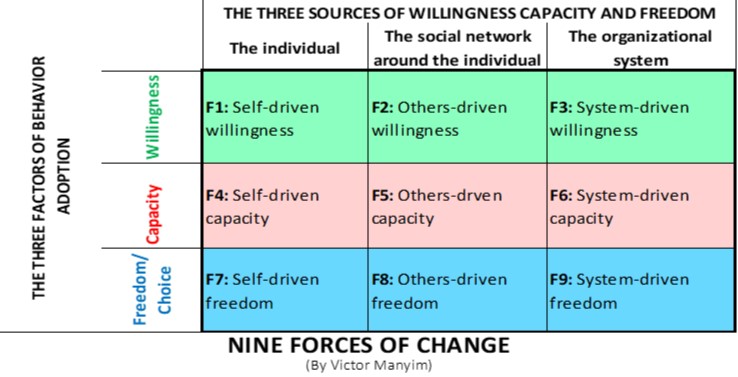
Thus the matrix of nine forces below which potentially play against you or could work for you –if you find creative ways to activate them–in any change effort:

Nine Forces of Change matrix by Victor Manyim. A 3x3 grid showing the intersection of three factors of behavior adoption (Willingness, Capacity, Freedom/Choice) with three sources (The Individual, The Social Network, The Organizational System). The nine forces are: F1 Self-driven willingness, F2 Others-driven willingness, F3 System-driven willingness, F4 Self-driven capacity, F5 Others-driven capacity, F6 System-driven capacity, F7 Self-driven freedom, F8 Others-driven freedom, F9 System-driven freedom.

We have developed a coaching system that can be used both for individuals and for companies to help them move from here to there regarding people’s behavior. We have developed and delivered a two or days seminar where we explore the Nine Forces framework with participants. We apply the framework to a real change problem, formulate a change objective, run creativity workshops where dozens of Nine Forces activation ideas are generated by participants themselves. We finish the workshop with a beta change plan based on four to six selected ideas. We include simple instruments participants would use to measure behavior adoption and progress toward the change objective, in order to adjust the beta plan. To turn after-training motivation into real action on the ground, we follow-up the training using coaching conversations where recipients are encouraged to reflect on what they are doing, on what works and what does not, and on what to adjust.

Kenya

Kenya’s Road to Sustainable and Inclusive Development

Felistus Mbole | 2017

Abstract

Sustainable development is inclusive development. As economies advance from being agrarian to services-based as is expected with the continual social change for the better, human capital is becoming the most important asset of every nation. Sustainable and inclusive development policy interventions are thus those that are targeted at enabling most of the citizens to contribute to the economic growth of their country and to share in this growth. Such interventions entail building the human capital stock of the nation through education and training Kenya’s past economic performance has been minimal, chequered, and unequally distributed. Its current development roadmap, Vision 2030, has little prospects of delivering the rapid, lasting, and wide-ranging growth that typifies sustainable development. A look at Malaysia, a globally acknowledged development success story and Kenya’s peer in many aspects in the 1960s, shows a wide divergence in their growth from the early 1980s. This project applies evidence and lessons from Kenya’s past and Malaysia to build a human capital model for sustainable development. Based on this model, the project then uses scenario analysis to identify credible and practical policy interventions to get Kenya on to the path for sustainable and inclusive growth in the future.

Global Consulting and the Leadership Development Process in Sub-Saharan Africa

Global Consulting and the Leadership Development Process in Sub-Saharan Africa

Samuel A. Adeyemi | 2017

Abstract

Sub-Saharan Africa has had its share of political, economic and social challenges. It needs to produce leaders with greater sophistication in leadership skills to overcome these challenges. Cabrera and Unruh (2012) assert that global leaders are not born, but made. Effective leadership development requires leadership training at the individual, organizational and national levels. There is a need to develop individuals to lead in a way that produces positive financial, social and environmental results (Van Velsor et al., 2010). It is pertinent for the leadership development curriculum for sub-Saharan Africa to take into consideration the peculiar cultures in that part of the world.

This dissertation explores the role of global consulting in the leadership development process in sub-Saharan Africa. Specifically, it applies consulting tools with a view to explore ways of making the Daystar Leadership Academy to be an enduring institution that is strategic and effective. It also explores opportunities for upgrading the Daystar Leadership Academy to a government recognized diploma or degree awarding institution over the short and long terms. These opportunities include making it a government-approved institute that awards its own diplomas, upgrading it to a degree awarding university, or making it an offsite campus for an existing university.

From Volunteer to Leader

From Volunteer to Leader

Christina V. Angelakos | 2017

Abstract

Volunteers are an integral part of our organizations. They are the driving force of nonprofits, churches, and community projects. Volunteers serve in a variety of roles, offering their support and donating their time, resources, and knowledge to complete tasks and help organizations function at their highest level. However, for all their assistance, very little time is spent developing them spiritually, physically, and emotionally. This is a mistake. Not only are volunteers one of our greatest assets, but they have the potential to become leaders in our organization and help us further expand our volunteer pool by developing others.

There is no “perfect” way to develop leaders, just as there are no “perfect” leaders. There are too many different personalities, situations, organizational cultures, and programs for it to be a one-size-fits-all solution. The purpose of this manuscript isn’t to prescribe a remedy that gives you exact instructions on how to develop volunteers into super leaders, but rather to be used as a compass to help guide you on your journey to grow volunteers into leaders.

The process for developing a volunteer intoa leader is broken up into six sections: 1) Know your team, 2) Know yourself, 3) Identify what leadership means to you and your organization, 4) Understand the roadblocks to leadership, 5) Establish the anatomy of your ideal leader within the organizational parameters, and 6) Take practical steps to help volunteers grow spiritually, mentally, emotionally, and professionally.

Leaders never fully arrive at the end of their journey. There is always room for growth no matter how long they have been leading. A vital part of developing leaders (and raising up volunteers) is to teach them how to connect with others who will help them along that journey. Coaching, mentoring, and peer relationships are where this magic happens, and this manuscript discusses various ways to incorporate them into the volunteer/leader experience at your organization.

Mastering Motivation: How to Motivate Your People to Buy-In, Own Their Roles, and Perform at the Highest Level

Mastering Motivation: How to Motivate Your People to Buy-In, Own Their Roles, and Perform at the Highest Level

Jason Baca | 2017

Abstract

This text takes a decidedly academic look at the real-world influences that motivate team members within an organization to buy into an organization’s mission, to take ownership of their roles and responsibilities within that organization, and to perform at their highest ability. This text provides a review of the research regarding the sociological and psychological facets of motivational influences including stress, incentives, power sharing, LMX theory, and leadership style. Ultimately, the text seeks to unpack and apply some of the academic research behind motivational influences within an organization in a way that leaders and team members in almost any arena can implement immediately.

Spirit of Excellence Workshop

Spirit of Excellence Workshop

Yolanda Brannen | 2017

Abstract

Many organizations are faced with the challenge of providing consistent, excellent customer service that leads to customer loyalty and growth in profits. The challenge of excellent customer service stems from the lack of prescribed values in organizations, or the failure to interpret and practice organizational values. The inception and design of the workshop is to ignite the understanding of values as a guiding principle, which can be demonstrated and cultivated in the workplace and society at large with fundamental teaching and exercises.

Values are drivers of excellence. The workshop will assist organizational leaders in understanding the importance of uncovering values then stimulating, activating & motivating (S.A.M) a base set of values in followers in order to align those identifiable values with the organization’s values. The alignment of personal and organizational values will create a plausible solution that drives excellence in customer service in both for-profit and non-profit organizations.

The workshop will present several comprehensive value-based modules to develop the customer service skills of the most vital assets (workforce). Creating a mindset that wants to perform with a “Spirit of Excellence,” that promotes sustain competitive advantage, making the organization a leader in their industry.

The sole intent of this project after its design is to facilitate workshops in organizations to help organizations answer the question, “How excellent is thy name?” The workshop will promote Psalm 8 (KJV), “O Lord, our Lord, how excellent is thy name in all the earth! Who hast set thy glory above the heavens.” While promoting the belief that excellence comes from wisdom. The delivery of the workshop will provide the wisdom, action, and guidance (W.A.G.) that will deliver measurable results month-over-month after implementation of proven motivational practices from workshop modules focused on understanding ‘values’ and the role they play instrumentally in order to reach a terminal end (goal).

The four-course module workshop’s final output will consist of a program of instruction, module slides, instructor’s notes, and evaluation forms. The overall mission of workshop is to equip and train leaders from a biblical perspective that changes the world by operating with a ‘Spirit of Excellence’ in order to change the world.

Police Leadership Development: An Application of Leadership Transparency and Leadership Role Modeling Through Ethical Leadership

Police Leadership Development: An Application of Leadership Transparency and Leadership Role Modeling Through Ethical Leadership

Lonnie Cain | 2017

Abstract

One of the most difficult challenges for law enforcement executives and training cadre is to find the time and resources to develop practical and formidable leadership curriculums for police officers in the junior years of their law enforcement careers. Leadership development is used to enhance the quality of leadership and leadership potential of individuals, teams, and organizations.[i] Law enforcement municipalities desire to attract the brightest, most ethical, self-motivated candidates to be employed in their respective agencies. Modern law enforcement officers are expected to solve many problems that range from domestic calls for service to mass casualty critical incidents. Naturally, the very best emergent leaders, those members deemed the most influential by people in the organization, should prepare themselves to promote from informal leadership roles to formal leadership positions.[ii]

The assurance of a successful transition from informal leaders to formal leaders rely heavily on the individual officers’ work performance, motivation and willingness to accept responsibility to shape the organization’s future. Mutually, the organization is charged to guide and provide the young officers with essential leadership development training. Leadership development programs are vitally important as they shall provide the framework and expectations of organizational leadership. Leadership development is more than an educational program; leadership development must be entrenched within the organizational virtue.

Successful leadership development embedded inside the organization support succession planning. Leadership curriculum fosters learning conducive to the organizational leadership expectancies of how officers shall lead followers. The most critical aspect of successful organizational leadership development is role model leaders, transparent in their leadership styles amid a firm ethical foundation.