

Nine Forces of Change
Nine Forces of Change
Victor Manyim | 2017
Abstract
Leadership is a process of influence and action where wonderful things are realized with people and through people consistently. In the volatile world where we live today, consistency requires a lot of agility on the part of the company. This is where change comes in as an ever present factor in the leadership equation. Change itself may well have other components like technology or environment, but as Dan and Chip Heath say in their bookSwitch: How to Change Things When change is hard:“all change efforts boil down to the same mission: can you get people to start behaving in a new way?” This need for leading change is high everywhere, and even more so in emerging economies where current growth trends will necessarily lead to dramatic revolutions in companies.
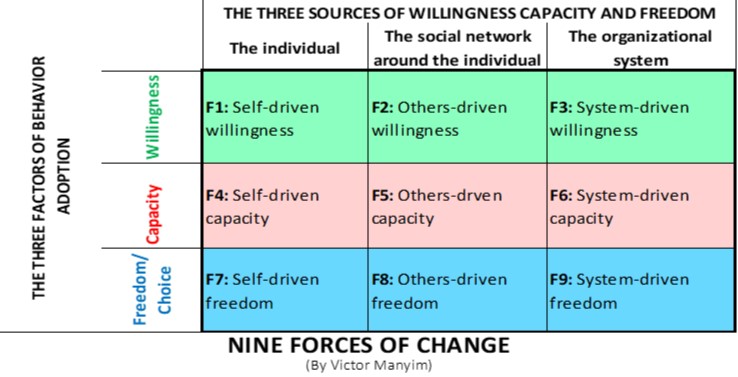
We extend Joseph Grenny et Al’s six sources of influence and develop behavioral change methodology which we called Nine Forces of Change (9F). This methodology is based on two principles:
- People truly and durably adopt a new behavior only when: (1) they arewillingto adopt it, (2) they areableto adopt it, and (3) they arefreeto adopt it.
- People’s willingness and capacity and freedom come from three sources: (1)peoplethemselves, (2)the social networkaround people, and (3)the organizational systemin which they live.
Thus the matrix of nine forces below which potentially play against you or could work for you –if you find creative ways to activate them–in any change effort:
We have developed a coaching system that can be used both for individuals and for companies to help them move from here to there regarding people’s behavior. We have developed and delivered a two or days seminar where we explore the Nine Forces framework with participants. We apply the framework to a real change problem, formulate a change objective, run creativity workshops where dozens of Nine Forces activation ideas are generated by participants themselves. We finish the workshop with a beta change plan based on four to six selected ideas. We include simple instruments participants would use to measure behavior adoption and progress toward the change objective, in order to adjust the beta plan. To turn after-training motivation into real action on the ground, we follow-up the training using coaching conversations where recipients are encouraged to reflect on what they are doing, on what works and what does not, and on what to adjust.