Skip navigation

Russian Organizational Leadership: Lessons from the Globe Study

This paper summarizes the authors’ findings on organizational leadership in Russia through the GLOBE cross-cultural research program and further develops an interpretation of empirical data on Russian business leadership. The authors discuss factors of effective leadership rooted in the country’s history, highlight relative scores on universal leadership attributes, interpret culture- contingent leaders’ characteristics, and summarize the influence of culture on effective leadership in a transitional society.


Among the important applications of contemporary leadership theories is the articulation of organizational leadership in diverse societies. Leadership is defined by universal as well as country-specific/culture-specific characteristics. While much has been done on leadership attributes and behaviors in industrialized countries, it is clear that in countries in transition to democracy and the free market leaders follow their own customs to encourage, motivate, and enable others to contribute to the success of the organizations of which they are members.

In the last decade, scholars have discussed Russian culture and its impact on business and management practices (Elenkov, 1997; Grachev, 2001; Michailova, 2000; Naumov, 1996; Naumov & Puffer, 2000; Puffer, 1992). In particular, they have analyzed the profile of the Russian business leader and compared the values and behaviors of Russian to American entrepreneurs (Kats de Vries, 2000; Hisrich & Grachev, 2001). However, these findings were neither placed into a larger international comparative framework nor linked to universal leadership attributes for comparative purposes.

This paper presents findings on organizational leadership in Russia from the large-scale cross-cultural research program, Global Leadership and Organizational Behavior Effectiveness (GLOBE), conducted in 62 counties. The program is based on a culturally endorsed implicit leadership theory (CLT) that focuses on beliefs about effective leaders shared by members of an organization or society (House, 1997, 1999, 2004). GLOBE findings position Russia in a cluster framework (Bakacsi, Takacs, Karacsonyi, & Imrek, 2002) and summarize its cultural profile (Grachev, 2004) and its CLT leadership profile in a cross-cultural context.

After reviewing the historically developed sources of effective leadership in Russia, the remainder of the article presents our empirical findings and relative scores on leadership dimensions that are universally perceived as contributors to or inhibitors from outstanding leadership.

Genesis of Russian Organizational Leadership

Modern societal culture in Russia is determined by three sets of factors: (a) traditional features, historically developed through centuries; (b) influence of the 20th century totalitarianism; and (c) radical revolution in values, beliefs, and behaviors through the transitional 1990s and early 2000s (Grachev, 2004). These factors may help to predict the profile of an effective Russian organizational leader.

Historically developed characteristics of Russian culture are rooted in Slavic history, Orthodox religion, specific features of natural environmental, and unique social capital. Holistic and influential, Slavic-Orthodox culture is regarded as one of the few “global cultures” (Huntington, 1993). Through the centuries, Russia has integrated basic values of both the West and the East – reason and inspiration. It has served as a bridge between Western and Eastern cultural traditions with a certain psychological dependence on both. Its national character combined such qualities as habitual, patient struggle with misfortune and hardship; the ability to concentrate efforts; the ability to cooperate across a large geographic distance, impersonal collectivism; humanism; and the search for truth (Chaadaev, 1991; Kluchevskii, 1904).

While Russia was growing through the centuries, its leaders were traditionally associated with the state, religion, or the military. The Russian Orthodox Church greatly influenced society, and several spiritual leaders were deified. Peter the Great, who began “Westernization” in the 18th century by autocratic and barbarian means, was an admired military leader. Business leaders in his time were traders who, along with the military, created Europe’s strongest military- industrial complex of those times. Later, the economic liberalism of Catherine the Great attracted the highest-ranking Russian nobles to entrepreneurship. The industrial revolution in the 19th century brought the real spirit of private initiative and leadership to Russia. Talented business leaders such as Morozov, Knopp, and Ryabushinski founded successful business empires in Russia and introduced many organizational innovations, including charitable initiatives.

In the 20th century under Communism, in contrast to the West, Russia appeared to have largely retained, even in periods of rapid industrial expansion, an autocratic or patrimonial system (single-centered). This sharply limited the autonomy of economic units in the use and disposal of resources and preserved for those in political control the right, if only de jure, to determine the pace and pattern of economic development (Guroff & Carstensen, 1983). Russian leadership characteristics were modified by specific Soviet (totalitarian) traits such as a perception of the environment as hostile and dangerous, supremacy of society’s goals over the individual’s, and a relativistic view of morality with an acceptance of double standards in life (Mikheyev, 1987). However, even within the Soviet command system, there existed a vigorous level of entrepreneurial response and positive leadership heritage, including military victories in the Second World War, courageous behaviors, and great technical projects.

In the 1990s, the transitional Russian economy was run by a small number of financial- industrial groups, arguably more powerful than the state. The stage of aggregating capital by selling state property (“privatization stage”) was over, and the new epoch could be defined as the stage of “managing capital effectively,” with the oligarchs – leaders of industrial and financial empires – displaying a new leadership model for the Russian economy.

Later, in the early 2000s, the political and economic landscape experienced a new shift. With the rise of a state bureaucracy supported by security corps, the government confronted disloyal oligarchs and selectively re-evaluated the results of the “wild” privatization of the 1990s. One of the major consequences of these changes was strengthened state control over economic development at the expense of democratic institutions. Russian President Vladimir Putin coined the term “managed democracy” to define the unique Russian path to economic prosperity. Bureaucratic rules limited entrepreneurial initiative, creativity, and the ability to successfully and ethically interact with Russia’s counterparts in the global economy.

The heterogenous kaleidoscopic culture of Russia’s current transitional society is different from the homogenous Soviet culture. Business leaders and managers in Russia are motivated by one or a combination of the following business philosophies: bureaucratic, based on active initiatives under state-run bureaucratic supervision; pragmatic, based on maximum profitability on a technocratic basis; predatory, based on achieving success through tough suppression of rivals including Mafia connections, growth by any means, and cheating on partners, consumers, and the state; and socially responsible, based on linking business to the promotion of national interests, the resolution of social problems, and universal human values (Ageev, Gratchev, & Hisrich, 1995).

The current transitional economy makes the carriers of those business philosophies very diverse, with a variety of economic and political interests. In the literature, a number of similar typologies exist to differentiate these carriers. While the typologies often do not go far beyond informal observations, they help to better explain the diversity of the Russian management community.

Our typology identifies Old Guard, New Wave, and International Corps by linking their root characteristics to the stages of Russian business history (Ageev et al., 1995). The first group, the Old Guard, consists of those who proved their talents as leaders in large-scale projects such as managing technological innovations. The Old Guard exploit their access to key decision- making centers and information and use bureaucratic connections and control of resources.

These people still keep leading positions in large industrial corporations or in internationally competitive sectors of the economy (oil-and-gas, aerospace, shipbuilding, and others). The second group, the New Wave, emerging from economic reform, follows a different road to economic independence by searching for innovations and reflecting advanced economic thinking. They are leaders of the former shadow economy, which has been being increasingly legalized and are former Communist party functionaries or military officers who successfully transformed into businessmen. A large proportion of this group is young people, hungry for entrepreneurial success. Another group of people, who can be called Unwilling Entrepreneurs, are forced to take initiatives due to fear of unemployment and are now involved primarily in small-scale trade transactions. Finally, there is a group of foreign businessmen (International Corps) that operates in the Russian market, including representatives of the Russian diaspora.

A similar system of categorizing Russian business leaders is suggested by M. de Vries (2000). He identifies two groups separated by a substantial generation gap. In the first group he places young enthusiastic, talented people who recognize the opportunities of the new open society. This group includes former black marketers turning to legitimized business and the children of Party nomenklatura. The administrators and bureaucrats who used to supervise the Soviet economy in the past make up the second group. However, this second group is not homogeneous. One subgroup includes a well connected business elite, retaining privileged positions. The other subgroup among the older generation is focused on self-preservation, making superficial adjustments to maintain their status, often giving only lip service to the new economy.

Globe Design and Russian Sample Composition

This paper summarizes findings on Russian effective leadership as a part of a large-scale cross-cultural research program called GLOBE*. The theoretical base that guides the GLOBE research integrates implicit leadership theory, value/belief theory of culture, implicit motivation theory, structural contingency theory of organizational form and effectiveness, and integrated leadership theory. The central GLOBE proposition is that attributes and entities that distinguish a given culture from other cultures are predictive of the practices of organizations of that culture and predictive of the leader attributes and behaviors that are most frequently enacted, acceptable, and effective in that culture.

The GLOBE cultural dimensions design was based on previous works by Hofstede (1984) and McClelland (1985) and also included the theoretical findings of Kluckhohn and Strodtbeck (1961) and Triandis (1995). Cultural values and practices were measured on a 7-point response scale with respect to nine cultural dimensions that display high within-culture and within-organization agreement and high between-culture and between-organization differentiation: societal collectivism, family collectivism, gender egalitarianism, assertiveness, power distance, performance orientation, future orientation, uncertainty avoidance, and humane orientation.

Several statistical procedures were applied to define the properties of the GLOBE cultural scales (House, Hanges, Javidan, Dorfman, & Gupta, 2004). The determination of cultural aggregation was justified by measures that compare the observed variance within a society to the variance expected if there is no within-society agreement. The ICC(1) statistic provided information on the appropriateness of aggregation, comparing the variance between societies with the variance within societies. The reliability of scales was assessed with respect to two random error sources (internal consistency and interrater reliability).

In a similar way, and consistent with the way implicit leadership theories of individuals have been measured in previous research, GLOBE combined trait and behavioral descriptors to reflect relevance to leadership effectiveness (Dunnette & Hough, 1991). These items were also measured on a 7-point scale from a low of “This behavior or characteristic greatly inhibits a person from being an outstanding leader” to a high of “This behavior or characteristic greatly contributes to a person being an outstanding leader.” Respondents reflected on a given definition of effective leadership as the ability of an individual to motivate, encourage, and enable others to contribute to the success of the organization of which they are members.

GLOBE provided evidence that people from different cultural groups (societies) share a high level of agreement on their beliefs about effective leadership and that significant statistical differences exist among cultural groups in their beliefs about leadership. These shared beliefs may be described by the CLT leadership profile. GLOBE research has also identified 21 specific leadership attributes and behaviors that are universally viewed as contributors to or inhibitors from effective organizational leadership. Based on second-order maximum likelihood exploratory factor analysis, the following factors that constitute six global leadership dimensions were identified. Two were found as universal contributors to effective leadership: charismatic/value-based and team-oriented. Two factors were found as culture-sensitive contributors to effective leadership: humane and participative. Two were culture-sensitive impediments to effective leadership: autonomous and self-protective. Internal consistency and interrater reliability, computed by using a linear composite reliability formula (Nunnally & Bernstein, 1994), displayed acceptable level of these scales – average internal consistency reliability = .84, and average interrater reliability = .95 (House et al., 2004, p. 136). And the countries were also placed into bands (high A – low D) in such a way, that their scores within the same band were statistically not significantly different from each other.

Within the GLOBE research we operationally measured the Russian cultural and leadership profile by assessing questionnaire responses from 450 middle managers in three industries (telecommunications, food processing, and financial services) with respect to (a) the values they endorse and (b) reports of practices of entities in their societies.

The main GLOBE survey was conducted in Russia in 1996-1998. Responses were received from 450 managers in food processing, telecommunication, and banking/finance, 150 managers from each industry. These managers represented different parts of the country – Far East, Siberia, the Urals, Southern and Northern Russia, and large cities of Central Region. The average age of respondents was 38.8 years, and the gender composition of the sample was 61.7% men and 38.3% women. The average employment profile of managers was as follows: number of years employed – 16.8 years, management experience – 7.4 years, and employment in current organization – 8.6 years. Forty percent were members of professional organizations, 15% were actively involved in trade and industry associations, and 5% had jobs in multinational corporations. Surveyed managers worked in production and engineering (42%), administration (28%), sales and marketing (15%), human resource management (8%), R&D (5%), and in planning and other functions (2%). The average educational level (15.5 years) of respondents was very high. The university/college background was 61% technical and 39% were in economics, planning, and finance. Twelve percent of all respondents received some training in Western management concepts and techniques.

Russian CLT Profile

The overall profile of a Russian organizational leader on globally endorsed leadership dimensions is displayed in Figure 1. Appendix 1 and 2 contain quantitative data.

Charismatic/Value-Based Orientation

According to GLOBE, charismatic/value-based leaders have the ability to inspire and motivate others and facilitate high performance outcomes on the basis of firmly held core values. The aggregate score for universal positive leader attributes for Russia, summarized in Charismatic/Value-Based Leadership dimension, is relatively low (5.66) with rank 47 in band D. This was interpreted as only slightly contributing to outstanding leadership. One major reason for the low score on value-based leadership is the current societal transformation in Russia; many beliefs that dominated under Communism are eroding, and the value structure has been transforming radically in the last two decades. Different groups with different leadership philosophies and values are replacing the homogenous Soviet system. But transformative new values and beliefs that go far beyond technocratic or predatory philosophies have not yet emerged in the corps of business leaders and managers. The Russian score on this dimension is lower than the East European mean (5.74), lagging behind other countries in the cluster.
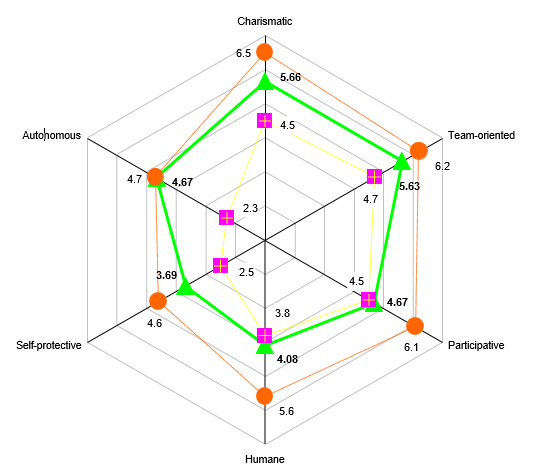
Figure 1. Global culturally endorsed implicit leadership (CLT) scores for Russia (circles – maximum mean, squares – minimum mean within 62 countries).

The first order dimensions for Charismatic/Value-Based Leadership display Visionary (6.07) as the prioritized dimension in considering effective leadership in Russia. Considering the relative vacuum of societal values and the high uncertainty regards the economy and society, the ability of leaders to formulate a vision on the organizational level is critical for the followers in the organization.

In the range of factors slightly contributing to effective leadership, we found Performance-Oriented (5.92), Inspirational (5.89), Decisive (5.86), and Integrator (5.72). Self-Sacrifice (4.28) had no impact on outstanding leadership. When we compared Russia’s scores and other countries’ scores on this second-order CLT dimension, we placed Russia in the A band on Decisive; in the B group on Visionary, Performance Orientation, and Integrity; and in the C band on Self-Sacrificial.

Team Orientation

Emphasis on effective team development and collective implementation of a common goal is central to the GLOBE interpretation of the second universal contributor to effective leadership. This second order dimension did not display an optimistic assessment of Russia, as well. Its Team-Oriented score was 5.63 with rank 46 in the C band. In the East European cluster it was lower than the group mean (5.88). While Russia has been long stereotyped as a collectivist country, GLOBE cultural scores display its transition to a more individualistic society. The vector of teamwork and group dynamics in such a society is not high or critically important to effective organizational leadership.

The first order scores prioritize the issues. While Administrative Competence is contributing to effective leadership in Russia (6.03), the other dimensions only somewhat contribute to effective leadership: Team-Oriented (5.15), Team Integrator (5.56), diplomatic (5.01), and Malevolent (reverse score 1.85). Russia’s comparative scores placed the country in the A band on the Administratively Competent dimension, but only in the C band on critical factors such as Team Orientation and Malevolence. On the other two dimensions, Diplomatic and Team Integrator, Russia fits the B band.

Humane Orientation

On this CLT dimension GLOBE research highlights supportive and considerate behavior that includes compassion and generosity. However, Russia’s low score (4.08) may be interpreted as having limited impact on outstanding leadership. This placed Russia with rank 60 into the D band. In the Eastern European cluster the score was lower than the group mean (4.67). In a transitional economy dominated by survival behaviors, with high corruption and bureaucracy, humanistic values exist in a limited number of companies that emphasize socially responsible philosophies.

First order dimensions related to this global CLT dimension are Modesty and Humane Orientation. In the case of Russia, the score on the former was 4.25 (no visible impact on effective leadership) and on the latter was 3.92, which slightly inhibits outstanding leadership. Both scores placed Russia into C band on these first order dimensions.

Participative Orientation

Involving others in making and implementing decisions, according to GLOBE, universally contributes to effective leadership. The Russian score on this dimension, however, is very low (4.67), placing the country in the D band. Within the Eastern European cluster, the Russian score was also lower than the group mean (5.08). Two major reasons support these findings. First, vertical structures and authoritarian decisions are effective in modern transitional Russia. Second, many successful Russian business networks depend on personal connections with bureaucracy and/or find themselves under the control of cruel criminal structures that leave no space for open, reciprocal, and trustful interaction and participation in decision-making.

Two first order dimensions explain contribution to Participative orientation. One was the high Autocratic score (4.16, reverse score). It placed Russia into A band and did not contribute to effective leadership. The other was Non-Participative (2.82, reverse score). Its relative value inhibiting from effective leadership was also high (B band). Hence, participation did not play an important role in defining effective leadership.

Autonomous

The second order dimension, Autonomous, displays independent and individualistic leadership. Many Russian business leaders emphasize their uniqueness and their autonomous performance. The score on this CLT (4.63) placed the country in band A. The first-order dimension score (Autonomous, 4.04) explained this CLT as inhibiting outstanding leadership. In the Eastern European cluster the Russian score was higher than the group mean (4.20).

Self-Protective

This CLT dimension corresponds to universal negative leadership attributes and focuses on ensuring the safety and security of the individual. In the case of Russia, this culture-sensitive impediment slightly negatively contributes to effective leadership. The Self-Protective score for Russia (3.69) placed the country in the A band with rank 17 and was about the same as the Eastern European mean (3.67). Since this was the reversed score, the negative impact on the universal CLT was quite visible.

The Self-Protective score is based on several first order dimension factors. Status Conscious (4.75) had no impact, and Conflict Inducer (3.90) had minimum influence on effective leadership. The other first order dimensions somewhat inhibiting people from being outstanding leaders were: Self-Centered (2.48), Face Saver (2.67), and Procedural (2.98).

On the comparative frame Russia found itself in B bands on Status Conscious, Self- Centered, and Conflict Inducer; in C band on Face Saver; and in D band on Procedural. The very low score on the Procedural dimension indicates that being procedural is likely to be a greater inhibitor from effective leadership in Russia than in most countries included in the GLOBE sample.

Conclusions

This research shed light on the current profile of organizational leadership in Russia. The GLOBE project was one of the first major attempts to collect an empirical data set on Russian leadership and culture and to rely on internationally recognized and reliable research methods. The findings presented herein seem to have quite important implications for both researchers and practitioners.

The comparative analysis on the GLOBE cultural scales showed contemporary Russia as having several extreme scores: very low in Uncertainty Avoidance, Future Orientation, Performance Orientation, and Humane Orientation; and very high in Power Distance. In particular, in a behavioral set of findings, extremely low Uncertainty Avoidance could be considered favorable for entrepreneurship activities unless one links it to the very low Future Orientation. This can be interpreted as a lack of vision in management and entrepreneurship and as a primary focus on survival and short-term business development. Low Performance Orientation makes it difficult to encourage managers to focus on continuous improvement and learning. Low ranking on Humane Orientation raises doubts about long-term investments in human resources. High Power Distance indicators explain the tough bureaucratic measures in crisis management and in restructuring enterprises and industries (Grachev, 2004).

In terms of global CLT dimensions Russia displays a clear picture of what makes its current leadership effective. Relatively more important attributes are Visionary and Administrative Competency. They are followed by Decisive, Performance Orientation, and Inspirational. Integrity, Team Integration, Collaborative, and Diplomatic somewhat contribute to outstanding leadership. At the same time Self-Sacrifice, Modesty and Human Orientation, Status Consciousness, and Conflict Inducer do not make a difference.

Our GLOBE results suggest that universal positive leadership attributes such as Charismatic/Value-Based Leadership (visionary, decisive, and inspirational) and Team Oriented Leadership are considered as slightly contributing to outstanding leadership in Russia. The latter mainly means to be administratively competent and collaborative oriented. However, the level of such influence is much lower than in most other countries. The other two dimensions that nearly universally contribute to leadership – Participative and Humane orientation – have only limited impact in Russia. What matters is a good “image” (linked to success competency and personal and social recognition) and acting as a “facilitator” (attract people, settle disputes, and control the situation) which seems to be the Russian manifestation of Participative Leadership. Humane Orientation is seen as relatively neutral to outstanding leadership whereas status consciousness and conflict inducing behaviors (Self-Protective leadership) are positively endorsed. Universal negative leadership attributes such as Self-Protective and Autonomous are relatively important in inhibiting effective leadership. For an outstanding leader in Russia, Autonomous leadership (individualistic, independent, and unique) is linked to “action-oriented” leadership endorsed in Russia (act with no hesitation, real fighter, enduring, and self-sacrificial).

Summarizing these findings, the paper displays the profile of an administratively competent manager, capable of making serious decisions and inspiring his/her followers to meet performance targets. To some extent he/she relies on teams and, through diplomatic and collaborative moves, succeeds in integrating efforts of his/her members. However, in his/her actions there is not much interest in humane orientation to others or modesty in personal behavior. He/she may sacrifice a lot and does not care about saving face. Status is not very important to the Russian organizational leader. Altogether one may consider that Russia is seeking its own way for effective leadership concepts and practices.


*The authors acknowledge participation of Boris Rakitski (Institute of Perspectives and Problems of the Country, Moscow, Russia) and Nikolai Rogovsky (International Labor Organization, Geneva, Switzerland) in GLOBE data collection and appreciate their conceptual insights that helped to finalize this paper.

* The authors served as GLOBE Country Investigators and conducted other GLOBE-related research on leadership. In particular, they contributed to the earlier research that explored leadership in 22 countries and further attested to the existence and importance of a CLT profile (Den Hartog et al., 1999). This research confirmed that attributes of charismatic-transformational leadership are universally endorsed as contributing to outstanding leadership. The other research highlighted cultural and leadership predictors of corporate and social responsibility of top management in 15 countries (Waldman et al., 2006).


About the Authors

Mikhail V. Grachev is associate professor of management at Western Illinois University and adjunct professor of management at the University of Iowa. He served as university faculty in the United States, France, Japan, Hungary, the Czech Republic, and Russia; and focused research on international dimensions of organizational behavior and strategy. He is country co- investigator in the multinational cross-cultural research project GLOBE.

Grachev, Mikhail V., Associate Professor of Management

Western Illinois University 3561 60th Street Moline, Il 61265, USA

Email: mv-grachev@wiu.edu

Mariya A. Bobina is a Ph.D. candidate at the University of Illinois at Chicago. Her business competencies are based on practical experience as senior financial officer in the aircraft industry and as consultant to a number of international organizations and companies in the energy sector. She is country co-investigator in the multinational cross-cultural research project GLOBE.


Reference

Ageev, A., Gratchev, M., & Hisrich, R. (1995). Entrepreneurship in the Soviet Union and Post- Socialist Russia. Small Business Economics, 7(5), 365-376.

Bakacsi, G., Takacs, S., Karacsonyi, A., & Imrek, V. (2002). Eastern European cluster: Tradition and transition. Journal of World Business, 37, 69-80.

Chaadaev, P. (1991). Philosophical works of Peter Chaadaev. Boston: Kluwer Academic Publilshers.

Den Hartog, D., House, R., Hanges, P., Ruiz-Quantanilla, S., Dorfman, P., & GLOBE associates. (1999). Culture-specific and cross-culturally generalizable implicit leadership theories: Are attributes of charismatic/transformational leadership universally endorsed? Leadership Quarterly, 10(12), 219-256.

Dunnette, M., & Hough, L. (Eds.). (1991). Handbook of industrial and organizational psychology. Palo Alto, CA: Consulting Psychologists Press.

Elenkov, D. (1997). Differences and similarities in managerial values between US and Russian managers. California Management Review, 40, 133-156.

Gratchev, M. (2001). Making the most of cultural differences. Harvard Business Review, October, 28-30.

Grachev, M. (2004). Cultural attributes of Russian management. Advances in International Management, 15, 159-177.

Gratchev, M., & Hisrich, R. (2001). The ethical dimensions of Russian and American entrepreneurs. Journal of Small Business and Enterprise Development, 8(1), 5-18.

Guroff, G., & Carstensen, F. (Eds.). (1983). Entrepreneurship in Imperial Russia and the Soviet Union. Princeton, NJ: Princeton University Press.

Hofstede, G. (1984). Cultures consequences. International differences in work-related values. Newbury Park: Sage Publications.

House, R. J., Hanges, P. J., Javidan, M., Dorfman, P. W., & Gupta, V. (Eds). (2004). Culture, leadership, and organizations: The GLOBE study of 62 societies. Thousand Oaks: Sage Publications.

House, R., Hanges, P., Ruiz-Quintanilla, S., Dorfman, P., Javidan, M., Dickson, M., Gupta, V., et al. (1999). Cultural influences on leadership and organizations: Project GLOBE. In W. Mobley, M. Gessner, & V. Arnold (Eds.), Advances in global leadership. Stamford, CT: JAI Press, 171-233.

House, R., Wright, N., & Aditya, R. (1997). Cross-cultural research on organizational leadership. A critical analysis and a proposed theory. In P. Ch. Earley & M. Erez (Eds.). New perspectives on international industrial/organizational psychology. San Francisco: Lexington Press.

Huntington, S. (1993). The clash of civilizations? Foreign Affairs, 72(3), 22-49.

Kats de Vries, M. (2000). A journey into the “Wild East”: Leadership style and organizational practices in Russia. Organizational Dynamics, 28(4), 67-81.

Kluchevskii, V. (1904). Kurs Russkoi istorii. [The course in Russian history]. Moscow: Sinodalnaya Tipografiya.

Kluckhohn, F., & Strodtbeck, F. (1961). Variations in value orientation. New York: HarperCollins.

McClelland, D. (1985). Human motivation. Glenview, IL: Scott, Foresman.

Michailova, S. (2000). Contrasts in culture: Russian and Western perspectives on organizational change. The Academy of Management Executive, 14(4), 99-112.

Mikheyev, D. (1987). The Soviet mentality. Political Psychology, 8(4), 491-523. Naumov, A. (1996). Hofstedovo Izmerenie Rossii [Hofstede’s dimension of Russia]. Menedzhment, 3, 70-103.

Naumov, A., & Puffer, S. (2000). Measuring Russian culture using Hofstede’s dimensions. Applied Psychology: An International Review, 49(4), 709-718.

Nunnally, J., & Bernstein, I. (1994). Psychometric theory. NY: McGraw-Hill.

Puffer, S. (Ed.) (1992). The Russian management revolution: Preparing managers for the market economy. Armonk, NY: M.E. Sharpe.

Triandis, H. (1995). Individualism and collectivism. Boulder, CO: Westview Press.

Kats de Vries, M. (2000). A journey into the “Wild East”: Leadership style and organizational practices in Russia. Organizational Dynamics, 28(4), 67-81.

Waldman, D., Sully de Luque, M., Washburn, N., House, R., Bobina, M., Grachev, M., & GLOBE associates. (2006, forthcoming). Cultural and leadership predictors of corporate social responsibility values of top management: A GLOBE study of 15 countries. Journal of International Business Studies.

APPENDIX A

Global Culturally Endorsed Implicit Leadership (CLT) Dimensions: Russia in Cross-cultural Space

Global Culturally Endorsed Implicit Leadership (CLT) DimensionsFirst-order DimensionsRussian ScoreScore for Eastern European ClusterRange for Mean Values for 62 Societal Cultures
Charismatic/Value-based (universal contributor to effective leadership)
 
Visionary, Inspirational, Self- sacrifice, Integrity, Decisive, Performance oriented 5.66     5.744.5 – 6.5    
Team Oriented (universal contributor to effective leadership)Collaborative team orientation, Team integrator, Diplomatic, Malevolent (reverse score), Administratively competent5.635.884.7 – 6.2
Participative (culture-sensitive contributor to effective leadership)  Autocratic (reverse score), Non-participative (reverse score), Delegator4.675.084.5 – 6.1
Humane (culture-sensitive contributor to effective leadership) Modesty, Humane orientation4.084.673.8 – 5.6
Self-protective (culture-sensitive impediments to effective leadership)   Self-centered, Status conscious, Conflict inducer, Face saver, Procedural3.69  3.672.5 – 4.6    
Autonomous (culture-sensitive impediments to effective leadership)Individualistic, Independent, Autonomous, Unique4.674.202.3 – 4.7

APPENDIX B

Summary of First-order Leadership Dimensions for Russia

Leadership DimensionIndicatorGroup ranking (band)Leadership DimensionIndicatorGroup ranking (band)
Performance Orientation5.92BProcedural (formerly bureaucratic)2.98D
Autocratic4.16AAdministratively Competent6.03A
Modesty4.25CSelf-centered2.48B
Charismatic III (Self Sacrificial)4.28CAutonomous (Formerly Individualistic)4.04A
Team I: Collaborative (Team Orientation)5.15CStatus Consciousness4.75B
Decisive5.86ACharismatic II (Inspirational) 5.89C
Diplomatic5.01BMalevolent1.85C
Face-saver2.67CTeam II: Team Integrator5.65B
Humane Orientation3.92CConflict Inducer3.90B
Charismatic I (Visionary)6.07BNon-Participative2.82B
Integrity5.72C   

Authentic Leadership: Commitment to Supervisor, Follower Empowerment, and Procedural Justice Climate

This study examined the authentic leadership relationships with follower outcomes of commitment to supervisor and empowerment and the extent to which procedural justice moderated these relationships through quantitative methodology. The study utilized a cross sectional survey approach and convenient sampling (N=152). Theoretical framework underpinning the study is provided as well as tested hypotheses. Summary of results and limitations of this research are discussed.


Authenticity as first referenced in management and organizational literature viewed the authentic capacity of a leader as a litmus test of executive quality (Kluichnikov, 2011). With renewed interest in recent years on positive leadership (Luthans, 2002), there has been scholarly focus on the development of the authentic leadership construct (Luthans & Avolio, 2009; Walumbwa et al., 2010a). The core of authentic leadership extends beyond the authenticity of the leader as a person to encompass authentic relations with followers (Gardner et al., 2005; Avolio & Gardner, 2005). This relationship is characterized by: (a) transparency, openness and trust, (b) guidance toward worthy objectives, and (c) an emphasis on follower development (Gardner et al., 2005). Consequently, authentic leaders’ behaviors are reflected on the followers’ actions (Bass & Steidlmeier, 1999; Fields, 2007; Zhu et al., 2011) and follower development (Bass & Steidlmeier, 1999; Gardner et al, 2005; Walumbwa et al., 2010a).

The role of followership in leadership outcomes has been duly documented in the literature (Yukl, 2010; Hickam, 2010; Gardner et al., 2005; Fields, 2007; Zhu et al., 2011). For authentic leadership, Gardener et al. (2005) asserted that followership is an integral part of authentic leadership and authentic followers are expected to replicate authentic leader development (Gardner et al., 2005). Consequently, as positive role models, authentic leaders “serve as a key input for the development of authentic followers” (p. 347). To progress authentic leadership theory development, scholarly studies have investigated a number of relational outcomes of authentic leadership on followers (Gardner et al, 2011) that include (a) follower job satisfaction (Avolio, Gardner et al., 2004) and (b) Job performance (Chan et al., 2005; Luthans et al., 2005, Illies et al., 2005) and (c) empowerment, Walumbuwa et al., (2010a). Gardner et al. (2011), in a comprehensive review of authentic leadership development and studies, called for more empirical investigations of the role of followers, various antecedents and outcomes in authentic relationship, specifically, for further research that examines what components and situations develop a deeper understanding of the authentic leader follower relationships (Gardner et al., 2011).

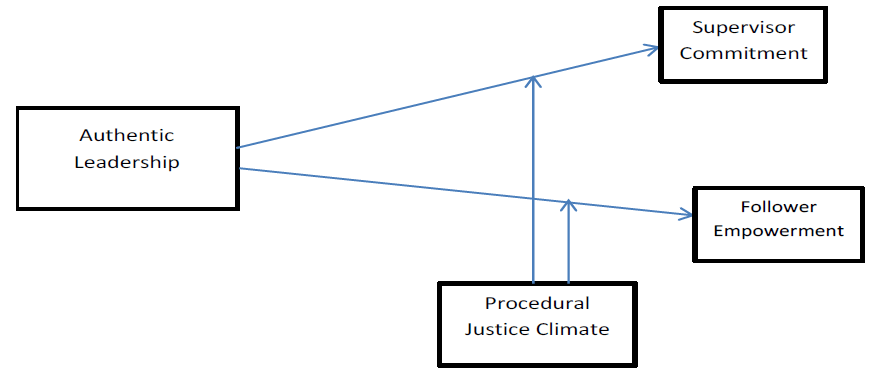
To heed the aforementioned call, this study examined (a) the relationship between authentic leadership and follower empowerment, and (b) the relationship between authentic leadership and follower commitment to supervisor. Further, this study investigated to what extent procedural justice as a perception of work climate moderates the AL relationship with both outcomes. Empowerment is generally accepted as in indicator that followers are trusted and capable (Walumbwa et al, 2010a). This derives from the conceptualization of empowerment as a psychological state that encompasses four cognitions, impact, influence, meaningfulness and self-determination (Speitzer, 2005) and commitment to supervisor indicates that the followers trust the supervisor to guide them and also an indicator of follower’s openness to supervisor’s influence (Illies et al., 2005) making these two outcomes important predictors of follower development. Consequently, findings from this study have implications for authentic leader-follower relationship development and will further aid understanding of the organizational climatic conditions that can enhance authentic leadership perception by followers in organizations.

Authentic leadership has been described in self- referent terms (Fields, 2007; Gardner et al., 2005), Self-reflective (Fields, 2007; Avolio & Gardner, 2005) and as a root concept for positive leadership approaches such as charismatic, transformational and ethical leadership (Gardner et al., 2005; Walumbwa et al., 2010). Drawing on positive psychology, Gardner et al. (2005) advanced a self-based model of authentic leadership and follower development defining authenticity as being true to oneself – owning one’s experiences (values, thoughts, emotions and beliefs and “acting in accordance with one’s true self” (p. 344). The central premise of this model is that through increased selfawareness, self-regulation, (Sparrowe, 2005) and positive modeling, authentic leaders foster the development of authentic followers (Avolio & Gardner, 2005, Gardner et al., 2005). Self-awareness means leaders know what is important to them (May et al., 2003, Kluichnikov, 2011) and Sparrowe (2005) observed that self-regulation helps to facilitate transparency and consistency a leader’s behavior. Primarily, authentic leadership represents the root construct for what constitutes other forms of positive leadership (Gardner et al., 2005). Positive leadership refer to the activation of a set of cognitions, affects, expectancies, goals, values and self-regulatory plans that both enable and direct effective leadership (Hannah, Woolfolk & Lord, 2009). Positive leadership behaviors elicit responses from followers which feedback to further enhance the positive selfconcepts of both leaders and followers (Hannah et al., 2009).


Authenticity is premised on understanding and being true to one’s self (Avolio & Gardner, 2005; George 2003). Authentic leaders are believed to be deeply aware of their values, beliefs, are self-confident, perceived to be genuine, reliable, trustworthy and of high moral character (Avolio & Gardner, 2005; Ilies, Morgeson & Nahrgang, 2005; Fields, 2007). Sparrowe (2005) links this awareness to self-regulation and a broader exploration of the self-regulation construct shows that it helps leaders weigh the gaps that may exist between their internalized standards and their praxis (Kluichnikov, 2011; Avolio & Gardner, 2005). The process of self-regulation is said to help the leader withstand external pressure and influence (Avolio & Gardner, 2005; Ilies, Morgeson & Nahrgang, 2005) increasing the authentic leader’s moral strength.

Authentic literature reviews indicated that the definition of the authentic leadership construct has converged around four underlying dimensions (Walumbwa et al., (2008) reflecting both conceptual and empirical composition (Gardner et al., 2011). These are: (a) balanced processing – a renaming of unbiased processing (Gardner et al., 2011), (b) internalized moral perspective, (c) relational transparency, and (d) self- awareness. Balanced/unbiased processing refers to the ability to objectively analyze and consider all information prior to decision making including contrary views. Internalized morality refers to the leader’s action being guided by deep rooted moral values and standards and not tossed by external pressures (peers, organizational and societal). Relational transparency involves personal disclosures, openly sharing information and expressing true thoughts and motives while self-awareness refers to leaders’ self -knowledge of their internal referent (mental states) and external referent (reflected self-image or how a leader is perceived) (Walumbwa et al., 2010; Gardner et al. 2005; Ilies et al., 2005; May, Chan, Hodges & Avolio, 2003). These related and substantive dimensions are all believed to be necessary for an individual to be considered an authentic leader.

As stated earlier, a number of authentic leadership relational outcomes have received empirical attention. Specifically, AL has been shown to be positively related to personal identification, positive leader modeling, follower job satisfaction, trust in leadership, organizational commitment follower work engagement, follower work happiness and follower job performance among others (Gardner et al., 2011). Altogether, “the available findings from quantitative studies provide support for the predictions advanced by and derived from AL theory” (P. 1139). Therefore, Gardner et al. (2011) assert that nomological network of constructs empirically associated with AL is generally consistent with the extended theoretical framework.

Hypothesized Theoretical Model

Authentic Leadership and Follower Commitment to Supervisor


Work experiences including supervisory conditions can have a strong influence on the extent of psychological attachments that are formed in organizations (Dale & Fox, 2008). Supervisory conditions refer to the degree to which a leader/supervisor created a climate of psychological support, mutual trust, respect, and helpfulness. Positive modeling is key role in the formation of authentic relationships between leaders and followers (Gardener et al., 2005). Walumbwa et al. (2010a) examining the links between authentic leadership and OCB posited that authentic leaders, through their ethical role modeling, transparency, and balanced decision-making, create conditions that promote positive extra-role behaviors from followers. Authentic leaders displaying relational transparency are focused on building followers’ strengths, enlarging their thinking, creating a positive, balanced and engaging organizational context (Ilies et al, 2005; Avolio & Gardner, 2005; Walumbwa et al., 2010a), a context which no doubt, provides follower desired climate of psychological support, mutual trust and helpfulness necessary for follower commitment (Dale & Fox, 2008). Furthermore, AL relational transparency operates from the root of relationship theory which is the same domain of affective commitment (Walumbwa et al., 2010). Affective commitment is defined as emotional attachment to, identification with, and involvement in the organization (Meyer & Allen, 1991). Macy and Schneider (2008) opined that employee engagement treated as a state could mean attachment, involvement and commitment) and Walumbwa et al, (2010a) found authentic leadership to be positively related to workplace engagement. Employee engagement as used here refers to the individual’s involvement and satisfaction with work as well as enthusiasm for work. Gardner, et al. (2005) argued that followers readily embrace a leader who displays candor, integrity and a developmental focus (as modeled by authentic leaders) to build a long and productive career. By setting a personal example of high moral standards of integrity, authentic leaders are expected to evoke a deeper sense of personal commitment among followers (Walumbwa et al., 2008) and in the process, elevate follower self-awareness.

In consideration of the above therefore,

Hypothesis 1: Authentic leadership is positively related to follower commitment to supervisor.

Authentic Leadership and Follower Empowerment


The theoretical work on authentic leadership has described authentic leaders as having followers who increasingly identify with and feel more psychologically empowered to take on greater ownership for their work (Ilies et al, 2005, Walumbwa et al., 2010a). The empowerment construct has been conceptualized as increased intrinsic task motivation which manifests in these four cognitions reflecting an individual’s orientation to work role: (a) competence , an individual’s belief in his or her capability to be effective, (b) impact, the extent to which an individual can influence strategic, operational and administrative outcomes in a work environment, (c) meaning, the value of work goal or purpose, judged in relation to an individual’s own ideals or standard, and (d) self-determination, an individual’s sense of having a choice in initiating and regulating actions. Follower developmental process is an integral part of authentic leadership and through positive modeling and direct communications, authentic leaders can help followers achieve authenticity and self-concordant identities Gardener et al. 2005). In this relationship, “followers’ needs for competence and autonomy can be met by helping them discover their talents, develop them into strengths and empowering them to do tasks for which they have capacity to excel” (p. 364).

Empowerment is characterized by autonomy. Self-determination reflects autonomy (Sprietzer, 1995; Walumbwa et al., 2010a). Authentic leaders support self-determination of followers, by providing opportunities for skill development and autonomy and through social exchanges, authentic leaders influence and elevate followers (Ilies et al., 2005). As Gardner et al argued, authentic leaders are expected to facilitate the experience of engagement by helping followers discover for themselves their true talents and to facilitate the use of those talents, “helping them to create a better fit between work roles and salient self-goals of authentic self” (p. 366). This in turn contributes to sustained veritable individual and organization performance. Walumbwa et al. (2010a) reported that followers of managers who promoted a more inclusive work climate and readily shared information, both of which are behavioral characteristics of authentic leaders, reported higher levels of psychological empowerment. Through their internalized moral perspectives and balanced processing, authentic leaders provide higher levels of feedback to their followers.

One way to motivate employees is with a sense of purpose to deliver sustained superior services, innovative and quality products (Walumbwa et al., 2008). Authentic leaders are more interested in fostering high-quality relationships based on the principles of social exchange rather than economic exchange (Ilies et al., 2005; Walumbwa et al., 2008). From the social exchange perspective, followers of authentic leaders are expected to be willing to put in extra effort into their work to reciprocate the highly valued relationship with their leaders. Feelings of empowerment have been positively related to organizational citizenship behavior (Walumbwa et al., 2010a) where individuals “perceive more of a line of sight between their actions and broader unit outcomes” (p. 905) in addition to feeling more responsibility for helping beyond their job responsibilities. Organizational citizenship behavior has been reported to be positively related to authentic leadership (Walumbwa et al., 2008; Gardner et al., 2011).

Furthermore, relational transparency means the authentic leader displays high levels of openness, and trust in close relationships with followers. Empowerment is a direct effect of supervisors trusting followers. By promoting and building transparent relationships, more rapid and accurate transfer of information occurs and this facilitates more effective follower performance (Walumbwa et al., 2008). Evidently, relational transparency drives follower empowerment because when the supervisor is transparent, he/she will let the follower know correct behaviors and task directions and therefore empower the followers to action and performance. Given the above premise, authentic leadership should positively relate to follower empowerment.

Hypothesis 2: Authentic leadership is positively related to follower perceived empowerment.


Procedural Justice Climate as a Moderator of Supervisor Commitment and Follower Empowerment in AL


Procedural justice climate is defined as “distinct group-level cognition about how work group as a whole is treated” (Naumann & Bennett, 2000, p. 882), although procedural justice has mainly been conceptualized as an individual-level phenomenon based on self-interest and implying “that which is fair is that which benefits all” (p. 881), climate perceptions represent meaning derived from the organizational context and they form the basis for individual and collective responses (Naumann & Bennet, 2000). According to Gardner et al. (2005), ‘structural theory of organizational behavior and an inclusive structure, provides a theoretical basis for examining a relationship between authentic leadership and followership and the organizational climate” (p. 367). Three important conditions underpin procedural justice perceptions (Walumbwa et al., 2010b), these are the extent to which the process (a) is moral and ethical, (b) consistently applied, and (c) provides equal opportunity for all employees to speak and influence the outcome. Considering the dimensions of authentic leadership – internalized moral perspective (acting ethically and with integrity at all times), relational transparency (openly sharing information), balanced processing (including others views) and self-awareness (knowing one’s mental state and concern for follower perception) of authentic leadership, it is expected that procedural justice climate will enhance the relationship between AL and follower outcomes. It is also expected that procedural justice will moderate this relationship because in order to elicit positive follower outcomes. Gardner et al. (2005) described authentic leadership work climates that provide full access to information, resources, and support as well as opportunities to learn and develop procedures that are structurally and interactionally fair.

Procedural justice is a signal that the leader is generally fair and acts with integrity (Dirks & Ferrin, 2002). Given that authentic leaders are primarily driven by internalized regulatory processes and are characterized with high-level of moral identity (Zhu et al., 2011), they are obliged to maintain a consistency between what they do, what they believe, and what they should do. These behaviors and mechanisms exhibited by authentic leaders, lend themselves to be positively influenced by procedural justice climate since procedural justice alludes to equity and fair play. Walumbwa et al (2010b) asserted that fair procedures signal to employees that they are valued (Walumbwa et al., 2010b).

Avolio and Gardner (2005) proposed that environments that provide open access to information, resources, support, and equal opportunity for everyone to learn and develop will empower and enable leaders and their associates to accomplish their work more effectively. Accordingly, a leader’s authenticity and integrity must be recognizable by followers in order for these positive personal attributes to make a difference in the degree or nature of the leader’s influence (Fields, 2007). The implication for the development of authentic leader-member relationships “in unconstrained settings is that followers and leaders will be most likely to form trusting and close relationships” (Gardner et al., 2010) with persons who see their true selves producing interpersonal feelings of justification. In addition, Ehrhart (2004) reported that fair leadership results in higher perceptions of procedural and distributive justice, that higher LMX are positively related to subordinate perceptions of supervisor fairness. Therefore, a fair and equitable context enhances authentic leadership given that the authentic leader exhibits transparency and is unbiased in decisions and treatment of followers. Given the above, this research tests the following hypotheses:

Hypothesis 3a: Procedural justice moderates authentic leadership-commitment to supervisor relationship so that the effects of AL on commitment are greater when procedural justice climate is rated higher.

Hypothesis 3b: Procedural justice moderates authentic leadership-follower perceived empowerment relationship so that the effects of AL on follower perceived empowerment are greater when procedural justice climate is rated higher.

Methods and Procedures


Research Design

The following variables are identified in the study: (a) Independent variable – authentic leadership, (b) dependent variables – commitment and empowerment, and (c) moderating variable – procedural justice climate. Measures of control for this study include followers’ age, gender, and tenure.

Participants

Use of questionnaires was the preferred data collection procedure for this study because of the economy of the design and the rapid turnaround data collection required for this study. A stratified random sampling (Kerlinger & Lee, 2000) was preferred, however, great difficulty was experienced in getting data as there was great reluctance by Nigerians in employment to complete questionnaires. Consequently, the study adopted a convenience sampling strategy. Convenient sampling allows the researcher to draw a sample from the larger population, which is readily available and convenient (Harrison, 2011). Sample of 20 respondent per independent variable has been suggested (Girden, 2001; Hair et al., 2011) and for this study 200 questionnaires were given out and a total of 168 respondents returned completed questionnaires yielding a response rate of 84%. Out of the 168 returned, 16 had missing data and were not used in the study. Total usable responses were 152. Respondents represent employees across sectors including banking (approximately 80%), education (5%), oil & gas (10%) and services industries (5%).

Measures

Previously validated instruments used in peer reviewed journals were utilized for this study. The authentic leadership questionnaire (ALQ) (Walumbwa et al., 2008) – a 16 items scale, was used to measure authentic leadership perception. The 16 items were used in this study and reliability was .78. Sample question include “My leader encourages everyone to speak their mind.”

Parker, Baltes, and Christiansen’s (1997) instrument was used to measure procedural justice climate, a 4-item scale that assesses employee perceptions of the extent to which employees have input and involvement in decisions as indicator for both voice and choice. The measure assesses judgments about the overall organization instead of policies or practices in a specific area (Fields, 2002). The 4-item scale was used in this study with reliability alpha of .75.

Commitment to supervisor was measured with Becker, Billings, Eveleth, and Gilbert’s (1996), 4-item scale for supervisor–related internalization was used for this study with reliability alpha of .78.

Spreitzer’s (1995) empowerment at work instrument was used to measure perceived empowerment. The scale has four dimensions: (a) competence (3 items), (b) impact (3 items), meaningfulness (3 items), and (d) self-determination (3 items). Sample item is “I have significant autonomy in determining how I do my job.” Although the 12 items were used in the data collection, only 11 items were used in the analysis as one dimension with a coefficient alpha of .82. These four measures were combined into one instrument of 36 item questions for ease of data collection, reducing multiple questionnaire completion by participants which can cause weariness and loss of interest. Unless otherwise indicated, all measures were answered on a 5-point Likert scale (1= strongly disagree to 5 = strongly agree). (See appendix A)

Prior to data analysis, all measures used in this study were tested for reliability within the sample and all of them returned a reliability threshold of > .6 (see Table 1 for details)

Table 1: Chronbach’s alpha for instruments used in the study

InstrumentChronbach alphaNumber of items in the scale
Authentic Leadership0.7716
Procedural Justice0.754
Commitment to Supervisor0.784
Empowerment0.8111

Procedure

Data obtained from the survey instruments were entered into Statistical package for the Social Sciences (SPSS) software (version 19.0). Inferential statistics, specifically multiple linear regression analyses were used to test the level of support for each hypothesis. According to Williams (1992), multiple regression can be used as a method of describing the relative degree of contribution of a series of variables in the multiple prediction of a variable. Also, categorical variables: age, gender and tenure were introduced as predictors in multiple regression equations.

Results

Prior to conducting the regression analyses, correlations between the variables were examined. The results of Pearson r correlation are shown in Table 2.

Table 2: Correlations between variables

VariableMSD1234567
1. Comm. to supervisor3.410.85
2. Empowerment3.960.51.29**
3. Authentic leadership3.750.79.46**.21**
4. Procedural justice 3.50.78.33**.25**.26**
5. Age34.337.61-0.080.03-0.14-0.13
6. Sex1.520.5300.08-0.07-0.02-0.14
7. Tenure2.562.64-0.14-0.01-.25**-0.17.32**-.10
*p < .05; **p < .01.

The dependent variables, commitment to supervisor and empowerment were found to be positively correlated with authentic leadership behaviors. Procedural justice was positively correlated to dependent variables empowerment and commitment to supervisor and authentic leadership. While authentic leadership had the strongest positive correlation with commitment to supervisor, tenure showed the strongest negative correlation with authentic leadership. In addition, age was positively correlated with tenure. The coefficients for authentic leadership, sex, and commitment to supervisor statistically significant in the model.

The first hypothesis suggested that authentic leadership behaviors will lead to commitment to supervisor. To test this relationship, authentic leadership was entered as the independent variable and commitment to supervisor as dependent variable. All control variables (age, sex, and tenure) were entered as independent variables (see Table 3 for detailed beta values).

The model accounted for 21.6% of variance in commitment to supervisor. The regression model is significant. With Authentic leadership, there was a variance increase of 19.5%. The standardized coefficient showed authentic leadership had a significant influence on commitment to supervisor. Standardized coefficient beta is .46.
P value = .004 < 05. Therefore, H1 is supported.

Table 3

Linear Regression for H1 : Dependent Variable = Commitment to supervisor.

Significant coefficient t (147) = 6.0, p < .05

Variable Model 1beta Model 2 beta
Authentic leadership 0.49
Age 00
Sex-0.020.06
Tenure-0.040
R20.02 0.22
∆R20.020.2
Df1 31
Df2148147
F for change1.0636.48
Sig F change0.370


The second hypothesis states that authentic leadership behavior can predict employee empowerment outcome. In this regression all control variables were entered in block 1 as independent variables (see Table 4 for detailed beta values).

Table 4

Linear Regression for H2: Dependent variable = Empowerment.

Variable Model 1beta Model 2 beta
Authentic leadership 0.16
Age 00
Sex-0.080.11
Tenure01
R20.010.06
∆R20.010.05
Df1 31
Df2148147
F for change0.488.61
Sig f change.69.00

Control variables accounted for just 1% variance in the model. Authentic leadership increased the variance by .055 (5.5%). R2 without authentic leadership = 0.01 and R2 with authentic leadership = 0.06. Authentic leadership is positively related to empowerment. p = .004 < .05, which means the model is significant and H2 is supported. The R2 change was also significant (∆R2 = .195, F(4,147) = 10.10, p<.05.

The first part of hypothesis 3 states that procedural justice moderates authentic leadership-commitment to supervisor relationship so that the effects of AL on commitment to supervisor are greater when procedural justice climate is rated higher. During this regression, a variable modeling the interaction of authentic leadership and procedural justices (INTPJAL2) was computed. Authentic leadership and procedural justices were entered as IV in block1 without the control variables and commitment to supervisor (Comsupervisor) as DV. The newly computed INTPJAL2 was entered as independent in block 2 of 2 (see table 5 for detailed beta values).

Table 5

Multiple Linear Regression for H3a : DV = commitment to supervisor. Moderating variable = procedural justice.
Variable Model 1 beta Model 2 beta

VariableModel 1 beta Model 2 beta
Procedural justice0.240.58
Authentic leadership0.43 0.77
INTPJAL2-0.09
R20.260.27
ΔR20.260.01
Df121
Df2149148
F change26.440.93
Sig f change00.34

The above table shows the influence of authentic leadership on commitment to supervisor and the moderating effect of procedural justice. R2 = .005 which means that less than 1% variance is accounted for in the in the model. The p value = .337 > .05 which means that hypothesis 3A is not supported. Therefore, the regression model is not significant.

Hypothesis 3b states that procedural justice moderates authentic leadership-follower perceived empowerment relationship so that the effects of AL on follower perceived empowerment are greater when procedural justice climate is rated higher. During this regression, a variable modeling the interaction of authentic leadership and procedural justices (INTPJAL2) was computed. Authentic leadership and procedural justices were entered as IV in block1 and excluding all control variables and empowerment as DV. The newly computed INTPJAL2 was entered as independent in block 2 of 2 (see table 6 for detailed beta values).

Table 6

Multiple Linear Regression for H3b: DV = empowerment and moderating variable = procedural justice

VariableModel 1 beta Model 2 beta
Procedural justice0.140.54
Authentic leadership0.10.5
INTPJAL2-0.11
R20.070.09
ΔR20.10.02
Df121
Df2149148
F change7.132.9
Sig F change00.09

R2 = .018 indicating that 1.8% of the variance accounted for by the regression model. Statistical significance = .091 > .05, H3b is supported and model is significant. In field studies .10 is an acceptable level in moderation effect. McClelland and Judd (1993) stated that when reliable moderator effects are present, the reduction in model error due to adding the product term “is disconcertingly low” (p. 377) therefore effects as little as 1% of the total variance should be considered important.

Discussion


This study was motivated by a desire to investigate and understand relationship between authentic leadership and employee outcomes. The study used regression analysis to determine the relationships of authentic leaderships with commitment to supervisor and empowerment as well the moderating effect of procedural justice in both relationships. Hypothesis 1 and 2 were supported in this study indicating that authentic leadership as a positive form of leadership influence employee outcome across cultures. The predicted outcome of positive relationship between authentic empowerment and commitment to supervisor is a clear indication that relational transparency, balanced processing are leadership behaviors that affect follower/employee development. The unsupported moderating effect of procedural justice on authentic leadership and commitment to supervisor is believed to be a result of followers’ perception of procedural justice to be inherent in fair leadership that resonates with authentic leaders. Ehrhart (2004) reported that perception of fair leadership results in higher perceptions of procedural and distributive justice. The opportunity to carry out this study in Nigeria, richly adds to the cross cultural application of authentic leadership in addition. Generally, the results indicate that the more leaders exhibit authentic leadership behaviors, the more employees identify with such leaders.

This study has organizational leadership implications. First, the results indicate that it is beneficial for managers and organizational leaders to emphasize transparency, balanced processing and self-awareness which enhances commitment and employees are empowered to achieve more. Consequently, organizational willingness and readiness to develop authentic leaders will see increased productivity from empowered and committed employees, reduced attrition and turnover costs as well as sustained innovation resulting from continuity and commitment.


Limitations and Future Research


As with any research design, this study has some limitations. First, convenient sampling was used for this study which can raise questions about generalizability. Creswell (2009) cautions on the use of convenient sampling noting that it can limit the generalizability and compromise the representativeness of the sample population. Second, employee attitudes, perceptions, authentic leadership, and procedural climate ratings are supplied by the employees (all measures by questionnaire), this could open the study to possible common-method bias. Third, there is possibility of cultural interference. Nigeria is characterized as a high power culture (Hosftede, 2001) and this could impact generalizability. Walumbwa et al. (2010a) reported that employees in high power distance cultures are more likely to maintain a formal relationship with the leader that could limit their meaningful interactions with authentic leaders. As a result, authentic leadership could have minimized influence on follower outcomes. This could possibly explain why tenure had strong negative correlation with authentic leadership. One would have expected that the longer an employee is exposed to authentic leadership behavior, the more similar they become but the outcome of this research points to the contrary.

Given the limitations outlined above, future research should aim to utilize a stratified sample methodology. Future research may also focus on other psychological processes linking authentic leadership to follower behaviors such as work engagement and organizational citizenship behaviors. This will further strengthen the authentic leaderfollower outcome necessary for theory development. Considering that authentic leadership is centrally based on self-awareness and have individual consideration for ethics and culture, future studies should investigate these same outcomes in another culture as possible interference has already been noted and according to Hosfstede (2001) different cultures exhibit different values and values are central to authentic leadership behaviors.

About the Author


Amara Emuwa is a Ph.D. student of entrepreneurial leadership at the Regent University school of Business and Leadership. Correspondence regarding this article should be addressed to Amara Emuwa.

Email: amaremu@mail.regent.edu


References

Avolio, B. J., Gardner,W. L.,Walumbwa, F. O., Luthans, F., & May, D. R. (2004). Unlocking the mask: A look at the process by which authentic leaders impact follower attitudes and behaviors. The Leadership Quarterly, 15, 801−823.

Avolio, B. J., & Gardner, W. L. (2005). Authentic leadership development: Getting to the root of positive forms of leadership. The Leadership Quarterly, 16, 315-338. Retrieved from www.sciencedirect.com

Bass, B., & Steidlmeier, P. (1999). Ethics, character, and authentic transformational leadership behavior. The Leadership Quarterly, 10(2), 181-217. Elsevier. Retrieved from http://linkinghub.elsevier.com/retrieve/pii/S1048984399000168

Castillo, J. J. (2009). Convenience sampling. Retrieved June 27, 2010 from Experiment Resources: http://www.experiment-resources.com/convenience-sampling.html

Clapp-Smith, R., Vogelgesang, G. R., & Avey, J. B. (2009). Authentic leadership and positive psychological capital: The mediating role of trust at the group level of analysis. Journal of Leadership and Organizational Studies, 15, 227–240

De Cremer, D., Dijke van, M., & Bos, A. E. R. (2006). Leader’s procedural justice affecting identification and trust. Leadership & Organization Development Journal, 27(7), 554-565.

Diddams, M., & Chang, G.C. (2012). Only human: Exploring the nature of weakness in authentic leadership, The Leadership Quarterly (2012), doi:10.1016/j.leaqua.2011.12.010.

Dirks, K. T., & Ferrin, D. L. (2002) Trust in leadership: Meta-analytic findings and implications for research and practice. Journal of Applied Psychology, 87( 4), 611– 628.

Ehrhart, M. G. (2004). Leadership and procedural justice climate as antecedents of unitlevel organizational citizenship behavior. Personnel Psychology, 57, 61–94.

Fields, D. L. (2002). Taking the measure of work: A guide to validated scales for organizational research and diagnosis. Thousand Oaks, CA: Sage.

Fields, D. L. (2007). Determinants of follower perceptions of a leader’s authenticity andintegrity. European Management Journal, 25, 195–206.

Gardner, W. L., & Schermerhorn, J. R., Jr. (2004). Unleashing individual potential: Performance gains through positive organizational behavior and authentic leadership. Organizational Dynamics, 33, 270–281.

Gardner, W. L., Avolio, B. J., Luthans, F., May, D. R., & Walumbwa, F. O. (2005). Can you see the real me? A self-based model of authentic leader and follower development. The Leadership Quarterly, 16(3), 343-372.

Gardner, W. L., Cogliser, C. C., Davis, K. M., & Dickens, M. P. (2011). Authentic Leadership: A review of the literature and research agenda. The Leadership Quarterly, 22, 1120-1145.

Hannah, S. T., Woolfolk, R. L., & Lord, R. G. (2009). Leader self-structure: a framework for positive leadership. Journal of Organizational Behavior, 30(2), 269-290.

Harms, P. D., Spain, S. M., & Hannah, S. T. (2011). Leader development and the dark side of personality. The Leadership Quarterly, 22, 495-509.

Hassan, A., & Ahmed, F. (2011). Authentic leadership, trust and work engagement. International Journal of Human and Social Sciences, 6(3), 164-171.

Henderson, J. E., & Hoy, W. K. (1983). Leader authenticity: The development and test of an operational measure. Educational and Psychological Research, 3(2), 63–75.

Hickman, G. R. (2010). Leading Organizations: Perspectives for a New Era (2nd ed.). Thousand Oaks, CA: Sage Publications.

Hofstede, G. H. (2001). Culture’s consequences: comparing values, behaviors, institutions, and organizations across nations (2nd ed.). Thousand Oaks, Calif.: Sage Publications.

Kerlinger, F. N., & Lee, H. B. (2000). Foundations of behavioral research (4 ed.). Orlando, FL: Harcourt College Publishers.

Kliuchnikov, A. (2011). Leader’s authenticity influence on followers’ organizational commitment. Emerging Leadership Journeys, 4(1), 70-90.

Lok, P., Crawford, J. (2001). Antecedents of organizational commitment and the mediating role of job satisfaction. Journal of Managerial Psychology, 16(8), 594 – 613.

McClelland, G. H., & Judd, C. M. (1993). Statistical difficulties of detecting interactions and moderator effects. Psychological Bulletin, 114(2) 376-390

May, D. R., Chan, A., Hodges, T., & Avolio, B. J. (2003). Developing the moral component of authentic leadership. Organizational Dynamics, 32, 247–260.

Macy, W. H., & Schneider, B. (2008). The meaning of employee engagement. Industrial and Organizational Psychology, 1, 3-30.

Mayer, R. C., Davis, J. H., & Schoorman, F. D. (1995). An integrative model of organizational trust. Academy of Management Review, 20, 709–734.

Meyer, J. P., & Allen, N. J. (1991). A three-component conceptualization of organizational commitment. Human Resources Management Review, 1(1), 61-89.

Naumann, S. E., & Bennett, N. (2000). A case for procedural justice climate: Development and test of a multilevel model. Academy of Management Journal, 43, 881–889.

Price, T. L., (2003). The ethics of authentic transformational leadership. The Leadership Quarterly, 14, 67–81

Salkind, N. J. (2011). Statistics for people who (think they) hate statistics (4th ed.) Thousand Oaks, CA: Sage Publications.

Sekeranm U. (2000). Research methods for business: A skill building approach (3rd ed.) New York:Wiley

Sprietzer, G. M. (1995). Psychological empowerment in the work place: Dimensions, measures and validations. Academy of Management Journal, 38, 1442-1465.

Walumbwa, F. O., Avolio, B. J., Gardner, W. L., Wernsing, T. S., & Peterson, S. J. (2008). Authentic leadership: Development and validation of a theory-based measure. Journal of Management, 34, 89–126.

Walumbwa, F. O., Wang, P., Wang, H., Schaubroeck, J., & Avolio, B. J. (2010a). Psychological processes linking authentic leadership to follower behaviors. The Leadership Quarterly, 21, 901–914.

Walumbwa, F. O., Hartnell, C. A., & Oke, A. (2010b). Servant leadership, procedural justice climate, service climate, employee attitudes, and organizational citizenship behavior: A cross-level investigation. Journal of Applied Psychology, 95(3), 517-529.

Williams, F. (1992). Reasoning with statistics: How to read quantitative research (4th ed.). Oralndo, Fla: Harcourt Brace Jovanovich.

Yammarino, F. J., Dionne, S. D., Schriesheim, C. A., & Dansereau, F. (2008). Authentic leadership and positive organizational behavior: A meso, multi-level perspective. The Leadership Quarterly, 19, 693–707.

Yukl, G. (2010). Leadership in organizations (7th ed.). Upper Saddle River, NJ: Prentice Hall.

Zhu, W., May, D. R., & Avolio, B. J. (2004). The impact of ethical leadership behavior on employee outcomes: The roles of psychological empowerment and authenticity. Journal of Leadership and Organizational Studies, 11, 16–26.

Zhu, W., Avolio, B. J., Riggio, R. E., & Sosik, J. J. (2011). The effects of authentic transformational leadership on follower and group ethics. The Leadership Quarterly, 22, 801-817.

Appendix

Questionnaire Sample Items

June 2012

Confidential Research Survey

About You: (a) Age …….. (b) Sex …….. (c) Tenure with current manager …….


Questionnaire completion Instructions: Please circle the right answer. Please answer all questions.
Responses for this section: (1) Strongly disagree (2) Disagree (3) Neutral (4) Agree (5) Strongly agree My Leader:

Responses for this section: (1) Strongly disagree (2) Disagree (3) Neutral (4) Agree (5) Strongly agree

My Leader:

  • says exactly what he or she means 1 2 3 4 5
  • ———- 1 2 3 4 5
  • ———- 1 2 3 4 5
  • ———- 1 2 3 4 5
  • ———- 1 2 3 4 5
  • demonstrates beliefs that is consistent with action 1 2 3 4 5
  • ———- 1 2 3 4 5
  • ———- 1 2 3 4 5
  • ———- 1 2 3 4 5
  • ———- 1 2 3 4 5
  • ———- 1 2 3 4 5
  • ———- 1 2 3 4 5
  • ———- 1 2 3 4 5
  • ———- 1 2 3 4 5
  • ———- 1 2 3 4 5
  • shows he or she understands how specific actions impact others 1 2 3 4 5

The following statements describe your perception of decision making in the organization

  • people involved in implementing decisions have a say in making the decisions 1 2 3 4 5
  • members of my work unit are involved in making decisions that directly affect their work 1 2 3 4 5
  • Decisions are made on the basis of research, data, and technical criteria, as opposed to political concerns 1 2 3 4 5
  • People with the most knowledge are involved in the resolution of problems 1 2 3 4 5
  • If the values of my supervisor were different, I would not be as attached to my supervisor 1 2 3 4 5

The following statements describe perceived commitment to your manager/leader.

(1) Strongly disagree (2) Disagree (3) Neutral (4) Agree (5) Strongly agree

  • says exactly what he or she means 1 2 3 4 5
  • ———- 1 2 3 4 5
  • ———- 1 2 3 4 5
  • ———- 1 2 3 4 5
  • ———- 1 2 3 4 5
  • demonstrates beliefs that is consistent with action 1 2 3 4 5
  • ———- 1 2 3 4 5
  • ———- 1 2 3 4 5
  • ———- 1 2 3 4 5
  • ———- 1 2 3 4 5
  • ———- 1 2 3 4 5
  • ———- 1 2 3 4 5
  • ———- 1 2 3 4 5
  • ———- 1 2 3 4 5
  • ———- 1 2 3 4 5
  • shows he or she understands how specific actions impact others 1 2 3 4 5

The following statements describe your perception of decision making in the organization

  • people involved in implementing decisions have a say in making the decisions 1 2 3 4 5
  • members of my work unit are involved in making decisions that directly affect their work 1 2 3 4 5
  • Decisions are made on the basis of research, data, and technical criteria, as opposed to
    political concerns 1 2 3 4 5
  • People with the most knowledge are involved in the resolution of problems 1 2 3 4 5

The following statements describe perceived commitment to your manager/leader.

(1) Strongly disagree (2) Disagree (3) Neutral (4) Agree (5) Strongly agree

  • If the values of my supervisor were different, I would not be as attached to my supervisor
    1 2 3 4 5
  • My attachment to my supervisor is primarily based on the similarity of my values and those represented by my supervisor 1 2 3 4 5
  • Since starting this job, my personal values and those of my supervisor have become more
    similar 1 2 3 4 5
  • The reason I prefer my supervisor to others is because of what he or she stands for, that is, his or her values 1 2 3 4 5

The following statements relate to your perceptions of your job.

Responses for this section (1) Strongly disagree (2) Disagree (3) Neutral (4) Agree (5) Strongly agree

  • The work I do is very important to me 1 2 3 4 5
  • My job activities are personally meaningful to me 1 2 3 4 5
  • The work I do is meaningful to me 1 2 3 4 5
  • I am confident about my ability to do my job 1 2 3 4 5
  • I am self-assured about my capabilities to perform my work activities 1 2 3 4 5
  • I have mastered the skills necessary for my job 1 2 3 4 5
  • I have significant autonomy in determining how I do my job 1 2 3 4 5
  • I can decide on my own how to go about doing my work 1 2 3 4 5
  • I have considerable opportunity for independence and freedom in how I do my job
    1 2 3 4 5
  • My impact on what happens in my department is large 1 2 3 4 5
  • I have a great deal of control over what happens in my department 1 2 3 4 5
  • I have significant influence over what happens in my department 1 2 3 4 5

Team Effectiveness and Six Essential Servant Leadership Themes: A Regression Model Based on Items in the Organizational Leadership Assessment

As evidenced by LaFasto and Larson’s (2001) work with over 6,000 team members and leaders, interest in teams continues to capture the attention of both leadership scholars and practitioners. Subsequently, research into what leadership behaviors contribute to team effectiveness becomes relevant for those at the crossroads of theory and practice. Utilizing the Organizational Leadership Assessment (Laub, 1999) as a measure of servant leadership and the Team Effectiveness Questionnaire (Larson & LaFasto, 2001) as a measure of team effectiveness, this paper presents a multiple regression model that is able to explain a significant percentage of the variance in the effectiveness of teams. The essential servant leadership variables identified were (a) providing accountability, (b) supporting and resourcing, (c) engaging in honest self-evaluation, (d) fostering collaboration, (e) communicating with clarity, and (f) valuing and appreciating.


Interest in the theory and practice of teams has grown dramatically in recent years as evidenced by LaFasto and Larson’s (2001) research with over 6,000 team members and leaders. This emergence of teams may be traced, in part, back to societal shifts which occurred in the 1960s and 1970s. One student of the impact of these shifts on organizational life was Robert K. Greenleaf. Writing in the 1970s, Greenleaf (1977) noted that in light of the revolution of expectation among young people, one who presides over a successful business “will need to evolve from being the chief into the builder of the team” (p. 85). It is arguable that such societal and organizational observations are even more relevant today as leaders seek to answer the question of how to lead organizations in the increasingly decentralized and team-based structures that are a growing mark of systems in the 21st century.

Some have argued that these shifts toward team-based structures are consistent with the shifts from Newtonian to Quantum paradigms (Irving, 2005; Wheatley, 1999). Addressing this point, Margaret Wheatley argued that “relationship is the key determiner of everything” (p. 11), rooted in physical realities at the subatomic level. For instance, Wheatley noted that “subatomic particles come into form and are observed only as they are in relationship to something else. They do not exist as independent ‘things’” (p. 11). From this, Wheatley argued that relationships, and not lone individuals, are the basic organizing unit of life. Therefore, participation and cooperation are essential for survival in this world of interconnected and networked organizations. These shifts toward the quantum world of thinking and organizing not only place an emphasis on relationships as the basic organizing unit; but they also emphasize (a) the whole over the part, (b) dynamic processes over static processes, (c) organizational networks over organizational hierarchies, and (d) systemic interconnectedness over linear progression and thought. The holistic focus on interconnectedness, relationship, and dynamic process in networked organizations naturally lends itself to the use of relational organizational structures such as teams.

Organizations reflect these macro shifts in our societies and lead to a critical leadership question for those at the crossroads of leadership research and practice: what form of leadership will be most effective in our emerging world of team-based and networked systems? This question provided the impetus for this study, which was designed primarily to examine the effect of servant leadership on team effectiveness by examining which items in Laub’s (1999) Organizational Leadership Assessment (OLA) will have the most significant impact on team effectiveness. The OLA as a single measure of servant leadership was the single greatest predictor of team effectiveness in a previous analysis (Irving & Longbotham, 2006). In light of this, the authors concluded that a closer examination of the OLA was in order. Based on this examination, the authors present a multiple regression model that explores this effect and identify six essential servant leadership themes that are especially predictive of team effectiveness. Toward this end, the authors review the essential literature surrounding servant leadership and teams, present an overview of the methods and results, and discuss at length the findings and implications of this study.

Literature Review

Servant Leadership

Through his initial work on servant leadership, Greenleaf (1977) provided a foundation for the contemporary study and emerging discipline of servant leadership. The key to Greenleaf’s conceptualization of servant leadership is his understanding of what characterizes the servant leader, namely being a servant first. In response to the question, “Who is the servant-leader?” Greenleaf provided his now frequently quoted response:

The servant-leader is servant first…. It begins with the natural feeling that one wants to serve, to serve first. Then conscious choice brings one to aspire to lead. That person is sharply different from one who is leader first…. The difference manifests itself in the care taken by the servant-first to make sure that other people’s highest priority needs are being served. The best test, and difficult to administer, is this: Do those served grow as persons? Do they, while being served, become healthier, wiser, freer, more autonomous, more likely themselves to become servants? And, what is the effect on the least privileged in society; will they benefit, or, at least, not be further deprived? (p. 27)

While persons in the leader-first model may utilize service at times for the purpose of realizing the visions and goals of the leader and/or the organization; the servant-first model is focused on making “sure that other people’s highest priority needs are being served” (p. 27) and, as such, is a follower-oriented theory of leadership (Laub, 1999; Matteson & Irving, 2005, 2006; Stone, Russell, & Patterson, 2004).

Building on this servant-first notion of leadership; Laub (1999), Stone et al. (2004), and Matteson and Irving (2005, 2006) all argued that the focus of the servant leader is on that which is best for their followers. On this point, Laub (2005) wrote, “servant leadership is an understanding and practice of leadership that places the good of those led over the self-interest of the leader” (p. 160). Stone et al. identified this point as a key to understanding what differentiates servant leadership from transformational leadership. They argued that while transformational leadership tends to be focused on an organizational vision (what is best for the organization), servant leadership is focused foremost on that which is best for the followers. Matteson and Irving (2005) took this a step further by contrasting the focus, motivation, context, and outcomes of transformational, servant, and self-sacrificial approaches to leadership.

From the early 1990s through 2003, the work surrounding servant leadership focused on identifying themes to help to operationalize the concept of servant leadership. Graham (1991) stressed the inspirational and moral dimensions. Buchen (1998) argued that self-identity, capacity for reciprocity, relationship building, and preoccupation with the future were essential themes. Spears (1998) emphasized the dimensions of listening, empathy, healing, awareness, persuasion, conceptualization, foresight, stewardship, commitment, and community building.

Farling, Stone, and Winston (1999) argued for the importance of vision, influence credibility, trust, and service. Laub (1999) put forward valuing people, developing people, building community, displaying authenticity, providing leadership, and sharing leadership. Russell (2001) argued for vision, credibility, trust, service, modeling, pioneering, appreciating others, and empowerment. Patterson (2003) presented the dimensions of agapáo love, humility, altruism, vision, trust, empowerment, and service as the essential dimensions of servant leadership. This study focuses on Laub’s (1999) servant leadership themes.

While these operational themes have been helpful for the study of servant leadership, recent developments of empirical measures for servant leadership have provided a platform for quantitative studies of servant leadership. Of the instruments that have been developed to date; including those developed by Laub (1999), Sendjaya (2003), Page and Wong (2000), Dennis (2004), and Dennis and Bocarnea (2005); Laub’s (1999) OLA has been the predominate instrument for measuring servant leadership at the organizational level. This is evidenced by Drury (2004), Hebert (2004), Irving (2004, 2005), Laub (1999, 2003), and Ledbetter (2003). Thus, the OLA is the instrument used to measure servant leadership in this study.

Team Effectiveness

Team effectiveness has been in evidence since the construction of the planet’s oldest monoliths in Malta c. 4000 B.C. Unfortunately, the factors contributing to team effectiveness were not documented until the beginning of the 20th century when Elton Mayo first “uncovered the importance of teams” (Parker, 1990, p. 16). Mayo (as cited in Parker) noted the importance of leadership and the fostering of conditions in the organization conducive to developing effective teams. In the 1930s, Kurt Lewin’s work narrowed this perspective and focused on group dynamics as the means of developing effective teams. McGregor (1960) in his The Human Side of Enterprise further narrowed the focus to that of individual employees, seeing them as more than just “cogs in the system.” It was the work of Blake and Mouton (1964), though, that focused on the importance of the leader in building an effective team.

In the 1980s and 1990s, the number of teams exploded as teams became an integral part of organizational life in the United States (Longbotham, 2000). With this explosion came the need to understand how to have effective teams. Most “how-to” literature focused on “team- building, team dynamics, conflict resolution, decision-making, and other team technologies” (Hacker, 1999, p. 61). There were, however, other voices. W. E. Deming’s (1986) book, Out of the Crisis, recognized the importance of leadership in the effectiveness of teams. This view was reiterated by Scholtes (1988) who viewed leadership’s importance so strongly that he attributed any team failure to indifferent or uninvolved leadership (Longbotham). The literature has identified many factors that may contribute to team effectiveness. As key as some of these factors may be to team effectiveness, it is the

role of the leader [that] is the toughest, most-important role for the team’s eventual success or failure…. It has been said that the role of the leader is “like giving a brain to the scarecrow, a heart to the tin man, and courage to the cowardly lion.” Teams with good leaders can accomplish results even when it appears that the deck is stacked against them. (Furman, 1995, p. 25)

In addition to these contentions from Deming, Scholtes, and Furman that leadership of teams is important; Harrington (1991) claimed that the focus on team building, team dynamics, conflict resolution, and other team technologies was on “the wrong part of the business” (p. x).

A recent Amazon.com search of popular press materials yielded 128 books on team effectiveness, indicating that the use of teams is alive and well and that there is considerable interest in how to have an effective team. A search for team effectiveness in academic literature, however, yielded few empirical studies. Most articles have proposed conceptual models or have a very narrow focus, but the trend is changing. There is an increasing focus on empirical research with respect to teams. Natalie, Sora, and Kavalipurapu (2004) identified mission, vision, and leadership as common themes in a qualitative study of 60 leaders of teams. Brenegan (2003) contended that knowing one’s team was a crucial factor in effective team leadership. Kuo (2004) studied transactional, transformational, and paternalistic leadership and found all three to be highly correlated with team effectiveness. This investigation of servant leadership and team effectiveness supports and augments the findings linking leadership and team effectiveness.

Statement of the Problem and Associated Research Questions

Impact of Servant Leadership on Team Effectiveness

As noted in the introduction, the use of team approaches by leaders in the organizational context continues to grow substantially. While it may be assumed that leadership that works well in one organizational level will likewise be effective in teams, it is vital that those at the crossroads of leadership scholarship and practice address the important questions facing leaders of team-based organizations. The question may be framed broadly as: what form of leadership will be most effective in our emerging world of team-based and networked systems? More specifically, it has been the interest of the authors to examine the effect of servant leadership on team effectiveness by means of examining which of the individual items in the OLA will have the greatest impact on team effectiveness. In light of this, the primary research question driving this study is: which servant leadership themes will have the greatest impact on team effectiveness and to what degree? Based upon this question and the associated results, the authors propose a model for understanding significant predictors of team effectiveness.

Method

Sample Characteristics

The research sample for this study is drawn from a U.S. division of an international nonprofit organization. The sample frame included around 1,800 members. Since the organization and the U.S. division in particular utilize team-based structures, this was an appropriate sample frame for the study. The research sample was collected from these 1,800 members in an open invitation via e-mail to each of the divisional members in order to provide equal opportunity for member participation, helping to insure a random sample and to be consistent with the method of communication frequently utilized in the normal flow of information within the organization. Of the 740 participants, 719 provided complete data that could be included in the analyses; this number represented a response rate of 40.5%. The participants (a) were 47% female and 52.2% male, with .8% not reporting their gender; (b) were 6.9% top leadership, 23% management, and 69.2% workforce, with .9% not reporting their position; and (c) 1.2% graduated high school only, 86.1% completed bachelors studies, 11.6% completed masters studies, and .7% completed doctoral studies, with .4% not reporting the highest level of education completed. Participation in the study was both voluntary and anonymous for these participants.

Once participants received an e-mail invitation to participate in the study, they were invited to a URL containing a web-based format of the OLA (Laub, 1999) and the Team Effectiveness Questionnaire (TEQ; Larson & LaFasto, 2001). In addition to these instruments, basic demographic questions related to participant position level, gender, and educational level were included. Utilizing this web-based format allowed for an electronically-mediated collection of the research data. Due to the geographically dispersed nature of the organizational division throughout the US, members of the sample frame were accustomed to using web-based resources. The instrument was available to the sample frame for a period of 2 weeks. Within this 2-week period, the minimum sample size was obtained.

For the purpose of this study, the operational definition of team was adopted from Larson and LaFasto’s (1989) work. In distinguishing teams from groups, Larson and LaFasto (1989) defined a team as (a) two or more people, (b) a specific performance objective or recognizable goal to be attained, and (c) a coordination of activity among the members of the team that is requisite for the attainment of the team goal or objective. While some groups may share the first two characteristics of this definition, it is the coordination of activity that is a distinguishing characteristic of teams. In this study, team leaders and team participants share all three characteristics.

Instrumentation

Participants in this study completed two instruments: Laub’s (1999) OLA, which is a measure of servant leadership at the organizational level, and the TEQ (Larson & LaFasto, 2001), which provides a collective measure of team effectiveness. In this study, the alpha coefficients for each of these scales were (a) .97 for the OLA and (b) .82 for the TEQ.

Results

Impact of Servant Leadership on Team Effectiveness

The ideal way to study the impact of servant leadership on team effectiveness would have been a designed experiment that controlled everything except the servant leadership behaviors being tested (Box & Draper, 1987). The reality of the organizational world is that gaining permission to experiment with teams would be unlikely. The next best option is to bring empirical tools to a specific organizational setting as was done in this study.

The goal in the data analysis was to develop a model for team effectiveness using individual components of the OLA to see which aspects of servant leadership at the organizational level most influenced team effectiveness in this setting. The model was developed using all possible regressions up to 10 independent variables. Determining the best subset of independent variables entails two opposing objectives: simplicity and fit. The goal “is to achieve a balance between simplicity (as few variables as possible) and fit (as many as are needed)” (Longbotham, 2000, p. 25). With this goal in mind, the best model has six OLA items. The increase from a model with six variables to one with seven had a negligible increase in R2 which will always increase with the addition of variables. The criterion used to determine the best six- factor model was lowest mean-squared error (MSE) or the tightest fit. The specifics for the possible six-item models are displayed in Table 1 with the chosen model first. All six of the OLA items in the chosen model have statistically significant coefficients as illustrated in Table 2.

Table 1: Model Summaries

Model sizeR2Root MSEVariables in model
60.38670.3518OLA 14, 30, 43, 47, 49, 55
60.38620.3520OLA 7, 14, 30, 47, 49, 55
60.38560.3521OLA 14, 30, 38, 47, 49, 55
60.38470.3524OLA 14, 30, 47, 49, 55, 59

Table 3 shows the analysis of variance for the six-item model. It displays the strength of the model as a whole and provides the probability (p =.00) that the relationship evidenced by the sample occurred by chance if there were no relationship between team effectiveness and the independent variables.

Table 2: Regression Coefficients

VariableCoefficientStandard errort-value (Ho: β=0)SignificanceDecision
Intercept1.480.1015.490.00Reject Ho
OLA_140.100.016.600.00Reject Ho
OLA_300.080.024.350.00Reject Ho
OLA_430.050.022.130.03Reject Ho
OLA_470.060.022.700.01Reject Ho
OLA_490.070.023.970.00Reject Ho
OLA_550.130.027.880.00Reject Ho

Table 3: Analysis of Variance for Six-Item Multiple Regression

SourceDFSum of squaresMean squareF-RatioSignificance
Intercept17488.747488.74  
Model654.809.1374.230.00
Residual70887.110.12  

Discussion

Six Essential Servant Leadership Themes

In view of the regression model identified in the analysis, the authors suggest that leaders should attend to six primary servant leadership themes when seeking to effectively lead in team- based environments. These themes, rooted in the six associated OLA items (see Table 4), are (a) providing accountability, (b) supporting and resourcing, (c) engaging in honest self-evaluation, (d) fostering collaboration, (e) communicating with clarity, and (f) valuing and appreciating.

Providing accountability. In the regression model, the first item raises the importance of accountability in the effective accomplishment of team goals. Based on the associated OLA item, leadership that “[holds people] accountable for reaching work goals” (OLA_14) is a significant predictor of team effectiveness. It is important to observe the role of accountability and initiative on the part of servant leaders. While the focus of servant leaders is primarily on followers (Laub, 1999; Matteson & Irving, 2005, 2006; Stone et al., 2004), this emphasis should not imply disinterest in the accomplishment of goals. Illustrating this reality, one of Laub’s (1999) essential characteristics of servant leadership is providing leadership. For Laub (1999), providing leadership involves (a) envisioning the future, (b) taking initiative, and (c) clarifying goals.

Rather than servant leadership wandering aimlessly without initiative, servant leaders care about taking initiative toward goal clarification and attainment. The distinctive of servant leadership is not that goals are not accomplished, but rather that the leader’s focus on serving the best interest of followers becomes the essential pathway for reaching goals.

Table 4: Regression Model Themes and Associated OLA Items

Servant leadership themeOLA item #Associated OLA item
Providing accountabilityOLA_14“In general, people within this organization are held accountable for reaching work goals.”
Supporting and resourcingOLA_30“Managers/Supervisors and top leadership in this organization provide the support and resources needed to help workers meet their goals.”
Engaging in honest self- evaluationOLA_43“Managers/Supervisors and top leadership in this organization honestly evaluate themselves before seeking to evaluate others.”
 Fostering collaborationOLA_47“Managers/Supervisors and top leadership in this organization encourage workers to work together rather than competing against each other.”
 Communicating with clarityOLA_49“Managers/Supervisors and top leadership in this organization communicate clear plans & goals for the organization.”
Valuing and appreciatingOLA_55“In viewing my own role I feel appreciated by my supervisor for what I contribute.”

Arguing a similar point, Patterson (2003) noted that pursuing “a mission does not mean . . . that organizations with servant leaders are unsuccessful; quite the contrary is true” (p. 4). As Branch (1999) pointed out, successful organizations such as Synovus, TD Industries, SAS Institute, and Southwest Airlines have been effectively led by servant leaders. One of the explanations for such success is the servant leadership focus on stewardship; a theme that Spears (1998), Nix (1997), and Russell and Stone (2002) have argued is an essential part of servant leadership. Stewardship implies that both “leaders and their followers are . . . stewards or agents of the organizations they lead” (Russell & Stone, p. 149), thus being accountable for reaching goals is not foreign to servant leadership. In fact, this type of stewardship necessarily involves honesty and accountability (Block, 1993; DePree, 1997; Russell & Stone); since a commitment to the development of others, another central feature of servant leadership, is related to fostering ownership and responsibility and insuring that leaders and followers are accountable for the matters for which they are responsible. Such observations from the servant leadership literature help explain the finding in this study related to providing accountability.

Supporting and resourcing. The second item in the regression model is the importance of leaders supporting workers and providing necessary resources for the accomplishment of their goals. Based on the associated OLA item, leadership which “provid[es] the support and resources needed to help workers meet their goals” (OLA_30) is a significant predictor of team effectiveness. Patterson (2003) argued that the servant leadership dimension of empowerment is one of the primary pathways used by servant leaders in supporting followers in goal clarification and obtainment. On this point, Patterson wrote, “by empowering followers, servant leaders are allowing them freedom to proceed toward their goals, helping them make dreams reality” (p. 24).

As with the first theme of providing accountability, this second theme in the regression model supports that servant leadership is not uninterested in goals; rather, it is providing creative and supportive pathways toward fostering goal attainment. In light of this ongoing interest in goals, emphasis on the servant leader’s role of supporting becomes essential. Rather than servant leaders taking over responsibilities from followers for the purpose of insuring that things are done right and goals are accomplished, servant leaders focus their energies on providing the necessary support and resources to help followers see their goals become reality. On this point, Blanchard (1996) addressed the concept of responsibility in light of the upside down pyramid, stating that “when you turn the pyramid upside down . . . the people become responsible, and the job of management is to be responsive to them” (p. 85). Rather than locating responsibility with the leader, it is located primarily with followers. This organizational shift makes the servant leadership dimensions of supporting and resourcing all the more important since the shift in mindset toward working for your people means that your purpose as a leader becomes primarily about helping your people “accomplish their goals” (Blanchard, p. 85).

The supporting role of the servant leader helps to insure that followers have the relational and structural support needed to carry out their responsibilities. The resourcing role of the servant leader helps to insure that followers have the human, fiscal, environmental, and material resources necessary to help followers accomplish their goals. This shift in focus toward leader supporting and resourcing is consistent with leadership transitions toward the influence and empowerment of people; which Russell (2001), Miles (1997), and Pollard (1996) see as being accomplished through structuring work environments in such a way that workers feel more effective and motivated.

Engaging in honest self-evaluation. The third item in the regression model is the importance of leader self-evaluation over (or at least prior to) an evaluating of others. Based on the associated OLA item, having leadership that “honestly evaluate[s] themselves before seeking to evaluate others” (OLA_43) is a significant predictor of team effectiveness. Though counterintuitive for some leaders, self-evaluation plays a central role in the type of servant leadership that is effective in the team-based context. One of the reasons for this is due to the fact that values are often instilled more through actions than words (Malphurs, 1996; Peters & Waterman, 1982). Russell (2001) built on this by explicitly engaging the importance of modeling in servant leadership. On this point, Page and Wong (2006) argued that servant leaders in high- involvement and high-impact teams model for others by setting a personal example in meeting high standards and investing considerable energy to champion the common goals of the organization. Actions often speak louder than words. In light of this, modeling humility in the form of self-evaluation is an important step in fostering an environment of personal growth and goal accomplishment for leaders and followers alike.

Seeing humility as a foundation dimension of servant leadership, Patterson (2003) described humility in leadership as a leader’s ability to grasp the idea of not knowing, understanding, or having all the answers. Such a conceptualization of humility is foundational to leader self-evaluation. Ferch (2005) argued, “one of the defining characteristics of human nature is the ability to discern one’s own faults, to be broken as the result of such faults, and in response to seek a meaningful change” (p. 97). While leadership in traditional or hierarchal organizational structures often is shaped around a downward flow of evaluation toward workers and followers, the present research demonstrates the importance of evaluation beginning at the level of self- leadership. In light of this, Ferch’s observation about human nature holds particular value for those seeking to lead as servants in the team-based environment.

In contrast to humility which contributes to the leader’s self-evaluation, the leader’s ego can significantly damage one’s capacity for self-evaluation. Noting that the issue of identity was the first and most often recurrent characteristic of the servant leadership, Buchen (1998) associated self-identity with the curtailment and redirection of ego and image. Based on Greenleaf’s thinking, Buchen noted that ego holds the capacity to clog reception in leaders. This observation is based on the argument that leaders who are full of themselves are regularly screening what and who is important to their ego and, therefore, insure that nothing else gets through. Such unhealthy filtering of information through ego works against the positive effect of servant leadership on team effectiveness. In contrast to this, leaders who have the capacity to humbly engage in self-evaluation will be able to demonstrate a level of leadership authenticity through maintaining integrity and trust (Laub, 1999) that will positively contribute to the effectiveness of teams.

Fostering collaboration. The fourth item in the regression model is the importance of the leader’s fostering an environment of collaboration over competition. Based on the associated OLA item, leadership which “encourage[s] workers to work together rather than competing against each other” (OLA_47) is a significant predictor of team effectiveness. The emphasis on collaboration in teams can be found throughout the servant leadership literature. First, it is a concept that was drawn out of Greenleaf’s reflections by Spears (2005). Spears (2005) labeled this emphasis as building community. In community building, the theme is not limited to collaboration in work but goes further in an attempt to foster community. As Spears (2005) noted, this has become especially important in light of what “has been lost in recent human history as a result of the shift from local communities to large institutions as the primary shaper of human lives” (p. 36).

Building on Spears’ (2005) comments about building community, Laub (1999) argued that working collaboratively with others is one of the primary means by which servant leaders build community. Such collaboration fostered by servant leaders is seen as the foundation for effective teams at a theoretical level in the literature. For instance, Page and Wong (2006) argued that in effective teams, leaders empower others and foster collaborative efforts. Additionally, Laub (2003) argued that higher OLA scores are indicative of higher levels of team functioning. For example, teams with low OLA scores are characterized by (a) members being out for themselves, (b) members being manipulated and pitted against each other, and (c) members being punished for nonperformance. Conversely, teams with high OLA scores are characterized by (a) an extremely high level of community, (b) members working together well, and (c) members choosing collaboration over competition against one another. Such observations are consistent with Buchen’s (1998) argument that servant leaders have a primary function of building human infrastructure on which relationships and community may be built. In light of these theoretical connections between servant leadership and teams, the findings of this study are grounded in the servant leadership literature. The servant leader’s role of fostering community and a collaborative work environment is essential in effective team leadership.

Communicating with clarity. The fifth item in the regression model suggests the importance of leaders communicating plans and objectives clearly. Based on the associated OLA item, leadership which “communicate[s] clear plans and goals for the organization” (OLA_49) is a significant predictor of team effectiveness. In light of the emphasis on goals in several of the previous themes, it should not be a surprise that clarity of communication around organizational plans and goals would also be a significant leadership behavior for those leading in team-based organizations. Clarity of communication begins with clarity of ideas and concepts. In pursuing clear communication around organizational plans and goals, leaders must have the capacity to lead out of a clear vision.

Farling et al. (1999) argued that vision is an essential part of servant leadership. Leaders who possess vision are better suited to communicate plans and goals clearly since they speak out of a clear mental picture of where the organization is going. Srivastva (1983) described this concept of a clear mental picture in the following manner: “by envisioning we mean creating in one’s mind an image of a desired future organizational state that can serve as a guide to interim strategies, decisions, and behavior” (p. 2). These interim strategies, decisions, and behavior facilitate goal accomplishment. In light of this, servant leaders who lead out of vision will be better suited for communicating organizational plans and goals with clarity. It is not surprising to see that Laub (1999) argued for clarifying goals as one of the primary means by which servant leaders provide leadership. The leader’s focus on helping people understand the goals of the organization and insuring that they are committed to these goals is one of the essential tasks of leadership (Handy, 1996). For servant leaders who do this well, clearly communicated goals facilitate greater effectiveness in the accomplishment of team and goals.

Valuing and appreciating. The sixth and final item in the regression model suggests the importance of leaders valuing their employees and expressing appreciation for the contributions they make. Based on the associated OLA item, leadership that makes employees “feel appreciated by [their] supervisor for what [they] contribute” (OLA_55) is a significant predictor of team effectiveness. This observation is consistent with what others have argued in the servant leadership literature. For instance, Russell (2001) emphasized the importance of appreciating others in servant leadership; noting that “servant leaders visibly appreciate, value, encourage, and care for there constituents” (p. 79). Russell’s observation is built upon Winston’s (1999, 2002) argument for the importance of leaders exhibiting love for coworkers. Dennis (2004) further described this by noting that the love of servant leaders includes truly caring about team members as people, making them feel important and being genuinely interested in their lives.

Further affirming the importance of leaders valuing and affirming followers, Laub (1999) argued that building up others through encouragement and affirmation is one of the primary means by which servant leaders develop people. Part of developing people involves truly empowering them in the context of team work. On this connection between empowerment and valuing others, Russell and Stone (2002) made the case that “empowerment is entrusting power to others, and for the servant leader it involves effective listening, making people feel significant, putting an emphasis on teamwork, and the valuing of love and equality” (p. 7). With such empowerment, servant leaders are able to demonstrate their words of affirmation with actions that speak clearly. This emphasis on truly valuing and appreciating followers for their contribution to the team and the organization is a significant factor that, based on the findings in the present study, is predictive of greater leadership effectiveness.

Recommendations for the Crossroads of Scholarship and Practice

At the crossroads of scholarship and practice is empirical research. In the present study, the individual items of the OLA have been examined in light of team effectiveness in order to determine which servant leadership themes are most significant in predicting the effectiveness of teams. These findings provide the basis for recommendations to both leadership researchers and practitioners.

Recommendations for leadership researchers. While the present study contributes to the study of leadership predictors of team effectiveness, additional work is needed to advance this line of inquiry. First; because the present study was limited to the nonprofit sector; similar investigations and analyses should be extended to other sectors such as business, education, military, and government. Second; since servant leadership, transformational leadership, and transactional leadership have all been linked to team effectiveness; these constructs, in addition to servant leadership, should be measured concurrently to explore which specific leadership themes in these constructs have the strongest impact on team effectiveness.

Third, leadership predictors of team effectiveness should be measured utilizing complementary instrumentation. While the OLA provides a well established measure of servant leadership, the inclusion of additional servant leadership measures would help to corroborate the present findings. Additionally, future studies should use other measures of team effectiveness in order to evaluate leadership predictors of this dependent variable from alternative or complementary perspectives. Finally, while this study provides a model for the effect of servant leadership on team effectiveness, it did not explicitly explore the qualitatively-oriented question of why this effect exists; though the six themes identified could provide a basis for such work. In light of this, qualitatively-oriented research could advance the field by better addressing the dynamics that make a servant leadership approach within organizations especially effective in team-based contexts. While not exhaustive, these recommendations provide a basis for future research in servant leadership studies.

Recommendations for leadership practice. While there are many opportunities for future research, the present research provides the basis for informed recommendations at the level of leadership practice. Because servant leadership is a significant predictor of team effectiveness, it is vital for organizations to incorporate these themes into leadership for team contexts. Beyond this broad recommendation, a second recommendation is derived from the regression model in this study. Specifically, the following servant leadership themes are recommended for those leading in the team-based context: (a) providing accountability, (b) supporting and resourcing, (c) engaging in honest self-evaluation, (d) fostering collaboration, (e) communicating with clarity, and (f) valuing and appreciating. For those seeking to lead at the crossroads of contemporary research and practice, these findings reinforce the vital importance of servant leadership in organizations structured around decentralized and team-based communities. While more autocratic or paternalistic forms of leadership may have their place in hierarchically governed organizations, the present research emphasizes the priority of servant leadership in the emerging networked communities commonplace in today’s organizations.

Summary

In light of the emerging trends toward decentralized and networked structures, the theory and practice of teams continues to be an important issue for those at the crossroads of scholarship and practice. This study provides significant data for researchers and practitioners alike. Servant leadership has been identified in this study as a significant predictor of team effectiveness. In light of this, those who use team structures in organizations are advised to better understand both servant leadership in general and the six essential servant leadership themes in particular if they desire to increase their effectiveness. These six essential themes; (a) providing accountability, (b) supporting and resourcing, (c) engaging in honest self-evaluation, (d) fostering collaboration, (e) communicating with clarity, and (f) valuing and appreciating; hold the capacity for leaders to effectively navigate the waters of team-based leadership. We trust that these findings will encourage increased exploration into the positive effects of servant leadership on team effectiveness as well as a robust application of servant leadership in contemporary organizational settings.


About the Authors

Justin Irving, M.Div., Ph.D. serves in the role of Assistant Professor of Ministry Leadership in the Center for Transformational Leadership at Bethel Seminary, a school of Bethel University (St. Paul, MN). His role at Bethel Seminary is focused on preparing people for effective leadership in a variety of ministry contexts. He has a special interest in servant and self- sacrificial leadership studies, team leadership, and the research and application of these disciplines in cross-cultural contexts. More information is available at http://www.IrvingResources.com.

E-mail: j-irving@bethel.edu

Gail J. Longbotham, Ph.D. serves as an Adjunct Instructor in the School of Global Leadership and Entrepreneurship at Regent University in Virginia Beach, Virginia where she works with students in the MOL and Ph.D. programs. Her research interests include spirituality and motivation in organizations, servant leadership, team effectiveness, and leading the implementation of change. In addition, with an M.S. in Applied Statistics, her interests also include the design of research and statistical modeling of complex organizational issues to inform top decision-makers.

E-mail: gaillon@regent.edu


References

Blake, R. R., & Mouton, J. S. (1964). The managerial grid. Houston, TX: Gulf Publishing.

Blanchard, K. (1996). Turning the organizational pyramid upside down. In F. Hesselbein, M. Goldsmith, & R. Beckhard (Eds.), The leader of the future: New visions, strategies, and practices for the next era (pp. 81-88). San Francisco: Jossey-Bass.

Block, P. (1993). Stewardship: Choosing service over self-interest. San Francisco: Berrett- Koehler.

Box, G. P. E., & Draper, N. R. (1987). Empirical model-building and response surfaces. New York: John Wiley & Sons.

Branch, S. (1999). The 100 best companies to work for in America. Fortune, 139, 118. Brenegan, L. (2003, December). Ten tips for team success. CA Magazine, 136(10), 49-50. Buchen. I. H. (1998). Servant leadership: A model for future faculty and future institutions. Journal of Leadership Studies, 5(1), 125-134.

Deming, W. E. (1986). Out of the crisis. Cambridge: Massachusetts Institute of Technology, Center for Advanced Engineering Study.

Dennis, R. S. (2004). Development of the servant leadership assessment instrument. Dissertation Abstracts International, 65 (05), 1857. (UMI No. 3133544)

Dennis, R. S., & Bocarnea, M. (2005). Development of the Servant Leadership Assessment Instrument. Leadership & Organizational Development Journal, 26(8), 600-615.

DePree, M. (1997). Leading without power: Finding hope in serving community. San Francisco: Jossey-Bass.

Drury, S. L. (2004). Servant leadership and organizational commitment: Empirical findings and workplace implications. Proceedings of the Servant Leadership Research Roundtable. Retrieved October 5, 2004, from www.regent.edu/acad/sls/publications/journals_and_proceedings/proceedings/servant_leadership_roundtable/pdf/drury-2004SL.pdf

Farling, M. L., Stone, A. G., & Winston, B. E. (1999). Servant leadership: Setting the stage for empirical research. Journal of Leadership Studies, 6, 49-72.

Ferch, S. (2005). Servant-leadership, forgiveness, and social justice. International Journal of Servant-Leadership, 1(1), 97-113.

Furman, F. M. (1995, May 22). Why do some ‘teams’ fail? Air Conditioning, Heating & Refrigeration News, 195(4), 25-26.

Graham, J. (1991). Servant-leadership in organizations: Inspirational and moral. Leadership Quarterly, 2(2), 105-119.

Greenleaf, R. K. (1977). Servant leadership: A journey into the nature of legitimate power and greatness. New York: Paulist Press.

Hacker, M. E. (1999). Team technology. Quality Progress, 32(1), 61-63.

Handy, C. (1996). The new language of organizing and its implications for leaders. In F. Hesselbein, M. Goldsmith, & R. Beckhard (Eds.), The leader of the future: New visions, strategies, and practices for the next era (pp. 1-10). San Francisco: Jossey-Bass.

Harrington, H. J. (1991). Business process improvement: The breakthrough strategy for total quality, productivity, and competitiveness. New York: McGraw-Hill.

Hebert, S. C. (2004). The relationship of perceived servant leadership and job satisfaction from the follower’s perspective. Proceedings of the American Society of Business and Behavioral Sciences, 11(1), 685-697.

Irving, J. A. (2004). Servant leadership and the effectiveness of teams: Findings and implications. Proceedings of the Servant Leadership Research Roundtable. Retrieved October 5, 2004, from http://www.regent.edu/acad/sls/publications/journals_and_proceedings/proceedings/servant_leadership_roundtable/pdf/irving-2004SL.pdf

Irving, J. A. (2005). Servant leadership and the effectiveness of teams. Dissertation Abstracts International, 66 (04A), 1421. (UMI No. 3173207)

Irving, J. A., & Longbotham, G. J. (2006). Servant leadership predictors of team effectiveness: Findings and implications. Proceedings of the American Society of Business and Behavioral Sciences, 13(1), 862-873.

Kuo, C. C. (2004). Research on impacts of team leadership on team effectiveness. Journal of American Academy of Business, Cambridge, 5(1), 266-277.

LaFasto, F., & Larson, C. (2001). When teams work best: 6,000 team members and leaders tell what it takes to succeed. Thousand Oaks, CA: Sage.

Larson, C. E., & LaFasto, F. M. J. (1989). Team work: What must go right, what can go wrong. Newbury Park, CA: Sage.

Larson, C. E., & LaFasto, F. M. J. (2001). The Team Effectiveness Questionnaire. In P. G. Northouse, Leadership: Theory and practice (2nd ed., p. 184). Thousand Oaks, CA: Sage.

Laub, J. (1999). Assessing the servant organization: Development of the servant organizational leadership (SOLA) instrument. Dissertation Abstracts International, 60 (02), 308. (UMI No. 9921922)

Laub, J. (2003). From paternalism to the servant organization: Expanding the Organizational Leadership Assessment (OLA) model. Proceedings of the Servant Leadership Research Roundtable. Retrieved July 15, 2004, from http://www.regent.edu/acad/cls/2003ServantLeadershipRoundtable/Laub.pdf

Laub, J. (2005). From paternalism to the servant organization: Expanding the Organizational Leadership Assessment (OLA) model. The International Journal of Servant-Leadership, 1(1), 155-186.

Ledbetter, D. S. (2003). Law enforcement leaders and servant leadership: A reliability study of the Organizational Leadership Assessment. Dissertation Abstracts International, 64 (11), 4200. (UMI No. 3110778)

Longbotham, G. J. (2000). The relationship of leadership, environment, and team factors to process improvement project team success: An ex post facto study. Dissertation Abstracts International, 61 (11A), 4457. (UMI No. 9994180)

Malphurs, A. (1996). Values-driven leadership: Discovering and developing your core values for ministry. Grand Rapids, MI: Baker Books.

Matteson, J. A., & Irving, J. A. (2005). Servant versus self-sacrificial leadership. Proceedings of the 2005 Servant Leadership Research Roundtable. Retrieved August 2, 2005, from www.regent.edu/acad/sls/publications/conference_proceedings/servant_leadership_roundtable/2005/pdf/matteson_servant.pdf

Matteson, J. A., & Irving, J. A. (2006). Servant versus self-sacrificial leadership: A behavioral comparison of two follower-oriented leadership theories. International Journal of Leadership Studies, 2(1), 36-51.

McGregor, D. M. (1960). The human side of enterprise. New York: McGraw-Hill.

Miles, R. H. (1997). Leading corporate transformation: A blueprint for business renewal. San Francisco: Jossey-Bass.

Natale, S. M., Sora, S. A., & Kavalipurapu, S. B. (2004). Leadership in teams: Managerial responses. Team Performance Management, 10(3), 45-52.

Nix, W. (1997). Transforming your workplace for Christ. Nashville, TN: Broadman and Holman.

Page, D., & Wong, T. P. (2000). A conceptual framework for measuring servant-leadership. In S. Abjibolosoo (Ed.), The human factor in shaping the course of history and development. Lanham, MD: University Press of America.

Page, D., & Wong, T. P. (2006). A conceptual framework for measuring servant-leadership. Retrieved April 28, 2006, from http://www.twu.ca/leadership/reading/faculty- writings/conceptual-framework.pdf

Parker, G. M. (1990). Team players and teamwork: The new competitive advantage. San Francisco: Jossey-Bass.

Patterson, K. (2003). Servant leadership: A theoretical model. Dissertation Abstracts International, 64 (02), 570. (UMI No. 3082719)

Peters, T. J., & Waterman, R. H. (1982). In search of excellence: Lessons from America’s best- run companies. New York: Harper & Row.

Pollard, C. W. (1996). The leader who serves. In F. Hesselbein, M. Goldsmith, & R. Beckhard (Eds.), The leader of the future: New visions, strategies, and practices for the next era (pp. 241-248). San Francisco: Jossey-Bass.

Russell, R. F. (2001). The role of values in servant leadership. Leadership & Organization Development Journal, 22(2), 76-83.

Russell, R. F., & Stone, A. G. (2002). A review of servant leadership attributes: Developing a practical model. Leadership & Organizational Development Journal, 23(3), 145-157.

Scholtes, P. R. (1988). The team handbook. Madison, WI: Joiner Associates.

Sendjaya, S. (2003). Development and validation of Servant Leadership Behavior Scale. Proceedings of the Servant Leadership Research Roundtable. Retrieved July 15, 2004, from http://www.regent.edu/acad/cls/2003ServantLeadershipRoundtable/Sendjaya.pdf

Spears, L. C. (Ed.). (1998). Insights on leadership: Service, stewardship, spirit, and servant- leadership. New York: John Wiley & Sons.

Spears, L. C. (2005). The understanding and practice of servant leadership. International Journal of Servant Leadership, 1(1), 29-46.

Srivastva, S. (1983). The executive mind. San Francisco: Jossey-Bass.

Stone, G. A., Russell, R. F., & Patterson, K. (2004). Transformational versus servant leadership: A difference in leader focus. Leadership & Organization Development Journal, 25(4), 349-361.

Wheatley, M. J. (1999). Leadership and the new science: Discovering order in a chaotic world. San Francisco: Berrett-Koehler.

Winston, B. (1999). Be a manager for God’s sake: Essays about the perfect manager. Virginia Beach, VA: Regent University.

Winston, B. (2002). Be a leader for God’s sake. Virginia Beach, VA: Regent University.

The Value of Succession Planning

Henri Fayol (1841-1925), French pioneer of management history, was among the first to recognize and document the universal organizational need for succession planning (Rothwell, 2001). However, effective leaders down through the centuries have developed and implemented succession plans for their organizations. Consider the scriptural picture of Joshua succeeding the revered Moses or Elisha who followed the mighty Elijah. These examples show that “spiritual leaders are always investing in the next generation of leaders” (Blackaby & Blackaby, 2001, p. 278). “The Bible reveals God’s pattern of working through successive generations. God gave his people specific instructions concerning how they were to train and prepare the emerging generation of leaders (Deut. 6:6-9; 20- 25)” (p. 278). There are many leaders today who give little or no “thought to the conclusion of their leadership and so they do little to prepare for it. However, when suddenly faced with leaving their office, they realize that much of their work will have been in vain unless there is a capable successor” (p. 279).

Great Britain’s former prime minister, Margaret Thatcher, came face to face with this reality when she was forced from office. “When it became clear she must relinquish her office, she observed: ‘But there was one more duty I had to perform, and that was to ensure that John Major was my successor. I wanted – perhaps I needed – to believe that he was the man to secure and safeguard my legacy and to take our policies forward’” (Blackaby & Blackaby, 2001, p. 279).

Why is this idea of succession planning so important? According to Bill George (2003), former CEO of Medtronic, “One of the most important things leaders do is to prepare for their own succession” (p. 187). Marketing Week magazine (2005) said, “Choosing a successor-in-chief is one of the most important decisions made by any organization, whether it is the cardinals in Rome selecting the next Pope or the United Kingdom wondering if the anointed successor is up to the job of King” (p. 24). Distinguished economist Clifton R. Wharton Jr. (2005) said, “One of the greatest dereliction of leaders is their failure to prepare or nurture their successors” (p. 270).

The concept of succession planning has been defined as “a deliberate and systematic effort by an organization to ensure leadership continuity in key positions, retain and develop intellectual and knowledge capital for the future, and encourage individual advancement” (Rothwell, 2001, p. 29). There are several views that endorse the value of succession planning in today’s modern organization. Senior leaders are keenly aware that “the continued survival of the organization depends on having the right people in the right places at the right time” (Rothwell, 2001, p. 8). The impact on organizational continuity would be devastating if a successor was suddenly required and none had been identified.

A succession planning process is most effective when it is a “systematic effort that is deliberately planned and is driven by a written, organization-wide statement of purpose and a policy” (Rothwell, 2001, p. 23). The basic tenants of this succession planning process would articulate a foundation for:

  • Communicating career paths to each individual
  • Establishing development and training plans
  • Establishing career paths and individual job moves
  • Communicating upward and laterally concerning the management organization
  • Creating a more comprehensive human resources planning system (Rothwell, 2001, p. 9)

Nearly “two-thirds of CEOs said they were likely to step down from their positions in the next 10 years” (Jusko, 2005). Of those CEO’s who will step down over the next decade, thirty-nine percent “said they have a likely successor in mind, with 45% having identified no successor at all” (Jusko, 2005). The latest Workplace Forecast from the Society for Human Resources Management (SHRM) indicates “that few organizations have executive succession plans” (Schramm, 2005). These startling facts place a new sense of value and importance on the succession planning process.

The process of succession planning should support and complement the strategic planning and strategic vision of an organization and “provide an essential starting point for leadership and employee development programs” (Rothwell, 2001, p. xxi). Without this strategic focus, “organizations will have difficulty maintaining leadership continuity – or identifying appropriate leaders when a change in business strategy is necessary” (Rothwell, p. xxi). This is important to remember because “the succession process and attendant politics tend to be most visible at the top of the organization” (Tichy & Devanna, 1990, p. 104).

While many Fortune 500 corporations have implemented a succession planning process, “small and medium-sized businesses also need them. In fact, inadequate succession plans are a common cause of small business failure as founding entrepreneurs fade from the scene, leaving no one to continue their legacy” (Rothwell, 2001, p. xxi).

As organizations today face the ever-increasing issues related to growth, globalization and competition, succession planning is needed to cultivate the right talent in order to meet these daunting challenges. Senior leadership should be strategically focused in the development of future leaders, “combining proactive assignments monitoring, rigorous success planning, and experiential educational programs [that will] help make companies more competitive, with a talented pipeline of leaders ready to take charge” (Mercer, 2005).

Today’s business and “the environment in which [it] operates are never static” (Alexander, 2005). The “incessant wave of mergers and consolidations” (Pfeffer, 1998, p. 3) along with “other cost containment efforts have led to reductions in the middle management ranks, a traditional training ground and source of top management talent” (Rothwell, 2001, p. 8). Effective succession planning can be a valuable resource to identify “promising candidates early and to actively cultivate their development” (Rothwell, p. 8).

In conclusion, organizations sponsor systematic succession planning programs for various reasons. The three most important are:

  • To provide increased opportunities for “high potential” workers.
  • To identify “replacement needs” as a means of targeting necessary training, employee education, and employee development.
  • To increase the talent pool of promotable employees. (Rothwell, 2001, p. 30)

With the resource of middle management talent depleting and two-thirds of CEOs stepping down within the next decade, it is incumbent on senior leaders to invest the time, energy and resources required to replenish the leadership pipeline with qualified candidates who can successfully lead their organization into the dynamic world of tomorrow.


About the Author

Dr. Jim Henderson is a nationally recognized leader in the defense industry with global expertise in the management of domestic and international security operations. Jim earned his Doctor of Strategic Leadership degree from Regent University in 2006 and a master’s degree in Communication from the University of Denver in 1990.

Email: jwhenderson1@raytheon.com


References

Alexander, M. (2005, January 17). Saving succession from politics and indifference. Canadian HR Reporter. 18(1), 8. Retrieved May 5, 2005 from ProQuest.

Blackaby, H., & Blackaby, R. (2001). Spiritual leadership. TN: Broadman and Holman.

George, B. (2003). Authentic leadership. CA: Jossey-Bass.

Jusko, J. (2005). Unplanned future. Industry Week. 254(3), 20. Retrieved May 5, 2005 from ProQuest.

Following the leaders. (2005, April 7). Marketing Week. p. 24. Retrieved May 5, 2005 from ProQuest.

Mercer, S. R. (2005, March). Best-in-class leadership. Leadership Excellence. 22(3), 17. Retrieved May 5, 2005 from ProQuest.

Pfeffer, J. (1998). The human equation. Massachusetts: Harvard Business School Press.

Rothwell, W. (2001). Effective succession planning. New York: American Management Association.

Schramm, J. (2005) Learning curves. HR Magazine. 50(2), 144. Retrieved May 5, 2005 from ProQuest.

Tichy, N. M., & Devanna, M. A. (1990). The transformational leader. New York: John Wiley and Sons.

Wharton, C. R. Jr. (2005, February 15). Personal reflections on leadership. Vital Speeches of the Day. 71(9), 270. Retrieved May 5, 2005 from ProQuest.

Managing for Innovation: Reducing the Fear of Failure

Organizations today face the problem that innovations are quickly arising from all over the world and changing the marketplace, with the pace of innovation and change increasing. Radical innovations are causing creative destruction in the marketplace and forcing out established products and services faster and faster. Management is mainly responsible for success or failure, so they must find ways to increase innovation, especially radical innovation, within the organization. One significant method of doing this is to reduce the fear of failure, which is caused by negative management reactions to both radical innovation and failures from attempts at risky new ideas.  That fear of failure inhibits innovation by hiding failures, suppressing new ideas, and avoiding risky concepts. Leadership practices that discourage innovation must be replaced with ones that encourage innovation, including accepting risk, viewing failure as a learning opportunity, allowing sufficient time for innovative ideas to develop, and encouraging champions to help overcome resistance and find resources.  Management needs to make the organization an ambidextrous operation that can continue to improve the efficiency of current products and services with incremental innovation, while simultaneously encouraging the discovery, adoption, and implementation of radical innovations, without the fear of failure, to increase the organization’s ability to be competitive.  


Management must find a way to increase innovation within the organization to compete with new products and services from around the world that can quickly reduce the  organization’s profits.  Deming discusses how leadership is responsible for the majority of the success or failure in an organization.  One of his fourteen points is focused on reducing the fear of failure, which can inhibit anyone from innovating. When management reacts negatively to a new idea or a failed attempt it can create a fear of failure that limits innovation. In such an environment, failures are punished and everyone will try to hide failures as much as possible to minimize the negative ramifications. In a positive management model these failures are accepted as part of the process to be used as tools to determine better what will succeed.1 While much of the literature on management’s encouragement of innovation is focused on the positive behaviors,2 fear of failure can have a significant negative impact and needs more study.

The most competitive industries deal with high technology and require radical innovation, but most industries face significant change from radical innovation.3 New innovations are appearing with greater speed,4 which forces each organization to deal with the potential destruction of their market.5 While incremental innovation is the essential mode of operation for normal business, radical innovation has become essential to develop new markets, find new customers, and remain competitive.   Organizations must be able to function ambidextrously in both innovation modes to remain competitive.6Thus, the task for management is to increase radical innovation to remain competitive. 

Need for More Radical Innovation

The need for innovation today is becoming increasingly important as competition from around the globe increases.7These innovations are rapidly changing the landscape of the competitive marketplace.8 In addition, the speed of introduction for these innovations is increasing.9 While incremental innovations are necessary to provide updates to existing products and services, if an organization does not implement more radical innovations, the process of creative destruction will enable the competition to leapfrog ahead and become dominant.110 This escalation in competition requires existing organizations to develop radical innovations that will become the new products and services to compete in this marketplace.  Since organizations normally develop incremental innovations to the existing products and services, the problem that management needs to solve is how to encourage more radical innovation in the organization so they can remain competitive.111  

New technology and other innovations can change a competitive situation quickly. The Internet changed business-to-business operations by enabling customers to shop online.  Service functions are available over the Internet and cell phones, and may need to work with customers using social media, such as Facebook and Twitter, in the near future. Many innovation changes are related to new technology, which can affect many organizations. There are also many discoveries and new technologies being developed, so any industry could have an innovation change its market.  Applying green concepts, changing technology and processes, or using the Internet to reach a different customer base can shift an industry in radical ways.  These changes have already occurred in many areas such as dating services, mobile banking, electronic money transfers, and the news industry.  Any industry can have innovation, which is how the marketplace grows and provides more value to the customer.12 Organizations need radical innovation to change the market and remain competitive against those also implementing radical innovation. Management must work towards enabling the organization to discover, adopt, and implement these radical innovations. 

Creative Destruction

Creative destruction is a concept where an organization brings a radically innovative product or service to market that, once successful, will start to destroy the existing market. Competing against the innovation will be difficult, if not impossible, because the innovation is more advanced and attracts a large customer base. The new idea, product, or service will change the market radically and make the existing one obsolete.13 

Christensen14 describes how leadership can make what appears to be a sound, logical, and profitable decision to not adopt and implement a radical innovation because it does not have a proven market, does not meet existing customer needs, and does not appear to provide the profitability necessary for the organization.  That radical innovation is implemented by another organization and it develops a new market.  The innovation eventually improves to where it can compete with and begin to take over the existing market.  The organization that implemented the radical innovation becomes the dominant organization. Thriving organizations often fail to innovate sufficiently with less than half of the original Fortune 500 organizations from 1955 still surviving.  In other top lists, the majority of organizations are either falling off the lists or ceasing to exist.  Organizations today need radical innovation or they can fail.15 

An excellent example of this process is in the computer information storage industry, where each new generation of technology allowed hard drives to be smaller, more rugged, and use less power.  Christensen’s classic description of the disruptive innovation in the hard disk industry, where successive generations of technology first developed a new market and eventually improved enough to compete with the previous products, appears to be happening again with the adoption of the solid-state memory to replace hard disks.  This new technology could not initially compete on cost or storage capacity for the existing computer customers, so it found a new market in products such as the iPod and other portable electronic devices.  These solid-state drives are starting to become cheap enough and large enough to be used in high-end laptop computers, such as the MacBook Air, which indicates that they are beginning to compete in the mainstream market.  Personal computer usage is also shifting towards mobile devices, which use the new solid-state memory technology.16

Management must able to adopt radical innovation, implement it using compatible management processes, and develop new markets. The new innovation must be allowed to creatively destroy the current market before another business does.  It may seem counterintuitive because it reduces a profitable business line, but it will allow the organization to build a new market.  Apple successfully brings out new iPods that creatively destroy their own products, but the new iPods build the market instead of a competitor’s product.  The ability to cannibalize an existing product is a key factor for being able to change the marketplace. If an organization is not willing to produce that next generation of product then another will bring it to market and the result for the older product will be the same, but the original organization will be in a much lower competitive position.17, 18  

Ambidextrous Organization

An organization’s ability to compete, especially over the long-term, is directly related to its ability to increase its operational efficiency. An organization needs to improve productivity, reduce costs, and improve profitability. More efficient processes mean less waste and a higher output for the resources invested.  Most organizations focus on incremental innovations, which are essential to improving existing products and services to meet current customer expectations. Incremental innovation is the normal method to improve operational efficiency and it has been demonstrated to be effective. The incremental innovations have less risk since they are mainly improvements. What is not taken into account is that a radical innovation can significantly improve a process, or change the entire market.19 A focus on incremental efficiencies can also set up a culture of performance that may exclude more radical innovations because they do not fit the existing business patterns.  It is difficult for an organization to be able to become efficient in its operational processes and be open to change and radical innovation, which has been shown to build competitiveness and creative destruction.20, 21 Thus, organizations need to balance the management of incremental innovations with the development of radical innovations. Radical innovations happen less frequently, but they bring significant changes to the market. The radical innovations can also have a high risk of failure and loss.  Since there is an increase in the pace of innovation, radical innovation is happening more frequently. Ambidextrous organizations need to work on both aspects at the same time to maintain or potentially improve competitiveness.22

Management and Innovation

Management is the Fulcrum

Edward Deming23describes the concept that management is the main reason for the success or failure of an organization. He determined that all business processes in an organization are subject to problems through statistical variations, and that management is responsible for 85 percent of that variation. He later increased the effect of management on the difficulties in an organization and the potential for improvement to 94 percent.24 That variation essentially means that the basic problems of an organization are caused by management policies, decisions and positions.  Deming’s work focused on how to reduce those problems to improve quality.25The point of this concept is that management is the most significant factor in an organization’s ability to be able to change to reduce fear and increase innovation. 

Innovation and Management Decisions

Organizations that have a good innovation development process to identify, adopt, and implement innovations as a normal part of business are more robust and produce new products and services to remain competitive.  Those organizations that do not have these capabilities tend to miss opportunities and have a more difficult time recovering from failures.26 A problem can happen in innovative organizations that are initially successful. Management can rely on what they believe is a successful formula, which can prevent them from seeing an innovation that does not fit their formula.27 

A significant problem with radical innovation is that it often does not meet existing customers’ requirements, or meet current management’s expectations concerning market share or profitability.28 An innovative idea may take time to develop, and/or it may need different business considerations, such as that the profitability may be lower or the market smaller at first. One example is the Apple Newton introduced in 1993.  Even though it sold more than the first Apple computer, management did not believe it sold well enough. Against that management failure, Apple later took the time to redevelop the concept, even when the current fad was netbooks. They introduced the Apple iPad in 2010, which some negatively compared to the previously failed Newton. It has since rapidly become the technology that is altering the computer experience for many sectors of the population.29 Unless management is willing to approach a radical innovation with a perspective that acknowledges that this innovation may be different from the existing market, management may miss a significant opportunity.30 

Most managers do not consciously work toward discouraging innovation.  Management needs to make sound financial decisions concerning the resources and profit.  The conflict arises when sound and logical business decisions do not take into account adopting radical innovations that could profit the organization even if it creatively destroys part of the existing market.31 The organization’s process controls can be too restrictive to take advantage of opportunities because of profitability requirements, budget reviews requiring set percentages, funds that are already committed in planned budgets, or meeting current performance review standards.32Mumford et al.33 discusses studies that show other management controls that can reduce innovation, including establishing tight completion dates, tight financial controls, and rigid process controls that are typically focused on ensuring efficiency instead of innovation.  

Managing Against Innovation Discouraging Innovation

The point where an innovative idea is presented to management is critical for its adoption.  An organization will see how management reacts to new concepts.34Innovation can be discouraged through management behaviors. These behaviors can range from things such as not listening seriously to new ideas and facial reactions that communicate disapproval, all the way to review processes that do not appear to accept anything other than incremental innovation. Also, if management always seems to find flaws and potential problems, innovations will decline.  People will not want to put forward an idea if it will be automatically discouraged, denied, or criticized.35Management discouragement can also occur from how management interacts with those under their supervision. Micro-management is one example of a lack of trust by an organization’s leadership that de-motivates people and decreases innovations.36 

Risk taking is a necessary activity for innovative ideas to develop and mature and there will be failures.  If management punishes failure and risk taking, it will significantly discourage creativity and innovation.37Management can state their encouragement for innovation, but it is the demonstration of acceptance for radical innovation that shows whether the support is truly there. People will only want to attempt something risky when there is little threat of significant negative consequences to their work or their career from a failure. Discouragement from management will quickly dry up innovations and force the organization to only focus on incremental innovations.38

Fear of Failure

Deming39 is well known for his fourteen points for improving management. One important point concerns his focus on driving out fear.  It is the fear of management’s negative reaction to failures that keeps people from bringing up new ideas or pointing out potential problems that could benefit from innovation. Fear will also keep people from admitting to failures that may cost the organization, or withhold a radical innovation that can mean developing a significant new market.40 It is this fear of failure that management must fight throughout the entire organization. Management’s reaction to failure determines whether fear will be a major inhibitor of innovation; this fear can be present at all levels of the organization.41Management itself may be afraid to accept and implement innovations for fear that they will fail. When management does not accept failures as part of the innovation process, the fear of failure will cause the organization to focus on incremental innovations that are safer and have less risk. The more radical innovations that can change the industry will be avoided because of fear.42 

Innovation Failures

Any creative process is not one of straightforward discovery and can include missteps and a wandering search for innovative solutions.43When only the general end goal is known, and the path to reach that goal has not been determined, it is just like exploring a maze.  There will be lots of choices and dead ends that will not lead to the correct goal. There may even be a few paths that will reach the goal, but not be the best route.44Management needs to understand that not all innovations will succeed and not all implemented concepts will be profitable and thus there is an inherent risk.45 Management needs to accept the risks inherent in innovation development. Even when everything is done in a reasoned business process, there will still be failures as a normal and acceptable part of innovation development.  Without that acceptance, the fear of failure will inhibit the creation of innovative ideas and the attempts to make risk-laden innovative ideas a reality.46 

Admitting Failure

One example for handling the problem with failure comes from Video Arts, a consulting company focused on improving business practices, in a presentation by John Cleese47 where he describes the value of accepting mistakes.  The essence of the concept is that a guided missile must repeatedly receive input on its performance and make adjustments to its trajectory to be able to hit the target.  In the business context, if no one admits to mistakes, there will be no corrections and the objective will be missed.  If the mistake is only found out at the end, there will typically not be enough time to fix the problem.  Thus, admitting to a small mistake, with management accepting these mistakes as a normal part of determining the best course for the business, is far superior.  If everyone in the organization is afraid to admit failures when they are smaller, then there will be few corrections until the problem is much worse, and a far higher likelihood that the objective will not be reached.  

Accepting Risk

Experimentation can be essential to innovation, but may result in failures. The ability to accept risks when exploring new ideas and trying to develop them into marketable concepts can be a valuable management trait. The optimum situation is for management to have a well-defined innovation development process that includes failures as an accepted part of business.48There are many examples of products that failed to meet management expectations for the current marketplace, but then quickly improved to the point where they became the dominant technology. The personal computers developed by Apple and IBM were not products for their existing customers that needed serious computing power. In fact, major electronics and computer companies did not want to produce the first personal computers because they did not see a market for such a product. Apple and IBM managements were willing to take the risk to develop a new product and a new market.49 

Innovations can be wasteful with experimentation and failures, but they can also lead to learning and new directions.50 Drucker51explained that failures could allow an organization to glean information about why it failed and from that knowledge develop an innovative perspective that could change the marketplace. His example is the well-known failure of the Edsel, which was highly researched and planned according to the market assumptions throughout the auto industry at the time.  That failure forced management to examine why the product had failed and discover a new market paradigm that was very successful, with the Thunderbird and Mustang. That failure analysis was the key to finding success through innovation.

Managing For Innovation

Encouraging Innovation

The process to discover new concepts and turn them into successful innovations relies on individuals. To be creative and innovative, people need to have the opportunity to work through ideas, combine disparate concepts, and have some time to recombine them into new ideas and innovations. Too much time pressure can reduce creativity innovation, but so can too much time.  Management must be able to balance the need to take the time to define the problem, and the need to meet schedules. The ability to take the time can be a challenge with the pace of innovation, so it requires a structure to keep the process from taking too long.52  

Creative people need an interesting challenge, the freedom to do the work in the most efficacious manner, the necessary resources, and supervisory encouragement, which includes recognition of the effort involved.53 Leadership needs to encourage creative people and support their innovations.  The leadership sets the climate for the organization and there are some identified characteristics for encouraging creativity, including building trust, allowing risk taking, establishing challenges, and encouraging open communications.54

Leading Innovation

Management has a direct impact on the overall organizational climate, which influences those creating innovation. Creativity and innovation in an organization can be directly affected by all levels of leadership, but they are most directly affected by the immediate supervisor.55 A supportive environment created by management can encourage creativity and innovation.56When the organization has a culture of collaborating and exchanging ideas, as well as receiving expert and creative management feedback on the ideas under development, it can be more innovative.57Management decisions concerning the strategy, policies, operations, goals, and more, if done with innovation at the core, can work to reduce fear and increase the acceptance of risk within the organization.58 

The leadership must establish a clear vision for the future and how innovation works with the strategy to fulfill that vision. The leadership must demonstrate their commitment through their behavior, including providing the necessary resources, structures, processes, and rewards. They must also communicate their positive focus on innovation to help reduce fear, especially concerning more radical concepts.59, 60  

Management creates the structures that can encourage innovation, which may include an objective group to determine the merits, feasibility, and adoption of decisions.  Having an independent group can help reduce problems of personality generated management decisions and can help provide a more balanced approach to move innovation from idea to implementation, which can help manage the risk and reduce fear.  It also makes the decisions to move forward an organizational decision so that the risk is spread and those spearheading a particular course of action do not become scapegoats if it fails, which can also reduce fear.61   

Champions

Champions can have a significant positive influence on the acceptance and development of an innovative idea. They can help overcome resistance, especially from other members of management, help to secure resources, and be a significant factor toward success. When an idea is first introduced it has to overcome the natural tendency to resist anything that goes against the status quo. A champion can help to reduce the fear of failure in addition to reducing the lack of resources. The more radical an innovation, or the more significant the change, the more it needs this advocacy.62,63  Also, the more uncertain the outcome of the innovation and its impact, the more a champion is needed to assist in the adoption and implementation of that innovation.64One significant characteristic of champions that needs to be emphasized is their willingness to take a risk on an innovation, and to put their efforts behind encouraging and promoting it so it has a better opportunity for success.65

Conclusion

Management today faces a difficult situation where innovations are increasing competition, which means they need to find ways to increase innovation development within the organization.  Incremental innovations are essential for improving existing products and services and for making operations more efficient. Radical innovations, which can change the market significantly, are essential and management must find ways to increase them within the organization before another organization creatively destroys the existing market. Radical innovations have more risk, which can increase the fear of failure.  Management must reduce the fear of failure, which can hinder people from discovering and bringing innovations to the attention of management. Since good business processes will have failures, management must change those failures from a source of fear and punishment into a learning tool to improve innovation.  Once new ideas are encouraged, they can work through an innovation development process to find the most effectual innovations. The leadership needs to determine the best methods for encouraging the discovery, adoption, and implementation of innovations. Ensuring that there is a solid vision for how innovation is a significant part of an organization’s strategy, building a structure that facilitates innovation, and having the leaders of innovation development have the requisite expertise to manage the effort effectively are essential. Encouraging champions to help overcome the inherent resistance to achieving successful innovations is a good tool. Even though it can be counterproductive to an efficient operation and cost the organization time and money, radical innovation development is the best way to introduce the significantly different products and services that will improve competitiveness in the marketplace.


About the Author

Dr. Alan Kuyatt has worked for the Department of Defense for the past 26 years. He has also been working for the University of Maryland, University College online MBA program for ten years. He earned his MBA from Regent University in 1998, and recently completed his Doctor of Management degree from the University of Maryland, University College.  He can be contacted at: alanofk@gmail.com or 689 Paddle Wheel Court, West, Millersville, Maryland 21108.


  1. Amabile, T. M. (1998). How to kill creativity. Harvard Business Review, 76(5), 76-87. 
  2. Amabile, T. M., Schatzel, E. A., Moneta, G. B., & Kramer, S. J. (2004). Leader behaviors and the work environment for creativity: Perceived leader support. The Leadership Quarterly, 15(1), 5-32.
  3. Desouza, K. C., Dombrowski, C., Awazu, Y., Baloh, P., Papagari, S., Jha, S., & Kim, J. (2009). Crafting organizational innovation processes.Innovation: Management, Policy & Practice, 11(1), 6-33. 
  4. Kurzweil, R. (2005). The singularity is near: When humans transcend biology. New York: Viking Penguin. Kindle Edition.
  5. Christensen, C. M. (1997).The innovator’s dilemma: When new technologies cause great firms to fail.  Boston: Harvard Business School Press. (p. 14-24). 
  6. Tushman, M. L. (1996). Ambidextrous organizations: Managing evolutionary and revolutionary change. California Management Review, 38(4), 8-30.
  7. Mumford, D. M., Hunter, S. T., Eubanks, D. L., Bedell, K. E., & Murphy, S. T. (2007). Developing leaders for creative efforts: A domain-based approach to leadership development. Human Resource Management Review, 17(4), 402-417.
  8. Desouza, Dombrowski, Awazu, Baloh, Papagari, Jha, & Kim (2009).
  9. Kurzweil (2005).
  10. Christensen (1997).
  11. Amabile, T. M., Conti, R., Coon, H., Lazenby, J., & Herron, M. (1996). Assessing the work environment for creativity.  Academy of Management Journal, 39(5), 1154-1184. 
  12. Mumford, M. D., Scott, G. M., Gaddis, B., & Strange, J. M. (2002). Leading creative people: Orchestrating expertise and relationships. The Leadership Quarterly, 13(6), 705-750.  
  13. Schumpeter, J. A. (1943/2010). Capitalism, socialism, and democracy.  New York: Routledge. Kindle Edition.
  14. Christensen (1997).
  15. Duboff, R. S. (2008). Share the dialogue.  Marketing Management, 17(2), 26-30.
  16. Haney, M., & Mahoney, J. (2010). Testing the goods: The new MacBook airs. Popular Science. Retrieved from http://www.popsci.com/gadgets/article/2010-11/testing-goods-new-macbook-airs
  17. Nijssen, E. J. (2005). Unraveling willingness to cannibalize: A closer look at the barrier to radical innovation. Technovation, 25(12), 1400-1409.  
  18. Pietersen, W. (2002). The Mark Twain dilemma: The theory and practice of change leadership.  Journal of Business Strategy, 23(5), 32-37.
  19. Benner, M. J., & Tushman, M. L. (2003). Exploitation, exploration, and process management: The productivity dilemma. Academy of Management Review, 28(2), 238-256. 
  20. Adler, P. S., Benner, M., Brunner, D. J., MacDuffie, J. P., Osono, E., Staats, B. R., Takeuchi, H., Tushman, M. L., & Winter, S. G.(2009). Perspectives on the productivity dilemma.  Journal of Operations Management, 27(2), 99-113.  
  21. Potts, J. (2009). The innovation deficit in public service: The curious problem of too much efficiency and not enough waste and failure. Innovation: Management, Policy & Practice, 11(1), 34-43.
  22. Tushman (1996)
  23. Deming, W. E. (2010).Out of the Crisis. Cambridge, MA: The MIT Press. (p. 314-318).
  24. Deming, W. E. (2002). Chapter 6. In J. Beckford, (Ed.). Quality: A critical introduction (p. 65-83). London: Routledge.
  25. Deming, W. E. (2008). Quoted in Guide to management ideas & gurus by T. Hindle. New York: Bloomsberg Press. (p. 233-234).
  26. Desouza, Dombrowski, Awazu, Baloh, Papagari, Jha, & Kim (2009).
  27. Tushman, M., & Nadler, D. (1986). Organizing for innovation. California Management Review, 28(3), 74-92.
  28. Christensen (1997).
  29. Bower, J. L., & Christensen, C. M. (1995). Disruptive technologies: Catching the wave. Harvard Business Review, 73(1), 43-53.   Furfie, B. (2010). Is the iPad a game changer? Will Apple’s iPad be the ‘game changer’ to realize the tablet computer’s potential, or will it join the ‘Newton’ graveyard?  Engineering & Technology, 5(4), 34-35. DOI:10.1049/et.2010.0406.   Carr, D. F. (2011). Gartner sees iPads as transformational. Information Week. Retrieved from http://www.informationweek.com/news/personaltech/tablets/229402925?queryText=gartner+sees+iPads+as+transformational
  30. Kanter, R. M. (2006). Innovation: The classic traps. Harvard Business Review, 84(11), 72-83.
  31. Amabile (1998).
  32. Kanter (2006).
  33. Mumford, Scott, Gaddis, & Strange (2002).
  34. Delbecq, A. L., & Mills, P. K. (1985). Managerial practices that enhance innovation. Organizational Dynamics, 14(1), 24-34.
  35. Amabile (1998).
  36. Amabile, Schatzel, Moneta, & Kramer (2004).
  37. Mumford, Scott, Gaddis, & Strange (2002).
  38. Amabile (1998).
  39. Deming (2010).
  40. Deming, W. E. (1985). Transformation of western style of management. Interfaces, 15(3), 6-11.
  41. Amabile, T. M. (2008). Creativity and the role of the leader. Harvard Business Review, 86(10), 100-109.
  42. Mumford, Scott, Gaddis, & Strange (2002).
  43. Mumford, M. D., & Licuanan, B. (2004). Leading for innovation: Conclusions, issues, and directions. The Leadership Quarterly, 15(1), 163-171.
  44. Amabile (1998).
  45. Nijssen (2005).
  46. Amabile (1998).
  47. Cleese, J. (1982). The importance of making mistakes: Adventures of Gordon the guided missile [Motion picture]. (Available from Video Arts, Elsinore House, 77 Fulham Palace Road, Hammersmith, London, W6 8JA, www.videoarts.com). Retrieved from http://www.johncleesetraining.com/index.php/Program/Title/TheImportance-of-Mistakes-Customer-Service-Training/Item/150
  48. Desouza, Dombrowski, Awazu, Baloh, Papagari, Jha, & Kim (2009).
  49. Bower & Christensen (1995).
  50. Potts (2009).
  51. Drucker, P. F. (1985). Innovation and entrepreneurship: Practice and principles. New York: Harper & Row (p. 50-52).
  52. Mumford, M. D. (2000). Managing creative people: Strategies and tactics for innovation. Human Resource Management Review, 10(3), 313-351.
  53. Amabile (1998).
  54. Mumford, Scott, Gaddis, & Strange (2002).
  55. Amabile, Schatzel, Moneta, & Kramer (2004).
  56. Amabile, Conti, Coon, Lazenby, & Herron (1996).
  57. Mumford, Hunter, Eubanks, Bedell, & Murphy (2007).
  58. Mumford, Scott, Gaddis, & Strange (2002).
  59. Tushman & Nadler (1986).
  60. Mumford & Licuanan (2004).
  61. Delbecq & Mills (1985).
  62. Desouza, Dombrowski, Awazu, Baloh, Papagari, Jha, & Kim (2009) .
  63. Nijssen (2005).
  64. Shane, S., Venkataraman, S., & MacMillan, I. (1995). Cultural differences in innovation championing strategies. Journal of Management, 21(5), 931-952.
  65. Howell, J. M., & Higgins, C. A. (1990). Champions of technological innovation. Administrative Science Quarterly, 35, 317-341.

Contextual Intelligence: An Emerging Competency for Global Leaders

In the midst of globalization, emerging technology, global citizenship awareness and the advent of the global organization, the contextual environment in which leaders must operate is increasingly complex, even mind-boggling. Today’s business and organizational context is dynamic, turbulent, continuously evolving and requires innovative leadership. Like Israel, in the days of the sons of Issachar, there is a clarion call for leaders who can both diagnose the context they are in then exercise their knowledge to know what to do in the midst of changing and turbulent times. Quite literally, decisions must be instant, pragmatic and offer real solutions for real problems. Leaders who have the ability to contribute to these kinds of solutions, regardless of age or experience, are a valued commodity. These leaders have a high contextual intelligence.

Contextual intelligence is a leadership competency based on empirical research that integrates concepts of diagnosing context and exercising knowledge. Today’s leaders, managers, and employees must be able to foresee and diagnose any number of changing contexts quickly, then seamlessly adapt to that brand new context or risk becoming obsolete and irrelevant. Diagnosing context successfully requires intentional leadership and a paradoxical devotion to having a global perspective in the midst of local circumstances.

For business leaders to better appreciate contextual intelligence, it helps to understand the general concepts of context, intelligence, and experience. Context consists of all the external, internal, and interpersonal factors that contribute to the uniqueness of each situation and circumstance. Intelligence is the ability to transform data into useful information, information into knowledge, and then most importantly, assimilate that knowledge into practice.

Experience is measured by the ability to intuitively extract wisdom from different experiences and is not necessarily dependent on the accumulation or passage of time. In culminating these concepts, contextual intelligence consists of a specific skill set whereby an individual effectively diagnoses their context. It applies intelligence and experience, and is fundamentally about recognizing and interpreting the proverbial baggage people bring to the table, then determines how that baggage affects the current context and possible future. The contextually intelligent person then uses that new knowledge to exert influence in crafting a desirable future.

Diagnosing Context

Context is the background in which an event takes place. Contexts come in various forms and involve any set of circumstances surrounding an event. It is a rudimentary fact that knowing the specific context of an event is imperative to a correct interpretation. The context of an event or circumstance is much more involved than knowing the specific work setting, a geographic or demographic, or the mastery of technical competencies required of a given work setting.

Context is often real and perceived and includes such things as: geography, genders, industries, job roles or titles, attitudes, beliefs, values, politics, cultures, symbols, organizational climate, the past, the preferred future,band personal ethics. Compounding the difficulty of context is the growing need to recognize these contextual variables in self as well as in various external and internal stakeholders. The presence of these contextual variables and any number of other external or internal, overt or covert variables makes each context unique. These and other contextual variables come together to create the contextual ethos.

The implication of this is that the ability to diagnose context can become a leadership skill that transcends specific roles or environments. Context (such as background events, attitudes, and stakeholder values) is relevant. When context is approached with the intent to extract knowledge from it, the knowledge extracted is transferable to any different or future work setting. Contextual intelligence and the requisite skills have a high degree of transferability. The implication is that a contextually intelligent person can influence others regardless of their job setting or role.

The Intuitive Practitioner

“My people are destroyed for lack of knowledge,” (Hosea 4:6, NIV) is a commonly quoted scripture. Knowledge in this case is described as perception, discernment, or wisdom. This is not referring to the accumulation of or storing away of data or facts for later recall. The root word is yada, which means “to know.” Inherent to contextual intelligence is the use of intuition or to use a biblical phrase revelation.

Intuition is a unique application of experience. Traditionally, experience is described as the accumulation of time or a long history of related experiences. However, intuition as described of contextual intelligence is not dependent upon years of experience or the accumulation of time. As used to describe contextual intelligence, it involves being adept at instantly assimilating past events into the current context, irrespective of the context in which the original event occurred. It is “an innate ability to synthesize information quickly and effectively” note researchers Erik Dane and Michael Pratt.

For example, they note the accuracy of decisions decreases as more time is used in deciding suggesting that using intuition is a way to leverage this inverse relationship. Intuition also appears to be especially acute in turbulent environments. Therefore, since contextual intelligence involves diagnosing a dynamic context, intuition is an asset.

Furthermore, what you know and how you came about learning it (i.e., experience) is much less important than the ability to learn. Knowledge [intelligence] is not purely the result of theoretical propositions, analytic strategies, or in identifying the elements of the decision. In short, knowledge (or discovering the correct answer) is not always linear. In a contextually rich world 1+2 does not always = 3. Intuition (i.e., arriving at knowledge without rational thinking) often forms the basis for later intellectual exercises.

The business implication of this is that intelligence can be gained from interpreting different events and using intuition, and therefore, does not purely result from formal education, experience, or intellect. Experience results when preconceived notions and expectations are challenged, refined, or unconfirmed by the actual. Therefore, demonstrating appropriate behavior is the best indicator of experienced-based intelligence and not longevity or experience.

Aristotle wrote in Nicomeachean Ethics, that wisdom is an issue of maturity or, as he states, the “defect” of not having wisdom is from “living at the beck and call of passion.” Therefore, presumably wisdom itself is not necessarily a direct result of the passage of time or living per se, but is a result of coming to maturity. Because experience is so unique and individualized, it is difficult to use it as a learning model with any kind of predictive strength. Therefore, within the framework of contextual intelligence, experience can be measured by the amount of knowledge extracted from a single event.

The most intelligent people, the ones with the greatest business acumen or organizational savvy can extract the most knowledge from a single event, regardless if the event is positive or negative. Presumably, the newly acquired knowledge, when applied, is transformed into wisdom that can be “reused” in new context. Intelligence is certainly rooted in experience, but more importantly in the ability to extract valuable information about people, events, attitudes, behaviors, etc., from those experiences. The value and relevance of experience is measured by the magnitude of an individual’s contribution to values and goals. Experience is validated in the ability to contribute early and often in a new environment.

For example, a leader may have one year of experience, but that year could be significantly bolstered by myriad, meaningful experiences that significantly influence his or her practice of leadership. Based on the ability to extract wisdom from a single experience, one year may be equivalent to four or five years. That phenomenon is what I like to refer to as “experience in dog-years.” Therefore, the description of novice and expert must not be solely set by age or even number of past experiences per se, but “experience” should be evaluated in light of significant contributions. In this respect, experience is best defined by the leader’s ability to effectively use history in making decisions, even if the individual has a very limited history (i.e., experience). A meaningful history can be gained from personal experience, but also from the observation and study of others past and present. The contextually intelligent practitioner is able to extract lessons from a single experience, versus the less contextually intelligent person who requires multiple experiences before learning the same or similar lessons.

Contextual Intelligence

Considering the above descriptions of context, intelligence and experience, contextual intelligence is the ability to quickly and intuitively recognize and diagnose the dynamic contextual variables inherent in an event or circumstance and results in intentional adjustment of behavior in order to exert appropriate influence in that context.

Figure 1: Contextual Intelligence Triad: Intuitive grasp of preferred future, awareness of relevant past events, and acute awareness of present contextual variables.

The contextually intelligent practitioner is knowledgeable about how to do something (i.e., has technical knowledge from formal education and observation), but more importantly is wise enough, based on intuition and experience, to know what to do. Knowing how to do can put someone in a position to influence and often is the result of formal education and traditional applications of experience. Knowing what to do keeps one in the place of influence and is a result of an intuitive awareness of past, present, and future. Knowing what to do, as opposed to knowing how to do something enables an individual to act appropriately in a context of uncertainty and ambiguity where cause and effect are not predictable. Figure 1 illustrates the conceptual framework of the contextual intelligence triad. The three interlocking circles represent the relationship of the three elements of contextual intelligence that work together within a contextual ethos (dotted line).

Awareness of the contextual ethos involves being able to discern and accurately detect the attitudes, motivations, and values of many or all of the people who have a stake in the current situation. Awareness of the relevant history involves being able to reconcile the outcomes of past events and decisions into information that can be leveraged for the preset context and for future position. Awareness of the preferred future involves an acute understanding and vision of the future. It is an innate understanding that an individual’s present circumstances are not a result of the accumulation of past decisions. Rather, the current context is also a product of the intended or preferred future.

Practical Implications

The concept of contextual intelligence has far reaching implications, and may help explain what happens (or what is missing) when, in one context a leader flourishes, but that same leader, when promoted, transferred, or transitioned into another context, is not as successful.

Furthermore, it may also help practitioners and scholars develop training programs that teach leadership skill sets that transcend a specific context, and that has tangible value to any organization regardless of their uniqueness.

From a biblical framework, contextual intelligence has multiple applications. Consider the sons of Issachar. “From the tribe of Issachar, there were 200 leaders of the tribe with their relatives. All these men understood the signs of the times and knew the best course for Israel to take” (I Chronicles 12:32).

The sons of Issachar are potent examples of how contextual intelligence is supposed to operate in a changing world or in turbulent environments. They had two very distinguishing abilities, which presumably were the hallmark of their qualification to lead and direct Israel. Those qualities were: understanding the times (akin to “diagnosing context”) and knowing what to do (i.e., application of knowledge).

These two abilities, when used in tandem, can be powerful leadership tools. Tools, when applied in the context of past and future events, can transcend roles, positions, and titles, and can influence the carrier of these tools in whatever context they are found. Therefore, leadership can be exercised by the contextually intelligent practitioner in any setting or in any role.

Conclusion

Contextual intelligence has merit in that it warrants discussions on how the practice of leadership can and should

transcend context. Business leaders who exercise contextual intelligence are able to assimilate, cognitively and intuitively, past and current events in light of the preferred future. They think and act quickly when the circumstances and events surrounding their context change. They tend to intentionally lead by always seeking to be empathetic and scanning the horizon for value that can be used instantly and in the future.

Contextually intelligent leaders are multi- tasking thinkers who routinely go outside of their existing context to acquire useful information about the world in which they live and integrate that information into their decision making. In light of the potential contextual intelligence has as a leadership competency, there is much dialogue and work to be done toward validating contextual intelligence as a transferable construct for effectual leadership in global business.

FIGURE 2: BEHAVIORS, SKILLS, AND BRIEF DESCRIPTORS ASSOCIATED WITH CONTEXTUAL INTELLIGENCE.
Future MindedHas a forward-looking mentality and sense of direction and concern for where the organization should be in the future.
InfluencerUses interpersonal skills to ethically and non-coercively affect the actions and decisions of others.
Ensures an Awareness of MissionUnderstands and communicates how the individual performance of others influences subordinate’s, peer’s, and supervisor’s perception of how the mission is being accomplished.
Socially ResponsibleExpresses concern about social trends and issues (encourages legislation and policy when appropriate) and volunteers in social and community activities.
Cultural SensitivityPromotes diversity in multiple contexts and aligns diverse individuals by creating and facilitating diversity and provides opportunities for diverse members to interact in non-discriminatory manner.
Multicultural LeadershipCan influence and affect the behaviors and attitudes of peers and subordinates in an ethnically diverse context.
Diagnoses ContextKnows how to appropriately interpret and react to changing and volatile surroundings.
Change AgentHas the courage to raise difficult and challenging questions that others may perceive as a threat to the status quo. Proactive rather than reactive in rising to challenges, leading, participating in, or making change (i.e., assessing, initiating, researching, planning, constructing, and advocating).
Effective and Constructive use of InfluenceUses interpersonal skills, personal power, and influence to constructively and effectively, affect the behavior and decisions of others. Demonstrates the effective use of different types of power in developing a powerful image.
Intentional LeadershipAssess and evaluates own leadership performance and is aware of strengths and weaknesses. Takes intentional action toward continuous improvement of leadership ability. Has an action guide and delineated goals for achieving personal best.
Critical ThinkerCognitive ability to make connections, integrate, and make practical application of different actions, opinions, and information
Consensus BuilderExhibits interpersonal skill and convinces other people to see the common good or a different point of view for the sake of the organizational mission or values by using listening skills, managing conflict, and creating win-win situations.

Matthew R. Kutz, Ph.D., ATC, LAT, CSCS is assistant professor of Athletic Training & Clinic Management in the School of Human Movement, Sport, and Leisure Studies at Bowling Green State University. He also serves as Director of Clinical Education in the ATCM program there. Formerly with Texas State University, Dr. Kutz earned his Ph.D. in Global Leadership. His professional and scholarly interests include human performance, leadership competency and development, and innovation and change strategies. Dr. Kutz can be reached for comment via e-mail at mkutz@bgsu.edu.

Notes

  1. Aristotle. (1998). Nicomachean Ethics. London: Dover.
  2. Concepts on intuition were referenced from: Dane, E. & Pratt, M. (2007). Exploring intuition and its role in managerial decision making. Academy of Management Review, 32(1), 33-54.

    Isaack, T. (1978, October). Intuition: An ignored dimension of management. Academy of Management Re- view, 917-922.

    Khatri, N. & Ng, H. A. (2000). The role of intuition in strategic decision making. Human Relations, 53: 57–86.
  3. Discussion on knowledge and learning models in leadership are found in: Benner, P. (2001). From Novice to Expert. Upper Saddle River, NJ: Prentice Hall.

    Grint, K. (2007). Learning to lead: Can Aristotle help us find the road to wisdom. Leadership, 3(2), 231-246.

The High Cost of Apathy: Why Leadership Coaching is Needed in Health Care

Investment in management and leadership infrastructure, or more notably a lack of investment, has had a significant and adverse impact on the health care industry over the last 20 years. As a result, health care is at a crossroads. During this time, a human resource crisis has been building in health care that continues to intensify year by year and is negatively affecting not only the accessibility of health care but the quality of health care as well. For the health care industry to move beyond this crisis, executives must invest in developing an effective management and leadership team. This begs the question: What can health care executives do to build a strong infrastructure? One solution that must be considered is the utilization of leadership coaching in health care.

“Don’t judge each day by the harvest you reap, but by the seeds you plant.”

– Robert Louis Stevenson (1850-1894)

Investment in management and leadership infrastructure, or more notably a lack of investment, has had a significant and adverse impact on the health care industry over the last 20 years. As a result, health care is at a crossroads. During this time, a human resource crisis has been building in health care that continues to intensify year by year and is negatively affecting not only the accessibility of health care but the quality of health care as well. A shortage of workers–from radiology technologists to nurses to pharmacists, physicians, and administrators–has escalated since 1990 and is expected to continue into the near future.1 Employee turnover rates in the health care industry are leading to mounting costs and placing a sizable strain on the existing staff of hospitals, physician practices, and other health care entities. The effects have been twofold in nature: (a) turnover rates in the health care industry aggravate the problem of a declining labor pool, and (b) the cost of replacing an employee in the health care industry continues to rise. To deal effectively with the crossroads that the health care industry finds itself at, health care leaders must seek to introduce creative recruitment strategies, increase retention rates, and contain turnover. This is easier said than done. Solutions, according to Numerof and Abrams, require that leaders understand the factors that underlie the current trends in health care.2 This requires an investment in leadership development of managers and leaders who are responsible for the day-to-day operations of health care organizations. However, there continues to be a significant lack of management and leadership infrastructure in place that can systematically engage the industry on these issues through goal-directed, efficient, and effective problem solving. For the health care industry to move beyond this crisis, executives must invest in developing an effective management and leadership team. This begs the question: What can health care executives do to build a strong infrastructure? One solution that must be considered is the utilization of leadership coaching in health care.

The Role of Leadership Coaching in Organizations

Leadership coaching, which can be used to fulfill several different roles within an organization, is a structured process and partnership between a coach and a client that encourages individuals to become intentional, lifelong learners and make changes in their behaviors and development that leads to positive outcomes in both their professional and personal lives. Coaches are trained to listen, observe, and customize their approaches to each individual. During the coaching process, the coach encourages self-discovery and holds the client responsible and accountable for making forward progress towards their goals.

One of the foremost roles that leaders in health care organizations should take is that of developing and retaining talent in organizations. One such option that leaders can consider is utilizing leadership coaching as a training and development tool. Caroline Horner noted that coaching in organizations today is less about fixing underachieving employees and more about recognizing those individuals who are competent to increase their personal effectiveness and reach their full potential.3 Accordingly, executives who look to leadership coaching for the development and retention of employees in their organizations must take the approach that coaching: (a) assumes untapped potential in everyone and insists that it be discovered and developed, (b) focuses on identifying and strengthening assets in individuals, and (c) looks at people and the organization as possibilities for constant reinvention.4 It begins with believing in people. As Stoltzfus pointed out in his book on leadership coaching, like Jesus’ belief in us, the unconditional belief of a coach in a person’s untapped potential unleashes the power of God for change in an individual’s life.5 And as Paul wrote to the church at Corinth, “From now on, therefore, we regard no one according to the flesh.   Therefore, if anyone is in Christ, he is a new creation. The old has passed away; behold, the new has come.”6

Another role that leadership coaching must take in organizations is instilling a culture of continuous learning. Leaders of organizations that have proven to be the most successful in retaining their employees are those that view themselves as leading learning organizations– entities that have become the setting for individuals and teams who are able to adapt to continually changing environments by acting decisively while in uncharted territory, uncover opportunities where others see only chaos, and perform at their best when the stakes are highest. However, to meet these challenges and to sustain high performance in today’s competitive environment, an organization must create a culture that promotes and supports learning at all levels and in any direction.7 To support this learning in all directions, business executives are turning to leadership coaching as the leadership and management development tool of choice to create a culture within their organizations that develops and grows employees.

Nancy Mercurio, president of Leadership Training Systems, stated that organizations are choosing coaching because it allows both the individual (who sets his or her goals) and the coach to easily track results as they monitor performance together. Further, and perhaps even more importantly, organizational leadership can observe results of the coaching process in the form of improvements in individual behavior, performance, and effectiveness.8 These observed outcomes are supported by Cohen who stated that working with a coach provides significant tangible and intangible results for organizations. These results include:

  • Support for succession planning, creating successful new leaders, and support for newly promoted individuals;
  • Increased satisfaction and motivation of employees and increased productivity;
  • Better understanding of organizational issues (via aggregate feedback);
  • Increased retention of high performing employees; and
  • Increased organizational effectiveness via more effective leaders.9

For health care organizations, utilizing leadership coaching for the purpose of retaining high performing employees and increasing organizational effectiveness via more effective leaders is a major key to overcoming the human resources crisis that is affecting the industry. This is supported by Starcevich who has stated that development, growth, and retention of employees and increased effectiveness of leaders is the single most important reason that organizations should undertake coaching initiatives.10 Unfortunately, this has not been a priority among senior executives in health care organizations. Starcevich goes on to state that, in a survey of 133 executives and individuals involved in coaching, 79% of respondents felt coaching was given no higher than a medium priority in their organizations and, of that percentage, 20% rated it a low priority.11 However, if health care executives were aware of the return on investment (ROI) that leadership coaching can bring to their organizations, they may think differently.

Leadership Coaching and Organizational ROI

Why measure return on investment obtained from leadership coaching? There are at least three legitimate reasons why return on investment should be measured. First, when organizations choose not to measure coaching, it undermines the value and impact that coaching has on the organization and calls into question what value the organization wants to gain from it. In addition, research published in June 2007 showed that few companies measure the return on investment of coaching despite spending a considerable proportion of their learning and development budgets on it every year.12 Lastly, measuring return on investment is imperative because a leader’s singular job is to get results.13 But how does one go about measuring a return on investment from leadership coaching?

Bird pointed out six steps that should be used to measure an organization’s return on investment from leadership coaching programs:

  1. Leaders must define and put a cost on business strategies and identify the critical issues facing their organization.
  2. There should be an alignment of coaching to address the business goals that leaders value the most. Only then should leaders and coaches agree on desired results, objectives, and specific measures of success.
  3. Build evaluation methodologies into the coaching process at the outset and integrate this with existing business and human resource processes to help keep things clear and simple.
  4. Create shared ownership of the evaluation by engaging evaluators from many levels and functions within the organization.
  5. Leadership must manage perceptions and expectations, provide best practice examples, and communicate quick business wins.
  6. Leadership must remember to hold on to the strategic value and intent throughout.14

When leaders believe in the monetary and intangible value coaching adds to an organization and expect to achieve transformational change, it will happen.

Still, many companies choose not to measure the ROI from leadership coaching. However, those who do continue to be astonished by the results that indicate clearly the worth of executive coaching. Alastair Robertson, manager of Accenture’s worldwide leadership development division in Boston, has stated that employers are shocked at how high their ROI numbers are for coaching. One large employer in the hospitality industry provided leadership coaching to its top 200 executives with the savings to the company being approximately $45 million.15 Still another study showed that executive coaching at Nortel Telecommunications produced a 529% return on investment and significant intangible benefits to the business. When the financial benefit from employee retention was included, the overall ROI rose to 788%.16 Clearly, business executives are discovering the benefits of working with a professional coach to improve the leadership skills of their employees. The result has been a transformation in the way coaching is applied and perceived.17

Applying Leadership Coaching in Health Care

To say that the work life of a health care professional is stressful tends to be a grand understatement. Very few industries demand from their employees what health care demands from those who make up their ranks. Consequently, many health care organizations have experienced or are experiencing problems such as: high turnover which is costing millions of dollars and affecting staff morale; clinical staff members who are well trained and talented yet are very frustrated, angry, and depressed; a lack of respect among co-workers that is affecting patient care; and employees who are implored to do more with less and stretch insufficient resources among numerous groups. Imagine, however, a health care industry in which all of the above statements were reversed: turnover would be low, people would feel fulfilled with their work, co-workers would function as a cohesive unit, and patients would receive quality care. It is possible for health care organizations to function in this type of environment. However, to reach this state, the needs of leaders in health care organizations must be met first. Why? Ultimately, it is the leader who will drive the organization forward. Coaching leaders so that they are in touch with who they are, know what they desire for their organizations, and have a willingness to do whatever it takes, both morally and ethically, to get to where they want to go, will be the leaders who succeed.

Richard Huseman has stated that in working with health care executives he has found that people in the industry are very bright and caring individuals yet health care is one of the worst run businesses in the world.18 As a result, there is a need to transform health care organizations. However, the transformation of hospitals and physician practices into performance-driven, business-oriented entities is a daunting task due to a lack of management and leadership infrastructure. The current group of health care leaders is running a race that will only frustrate, exhaust, and ultimately lead them to leave the industry. Why? The lack of management and leadership infrastructure, according to Huseman, has led to an exhausted and frustrated group of individuals who cannot execute the transformations necessary to create an effective health care system. Only people who are trained and prepared to manage and lead can make the changes happen that are needed in health care.19 But how does one develop as a health care leader? Gerbarg listed investment in coaching as one of the keys to the long-term success of health care organizations.20

One key element of leadership coaching for health care leaders is the development of emotional intelligence. Tuso stressed the importance of health care leaders developing a sense of awareness where one recognizes their skills and limitations, self-management where one learns to control emotions, social awareness where one learns to develop a sense of empathy towards others, and relationship management where one develops the ability to move people in a positive direction.21 Further, Henochowicz and Hetherington pointed out that leaders also have the unenviable task of coordinating activities of headstrong, ego driven medical professionals who have an innate distrust of non-medical personnel.22 This requires the development of conflict management skills that Brooks maintained can be learned through leadership coaching.23

Concluding Thoughts

For too long there has been indifference on the part of senior health care leadership when it comes to leadership and management infrastructure development and the costs have been extremely high. Accordingly, health care executives must exhibit core competencies to accomplish change goals. They need to be trained in the disciplines of coaching to more effectively manage others, including employees, trainees, and even patients. Health care leaders, in order to build a sustainable management and leadership infrastructure, must focus on the human dimension of interpersonal and organizational structures. Coaching is an essential tool in making that transition a reality. There is a growing realization that it is the immediate leaders at every level of a health care organization who determine results. According to the Baptist Health Care Leadership Institute, the most frequently cited reason employees are unhappy and quit in health care is their immediate leader.24 On a more positive note, the most frequently cited reason that employees are energized, work hard, and love their jobs is their immediate leader. More and more, health care organizations are moving to a focus on leadership coaching to plants seeds of change as the means to drive success in the future and overcome the apathy of the past.


Endnotes

1 Numerof, R., & Abrams, M. (2003). Employee retention: Solving the health care crisis. ACHE Press: Chicago, IL.

2 Numerof & Abrams. (2003).

3 Horner, C. (2006). Coaching for the better. Training and Management Development Methods, 20, 4.

4 Columbia Partnership, Inc. (2006). Tenets of a coach approach. Retrieved January 19, 2008, from http://www.thecolumbiapartnership.org/ourservices/coaching

5 Stoltzfus, T. (2005). Leadership coaching. Coach 22 Publishing: Virginia Beach, VA.

6 2 Corinthians 5:16-17, ESV

7 Barnes, K. (1999). Coach for peak performance. Retrieved January 12, 2008, from www.barnesconti.com

8 Mercurio, N. (2004, Winter). Mastering individual effectiveness through the coaching process. The Canadian Manager, 29, 4.

9 Cohen, J. (2007). Coaching programs for organizations. Retrieved January 18, 2008, from www.julieohencoaching.com/benefits_org.html

10 Starcevich, M. (2001). The status of coaching in organizations. Retrieved January 16, 2008, from www.coachingandmentoring.com

11 Starcevich. (2001).

12 Gaskell, C. (2008). Trade secrets: Measuring the impact of coaching. Personnel Today. Retrieved January 16, 2008, from www.personneltoday.com/articles

13 Goleman, D. (2000). Leadership that gets results. Harvard Business Review Article. Product#: R00204 Pub. Date: March 01, 2000 Cambridge, MA.

14 Bird, H. (2007, November 12). Trade secrets: Measuring the impact of coaching. Personnel Today. Retrieved January 19, 2008, from www.personneltoday.com/articles

15 Signtaure, Inc. (2007). Executive coaching ROI. Retrieved January 16, 2008, from http://home.att.net/~coachthee/Archives/ROIexecutivecoaching.html

16 Anderson, M. (2001). Executive briefing: Cases study on the return on investment of executive coaching. Retrieved January 18, 2008, from www.metrixglobal.net

17 Flanagan, B. (2004, February). The case for coaching. Pharmaceutical Executive, 24, 2.

18 Huseman, R. (2007). Performance coaching. Leadership Excellence. Retrieved January 17, 2008, from www.courageouscarefronting.com

19 Huseman. (2007).

20 Gerbarg, Z. (2002). Physician leaders of medical groups face increasing challenges. Journal of Ambulatory Care Management, 25(4), 1-6.

21 Tuso, P. (2003). The physician as leader. The Permanente Journal, 7(1), 68-71.

22 Henochowicz, S., & Hetherington, D. (2006). Leadership coaching in health care. Leadership and Organizational Development Journal, 27(3), 183-189.

23 Brooks, K. (1994). The hospital CEO: Meeting the conflicting demands of the board and physicians. Hospital Health Services Administration, 39(4), 471-485.

24 Baptist Health Care Leadership Institute. (2007). Coaching for great leadership in health care. Retrieved January 17, 2008, from www.BaptistLeadershipInstitute.com

Why Does Leader Integrity Matter to Followers? An Uncertainty Management-Based Explanation

We seek a theoretical answer to the question of why leader integrity matters to followers. We begin by defining leader integrity to include both the leader’s word/deed consistency and the consistency between the leader’s values and the follower’s values. Drawing on Fairness Heuristic Theory and the Uncertainty Management Model, we suggest that followers use attributions of leader integrity as a heuristic for how the leader will behave in the future. Leader integrity attributions act as a proxy for necessarily missing information about leadership outcomes and offer followers needed confidence that their decision to follow is correct. Based on this uncertainty management model for leader integrity, we conclude with research propositions that may direct future studies.


Business practitioners have a long history of advising leadership students and scholars that integrity is of central importance to effective leadership (Gostick & Telford, 2003). For example, George’s (2003) book Authentic Leadership calls for business to elevate leaders who are ―authentic leaders, people of the highest integrity, committed to building enduring organizations…[w]e need leaders who have a deep sense of purpose and are true to their core values (p. 5). In his more recent book, True North, George (2006) similarly elevated the importance of leader integrity by calling it the foundation of all efforts of leaders to lead in the best fashions.

In The Leadership Challenge, Kouzes and Posner (2007) reported on surveys of over 75,000 people around the globe that asked the question: What do you most look for and admire in a leader? Leader honesty, which aligns with integrity, was selected more often than any other leadership characteristic. Lennick and Kiel (2008) cited integrity as ―the hallmark of the morally intelligent person and one of ―four principles that are vital for sustained personal and organizational success (p. 7). Simons (2008) in The Integrity Dividend argued that integrity is the predominant characteristic that ―touches every aspect of your business (p. 20) and, when practiced properly, enhances both the value of the business and yields a significant financial dividend. Indeed, the well-accepted importance of leader integrity even shaped voter decisions in the 2008 US presidential race: ―A new Associated Press – Ipsos poll says that 55 percent of those surveyed consider honesty, integrity and other values of character the most important qualities they look for in a presidential candidate (Fournier & Thompson, 2007, p. 3A).

Why Leader Integrity Matters to Followers

Many of these prescriptions regarding the importance of integrity, however, appear to accept the value of integrity without discussing why it and its correlates, such as trust and honesty, are so important to followers. Laypeople and leadership theorists alike seem to agree that integrity matters, but lacking is a clear exploration of why leader integrity is apparently fundamental in affecting follower decisions to engage as followers. Integrity is instead asserted to be important to leadership simply because its value appears obvious and intuitive (Palanski & Yammarino, 2007; Simons, 2008). Missing are discussions and explanations of why leader integrity is so important to followers or, in our terms, why leader integrity ―matters. While we would serve little purpose in advising scholars and practitioners that leader integrity does matter, this paper examines the process of how leaders come to affect followers to determine why leader integrity matters to them.

The intent of this paper is to explore the process through which followers attribute integrity and decide to engage. Our premise is that integrity matters because an attribution of integrity offers a great deal of useful information that makes a follower’s decision to follow much less risky. The decision to follow is a decision made in conditions of uncertainty where followers must decide, based on a belief about future outcomes, whether to commit to a leader and engage in his or her leadership efforts. The decision to follow is a prediction, based on the best available information, that following will result in what the leader promises and what the followers want (Janson, Levy, Sitkin, & Lind, 2008). This prediction is made more complicated by the fact that followers rarely have information beyond the plans and promises provided by the leader.

We suggest that because followers rarely have clear and direct rationales for following or direct information about the leader, followers will seek suitable and available information to fill the void and help them make the most informed decision possible (van den Bos, Wilke, & Lind, 1998). It is a long established part of social cognitive psychology that people use heuristics, or cognitive ―shortcuts, to create impressions or judgments of other people (Fiske & Taylor, 1991). In the likely occurrence that followers must make decisions about leaders lacking the specific and omniscient information needed to predict leadership success, we believe attributions of leader integrity stand as a primary proxy and provide a) useful information on the likely link between the leaders’ words and their subsequent actions and b) useful information on whether what leaders may come to ask followers to do will be consistent with the followers’ values and moral frameworks.

This paper explores the process of how and why people make attributions of leader integrity and why it is important to them. We first examine the definition of leader integrity. We will then describe how integrity can serve followers as an important proxy for needed yet unavailable information about leadership results. We conclude with research propositions that assert testable reasons why leader integrity is perceived as so important by followers.

Leader Integrity Defined

The definition of leader integrity has been the subject of significant disagreement in both the philosophy and leadership literatures (Grover & Moorman, 2007). Palanski and Yammarino (2007) suggested that integrity research suffers from ―confusion and disagreement about the term and that this disagreement has prevented both the development of theoretical models on cause and effect relationships of integrity and the development of empirical tests of those relationships. Palanski and Yammarino suggested further that the central point of disagreement is whether integrity describes more narrow conceptions of wholeness or consistency or whether integrity is better thought of more expansively to include references to authenticity, ethicality, morality, or character (Dunn, 2009).

The root of all integrity judgments is a sense of consistency or congruence between seemingly disparate elements. To have integrity means that things fit together in a coherent form. Reviews of integrity definitions, like Palanski and Yammarino (2007) and Dunn (2009) have found little disagreement on the importance of consistency; however, where things get more interesting is when discussions turn toward just what should be consistent to indicate integrity.

For example, Palanski and Yammarino (2007) began their discussion of integrity definitions with the general but vague definition of integrity as ―wholeness, reflecting its Latin root of ―integer. Integrity as wholeness may refer to something like the integrity of the hull of a ship, suggesting that the hull is watertight, or the integrity of a bridge, where the two ends are anchored and the span supported. For leaders, integrity as wholeness speaks to a general consistency among all elements of a person, such as the person’s values, beliefs, words, and actions. Furrow (2005) supported the idea of integrity as wholeness when he noted that integrity is ―the extent to which our various commitments form a harmonious, intact whole (p. 136). This definition suggests that the key for integrity is the alignment of commitments, but it offers little explanation of what those commitments must be.

A more specific definition of leader integrity is the definition and operationalization of behavioral integrity developed by Simons (2002) and adopted, with some adjustment, by Palanski and Yammarino (2007). Simons (2002) defined behavioral integrity as the perceived pattern of alignment between a leader’s words and deeds. Behavioral integrity refers to both a pattern of consistency between leaders’ espoused values and their actions and also the extent to which promises are kept (Simons, Friedman, Liu, & McLean Parks, 2007). Palanski and Yammarino (2007) considered this to be a more restricted definition of integrity because it did not include consideration of the nature of the leader’s actions beyond their consistency with the leader’s words.

Behavioral integrity is related to various employee attitudes and behaviors. For example, Simons and McLean-Parks (2000) found that behavioral integrity was related to trust in managers and organizational commitment. Simons (2008) also found that behavioral integrity directly affects employee trust in leaders and that this trust is a central mechanism for predicting a causal chain from behavioral integrity to trust, commitment, and various discretionary behaviors tied to individual, group, and organizational performance. Dineen, Lewicki, and Tomlinson (2006) reported that levels of behavioral integrity moderated a relationship between supervisory guidance and organizational citizenship behavior and deviant behavior. They found that when behavioral integrity was at a high level, supervisory guidance was more positively related to OCB performance. However, the opposite occurred when behavioral integrity was low: when behavioral integrity was low in the leaders, providing guidance actually increased the deviance.

More expansive definitions of integrity suggest that not only is integrity defined by internal consistencies (such as word/deed consistency), it is also defined by the external consistency of those actions with either individual moral frameworks or community moral frameworks. For example, Becker’s (1998) definition of behavioral integrity represents the degree a course of action adheres to or is consistent with a morally justifiable set of ethical principles. This definition was adopted by Parry and Proctor-Thomson (2002) in their study of links between perceived integrity and transformational leadership. Similarly, Brown and his colleagues characterized a leader with integrity as one who behaves according to a set of normative ethics (Brown, Treviño, & Harrison, 2005).

Virtue ethics theory integrates both the internal and external perspectives on leader integrity. Palanski and Yammarino (2007) defined integrity as an adjunctive virtue, which aligns with other virtuous moral constructs like honesty, authenticity, trustworthiness, fairness, and compassion. They defined integrity as ―the consistency of an acting entity’s words and actions (p. 178). Their definition therefore includes an indirect admission that perceived integrity may also infer an external consistency between leader deeds and the perceiver’s moral framework. While their definition (following Simons, 2002) references only word/deed consistency, their belief that integrity is a virtue indicating good character necessitates that integrity also be thought of as a measure of good moral character.

Dunn (2009) rejected the argument that integrity is a virtue and instead expanded the definition of integrity to include a much wider set of both internal and external consistencies. Included in Dunn’s definition is not only an internal coherence between moral values, words, and behaviors, but he also asserted that integrity requires this internal coherence to be consistent with a set of social values. He further noted that these consistencies must hold over time and across social contexts.

Consistent with an expanded view including both internal and external consistencies, the present paper believes that perceived leader integrity includes the perceived consistency of a leader’s words and deeds as well as the perceived consistency of these deeds with the values shared by the leader and the follower. The first clause is the judgment of whether a leader’s actions are consistent with his or her words, and the second clause is the judgment whether those actions are consistent with actions deemed by the follower to be ethical and moral. Our purpose in expanding the definition beyond the more restrictive definitions of word/deed consistency is that adding additional characteristics acknowledges that followers may gain additional information about leaders from more expansive definitions.

Leader Integrity in the Literature

The prevalence of calls for leader integrity in the business literature suggests that leader integrity should be a central theme in more academic business leadership theories (Grover & Moorman, 2007). Surprisingly, the academic business leadership literature has not elevated leader integrity to a similar level of importance or activity. One reason for this may be that leader integrity can be traced to trait theories of leadership (Bass, 1985; Stogdill, 1948) which have been discredited in some quarters (Lord, de Vader, & Alliger, 1986). For example, Judge, Bono, Ilies, and Gerhardt (2002) cites ten reviews of the traits associated with leadership and found that six includes mention of leader integrity or honesty (Bass, 1990; Daft, 1999; Kirkpatrick & Locke, 1991; Northouse, 1997; Yukl & Van Fleet, 1992). However, Judge et al. (2002) suggested that these trait results have been devalued in the leadership literature because traits may only be associated with leader emergence rather than leader effectiveness (Lord et al., 1986). If leader integrity is considered a key trait in explaining effective leadership, it may fail, much like other leader traits, to compete with researcher interest in behavioral theories of leadership.

A second reason could be that leader integrity is central to leadership theory; however, its contribution is referenced by different names. As discussed above, integrity has been cited as a concept in need of clarification (Palanski & Yammarino, 2007), and it might be the case that definitional nuances have nudged the term ―integrity from a central role in leadership theories. For example, transformational leadership theory (Bass, 1960; Bass, 1985; Burns, 1978) includes a set of behaviors defined as idealized influence. Leaders who offer idealized influence are described by Bass (1998) as being ―consistent rather than arbitrary…can be counted on to do the right thing, demonstrating high standards of ethical and moral conduct (p. 5). The consistency of behavior in idealized influence is quite consistent with the core of leader integrity (Palanski & Yammarino).

Similarly, recent work describing authentic leadership may subsume the contributions of leader integrity. Luthans and Avolio (2003), Gardner, Avolio, Luthans, May, and Walumbwa (2005), and Avolio and Gardner (2005) have detailed their theoretical perspective on authentic leadership. Luthans and Avolio (2003) described authentic leadership as ―the confluence of positive organizational behavior…, transformational/full-range leadership…, and work on ethical and moral perspective-taking capacity and development (p. 243). Authentic leaders have self- knowledge, understand their own values, and act upon their values transparency (Gardner et al.). Such an emphasis on transparency echoes a central theme of leader integrity—leaders with high integrity act in ways that are consistent with their core values (Simons, 2002).

Leader integrity is included in the ―moral leader approach most notably discussed by Brown and Trevino (Brown & Trevino, 2009; Brown, Treviño, & Harrison, 2005; Treviño, Brown, & Hartman, 2003). They described the moral leader as one who behaves according to the general concept of ethicality and integrity. According to Brown et al. (2005), moral leaders demonstrate ―normatively appropriate conduct through personal actions and interpersonal relationships, and the promotion of such conduct to followers through two-way communication, reinforcement, and decision-making (p. 120). The moral leader not only behaves in ways that are consistent with his or her espoused values, but the moral leader also behaves in ways that are consistent with the moral and ethical frameworks shared by themselves and their followers.

The prevalent model of organizational trust centrally includes integrity (Mayer, Davis, & Schoorman, 1995). While Mayer and colleagues do not present a leadership theory, the elements of trust are so closely related to leader integrity that the models are parallel. Trust in the leader is considered such a central mechanism driving follower engagement that models of the factors that determine trust are merely short steps away from models of effective leadership. In Mayer, Davis and Schoorman’s model of trust, integrity, ability, and benevolence are modeled as factors predicting perceived trustworthiness, which in turn is a condition that leads to trust. Integrity leads to trust due to the fact that people can rely on leaders who behave consistently over time because they have some indication of how the leader will react to situations. This sense of reliability makes it much less risky to make oneself vulnerable to another party (Meyer et al., 1995). Followers who trust make themselves vulnerable because they have some basis for the belief that their leaders will act in their interest and protect them from negative consequences in the future (McAllister, 1995).

Research on the Mayer et al. model supports the importance of integrity in the establishment of trust. For example, Colquitt, Scott, and LePine (2007) found that trustee integrity was related positively with the level of trust in interpersonal relationships. Similarly, Mayer and Gavin (2005) found that people who trusted their leaders were more likely to engage in in-role and extra-role behaviors on behalf of the organization.

A Justification of Leader Integrity

Having given an overview of the ways to examine leader integrity, it is important in this section to return to our central concern: Why does integrity matter to followers? Leader integrity matters because it plays a significant role in the decision process used by followers when deciding who they will follow, who they will trust, to whom they will be loyal and committed, and ultimately for whom they will perform. Leader integrity’s importance may lie in its positive influence on the leadership process and the positive organizational outcomes it achieves.

Our theoretical focus lies with followers’ perceptions of leaders and how such perceptions are crucial to the leadership process. Because our interest lies with understanding how follower perceptions of the leader affect follower engagement, we examine leadership from the employee-centered perspective (Felfe & Schyns, 2006; Lord & Maher, 1991). The employee or follower-centered perspective most often emphasizes ―followers’ attributions and perceptions as the main source of variance in follower reactions (Felfe & Schyns, 2006, p. 710). This perspective suggests that the leadership process, while certainly affected by a leader’s behavior, is a more complicated process that also includes elements embedded in how followers perceive and react to leader attributes. A definition of leadership that elevates the follower perspective is offered by Lord and Maher (1991) in their discussion of implicit leadership theory. They suggest leadership is based on being perceived by others as a leader and it is the interaction of leader qualities with follower perceptions of those qualities that define the leadership process. Thus, leadership does not reside entirely in the leader, nor does it reside entirely in the follower. Lord and Maher cited Mischel’s (1973) implied assertion that traits serve as important summary labels which help perceivers understand and predict a leader’s behavior. Leader traits are thus ―perceiver constructs and have value in how their perception affects follower behavior.

The follower-centered approach fits well with the literature on leader integrity. Indeed, Simons (2002) noted that leader traits such as integrity can be thought of as perceiver constructs. In his discussions of behavioral integrity, Simons considered integrity as subjective and as an ascribed trait. He wrote that ―behavioral integrity is likely to be influenced by the actor, by the relationship between the actor and the perceiver, and by the attributes, history, and state of mind of the perceiver (p. 24). Simons (2008) also conceded that for behavioral integrity to affect followers, the followers must first be aware of it in their leaders. He stated, ―Like beauty, behavioral integrity is in the eye of the beholder (p. 6). While the leader’s conduct is an important influence on perceptions of integrity, how the perceiver comes to a judgment about a leader’s integrity will have an even more direct influence on subsequent perceiver actions and reactions. It is these responses to attributions of integrity that we are most interested in exploring.

Making the Decision to Engage: The Effect of Perfect and Imperfect Information

We find guidance toward understanding reasons why leader integrity matters to followers in the uncertainty management model proposed and tested by van den Bos and colleagues. Van den Bos, Lind, and others first proposed Fairness Heuristic Theory, which they later refer to as the Uncertainty Management Model, in order to answer a question parallel to the question of why leader integrity matters: why do procedural justice judgments matter to people who must follow authorities (Lind, 2001; Lind, Kulik, Ambrose, & de Vera Park, 1993; van den Bos, 2003; van den Bos, Wilke, & Lind, 1998)?

The uncertainty management model suggests that ―because ceding to authority of another person raises the possibility of exploitation and exclusion, people frequently feel uneasy about their relationships with authorities (van den Bos & Miedema, 2000, p. 356). To ameliorate this uneasiness, van den Bos, et al. (1998) argued that people seek information about whether they can believe that the outcome of a request will indeed be fair. The best decision situation for followers making the decision to cede to authority is when they have ―solid outcome information (van den Bos, 2003, p. 483) upon which to make any judgments. Solid outcome information is information that there is little risk in ceding to authority because the outcome is most assuredly fair and just. Such information may range from the extreme of actually knowing what the outcome will be to the less extreme condition where history has shown that under similar conditions a specific outcome is very likely.

Having such information, however, is a luxury not often available (van den Bos & Lind, 2002). Instead, the uncertainty management model suggests it is much more likely that followers must decide to cede to authority in uncertain situations where ―people start using other information – as heuristic substitutes – to assess what is just (van den Bos, 2003, p. 483). One such heuristic substitute is the perception of procedural justice. When direct information about outcome fairness is not available, people will resolve the question of how they should interpret the decisions of the authority by relying on perceived procedural fairness. Procedural fairness offers indirect evidence that the authorities are trustworthy and that the outcome is likely fair because it emerges from a fair process. Procedural justice acts as a proxy for other more direct information about whether the authority would have the best interests of the follower at heart.

Attributions of leader integrity may, much like procedural justice judgments in the uncertainty management model, serve as useful and available information for followers seeking to decide to follow. In the case of judgments concerning one’s leader, the first question must be whether it is more likely that follower decisions to follow are made in information uncertain situations or are made based on perfect or nearly perfect information about leader outcomes.

First, consider the hypothetical situation of a follower having perfect knowledge of what will happen as the result of a leadership effort. In this situation, followers would decide to engage based on an evaluation of the known results of the leadership effort. The results, and the degree those results are deemed valuable and worthy of effort, would predict the degree to which followers would engage. Importantly, information about leader integrity or any other leader characteristics would be inconsequential since it would add no value to the followers’ decision. For example, with perfect information, followers deciding to join a leader in his effort to create a new consumer product would know whether the product would find a market and whether the product would become something that provided benefits in line with the followers’ values. Followers would only need the perfect knowledge of results to decide to follow and engage, and they would have no need for any other information sources. Similarly, a follower deciding on which candidate to vote for would benefit from the ability to know exactly whether the candidate would raise taxes, balance the budget, enact health care reforms, or strengthen national defense. Issues of the candidate’s personality or character would become less important the more the voter knew about guaranteed outcomes.

However, what is clear is that followers will never or nearly never have perfect information about the leadership results they desire. Because the results of a leadership effort only occur in the future, following is based on predictions of what may come true. Followers are thus always in the position of having to decide to engage with less than perfect information about what may happen. The leader/follower relationship is defined by information asymmetry where leaders and followers know different things (Akerlof, 1970). It is often the case that following is a risky decision which requires some degree of faith in the leader and the leader’s words, as well as in tenuous predictions about future events.

In the absence of perfect information about results, followers must undergo the very same process described by uncertainty management and rely on proxy sources of information drawn from what they can know. These proxy sources are available, yet imperfect, predictors of leadership results. They may offer important clues to possible results, but nevertheless are imperfect, perhaps even wild, approximations.

Leader Integrity as a Proxy Source of Information

Why may leader integrity attributions serve as a useful proxy for the lack of concrete information about leadership outcomes? Leader integrity matters so much to followers because integrity attributions offer information to support important judgments about leaders’ likely behavior and their values and ethical orientations. In our discussion of the definition of integrity above, we defined leader integrity as a characteristic that includes both Simons (2002) definition of word/deed consistency and, more indirectly, the belief that integrity signals that the leader’s values are consistent with values held by the follower. Attributions of word/deed consistency may be instrumental in increasing followers’ ability to predict leaders’ actions from their words. Followers are likely to have heard leaders articulate plans, but they may have little more than the leader’s words or promises. Once successful combinations of leaders’ statements of intent and follow-up actions occur, attributions of word/deed consistency increase follower confidence in a prediction of the behaviors to follow. Leaders with such integrity ―follow through, ―practice what they preach, and ―walk the talk. The words professed by leaders with integrity therefore become useful predictors of action. In the contrasting situation, leaders who lack integrity provide no basis for followers to infer actions from their words.

In addition to the predictability that follows word/deed consistency, followers may find it easier to follow a leader of integrity because the followers may have increased confidence in the moral basis of the leader’s actions and may believe more strongly that the leader’s values are consistent with their own. Followers who label a leader as having integrity may believe that the leader’s values are moral and that they are consistent with their own moral fabric. With attributions of values consistency, followers would be confident that they would believe in and accept as worthy most anything that the leader would ask them to do. Followers would have increased confidence that not only would the leader act in ways consistent with shared values, but the leader would only ask followers to behave appropriately. There would be less risk that, down the line, leaders would derail the plan because they acted inappropriately or asked the followers to do the same. In essence, we engage with leaders who have similar values because leader integrity mitigates risk about a leader’s future behavior. Such mitigation reduces the uncertainty that complicates the leader-follower relationship.

Finally, followers may find it easier to follow a leader of integrity because the leader’s communication of the nature of the plan and his or her own competence in enacting that plan would likely be more believable. Besides the confidence they gain from attributions of leader integrity, followers also a) seek information about the leader’s plan and whether the plan itself makes sense and b) seek information about whether the leader is credible as the one to execute the plan. Leader integrity attributions help here because they help followers believe the leader’s description of what the plan really entails and help followers believe the leader’s credentials as a person with the necessary expertise.

In sum, the result of an attribution of integrity is that followers will believe a) that a leader’s words will be indicative of his or her actions and could be used to predict future actions; b) that the leader’s actions, now and in the future, will be consistent with values likely shared with the follower; c) that, in the future, the leader may only ask the follower to behave in ways consistent with the values they already share; and d) that the leader’s communications of the plan’s attributes and his or her competence is credible. These four beliefs coalesce to significantly decrease the perceived risk of following a leader and to significantly increase the belief that good things promised will come true.

Research Propositions

Based on our discussion above about leader integrity and how its significance may be due to how it influences followers’ decisions to follow, we propose these research propositions:

Proposition 1: Attributions of leader integrity will be based on follower perceptions of word/deed consistency and follower perceptions of whether the leader’s values as evidenced by his or her words/deeds align with the moral and ethical frameworks of the follower.

Proposition 2: Perceptions of leader integrity will be important in follower decisions to follow because they provide information that increases follower certainty that the leader will deliver what he or she promises.

Proposition 3: Perceptions of leader integrity will be important in follower decisions to follow because they provide information that increases follower certainty that the leader will act in ways that are consistent with the follower’s values and moral frameworks.

Proposition 4: Perceptions of leader integrity will be important in follower decisions to follow because they provide information that increases follower certainty that the leader will ask the follower to act in ways that are consistent with the follower’s values and moral frameworks.

Proposition 5: If followers do not perceive the leader to have integrity, information about leader competence will only inform their decision to follow if that information comes from sources other than the leader.

Proposition 6: If followers do not perceive the leader to have integrity, information about plan attributes will only inform their decision to follow if that information comes from sources other than the leader.

Conclusion

Why does leader integrity matter? Leader integrity has long been cited as an important if not the most important leader characteristic. However, we have often simply accepted that integrity is important without articulating why. Our purpose was to describe a process that may

explain why leader integrity has been cited by leadership scholars and practitioners as so central to leader effectiveness.

We believe leader integrity matters to followers because of the information it communicates to followers that may help them deal with the inherent uncertainty of follower decisions. The uncertainty management model for procedural justice suggests that procedural justice is important because it serves as a proxy in place of clear information about the fairness of outcomes. We believe that leader integrity attributions also serve as a useful substitute for elusive information about the results of a leadership effort. When followers must make a prediction about what a leader will do, an attribution of leader integrity will help them feel much more comfortable relying on the leader’s words to predict his or her actions and believing that the leader will act appropriately. If follower decisions did not require predictions in the face of uncertainty, or did not require other leaps of faith, integrity would be of much less importance. However, because leaders ask followers to have faith and ask followers to take steps into the unknown, attributions of leader integrity lend confidence that everything will turn out alright.


Dr. Robert H. Moorman earned his Ph.D. in Organizational Behavior from Indiana University, Bloomington. He is currently the Robert Daugherty professor of management at Creighton University and is the founding director of the Anna Tyler Waite Center for Leadership. Dr. Moorman has published extensively on topics such organizational citizenship behavior and organizational justice, and his most recent work examines the measurement of leader integrity.

Email: rmoorman@creighton.edu

Dr. Steven Grover is professor of Management and deputy dean of the University of Otago School of Business in Dunedin, New Zealand. He received his Ph.D. from Columbia University in New York and held teaching positions at Indiana University and Georgia State University. His research focuses on behavioral ethics, particularly leader integrity and its effects.

Email: sgrover@business.otago.ac.nz


References

Akerlof, G. A. (1970). The market for ―lemons: Quality uncertainty and the market mechanism. The Quarterly Journal of Economics, 84, 488-500.

Avolio, B. J., & Gardner, W. L. (2005). Authentic leadership development: Getting to the root of positive forms of leadership. Leadership Quarterly, 16, 315-338.

Bass, B. M. (1960). Leadership, psychology, and organizational behavior. New York: Harper & Brothers.

Bass, B. M. (1985). Leadership and performance beyond expectations. New York: The Free Press.

Bass, B. M. (1990). Bass and Stogdill’s handbook of leadership (3rd ed.). New York: The Free Press.

Bass, B. M. (1998). The ethics of transformational leadership. In J. B. Ciulla (Ed.), Ethics, the heart of leadership (pp. 169-189). Westport CT: Quorum Books.

Becker, T. E. (1998). Integrity in organizations: Beyond honesty and conscientiousness. Academy of Management Review, 23, 154-161.

Brown, M. E., & Trevino, L. K. (2009). Leader-follower values congruence: Are socialized charismatic leaders better able to achieve it? Journal of Applied Psychology, 94, 478-490.

Brown, M. E., Treviño, L. K., & Harrison, D. A. (2005). Ethical leadership: A social learning perspective for construct development and testing. Organizational Behavior & Human Decision Processes, 97, 117-134.

Burns, J. M. (1978). Leadership. New York: Harper & Row.

Colquitt, J. A., Scott, B. A., & LePine, J. A. (2007). Trust, trustworthiness, and trust propensity: A meta-analytic test of their unique relationships with risk taking and job performance. Journal of Applied Psychology, 92, 909-927.

Daft, R. L. (1999). Leadership: Theory and practice. Orland, FL: The Dryden Press.

Dineen, B. R., Lewicki, R. J., & Tomlinson, E. C. (2006). Supervisory guidance and behavioral integrity: Relationships with employee citizenship and deviant behavior. Journal of Applied Psychology, 91, 622-635.

Dunn, C. P. (2009). Integrity matters. International Journal of Leadership Studies.

Felfe, J., & Schyns, B. (2006). Personality and the perception of transformational leadership: The impact of extraversion, neuroticism, personal need for structure, and occupational self- efficacy. Journal of Applied Social Psychology, 36, 708-739.

Fiske, S. T., & Taylor, S. E. (1991). Social cognition. New York: McGraw-Hill. Fournier, & Thompson. (2007, March 11). Lincoln Jounral-Star, p. 3A.

Furrow, D. (2005). Ethics: Key concepts in philosophy, New York, New York: Continuum International Publishing Group.

Gardner, W. L., Avolio, B. J., Luthans, F., May, D. R., & Walumbwa, F. O. (2005). Can you see the real me? A self-based model of authentic leader and follower development. The Leadership Quarterly, 16, 343-372.

George, B. (2006). True north: Discover your authentic leadership. San Francisco: Jossey Bass. George, W. (2003). Authentic leadership: Rediscovering the secrets to creating lasting value. San Francisco, CA: Jossey-Bass.

Gostick, A. R., & Telford, D. (2003). The integrity advantage. Layton, UT: Gibbs Smith.

Grover, S. L., & Moorman, R. H. (2007). Grasping the meaning and interpretation of integrity in business leadership. European Management Journal, 25, 167-170.

Janson, A., Levy, L., Sitkin, S. B., & Lind, E. A. (2008). Fairness and other leadership heuristics: A four-nation study. European Journal of Work and Organizational Psychology, 17, 251- 272.

Judge, T. A., Bono, J. E., Ilies, R., & Gerhardt, M. W. (2002). Personality and leadership: A qualitative and quantitative review. Journal of Applied Psychology, 87, 765-780.

Kirkpatrick, S. A., & Locke, E. A. (1991). Leadership: Do traits matter. Academy of Management Executive, 5, 48-60.

Kouzes, J. M., & Posner, B. Z. (2007). The leadership challenge (4th ed.). San Francisco: Jossey-Bass.

Lennick, D., & Kiel, F. (2008). Moral intelligence: Enhancing business performance and leadership success. Philadelphia: Wharton School Publishing.

Lind, E. A. (2001). Fairness heuristics theory: Justice judgments as pivotal cognitions in organizational relations. In J. Greenberg & R. Cropanzano (Eds.), Advances in organizational justice (pp. 56 – 87). Palo Alto, CA: Stanford University Press.

Lind, E., Kulik, C. T., Ambrose, M., & de Vera Park, M. V. (1993). Individual and corporate dispute resolution: Using procedural fairness as a decision heuristic. Administrative Science Quarterly, 38(2), 224-251.

Lord, R. G., de Vader, C. L., & Alliger, G. M. (1986). A meta-analysis of the relation between personality traits and leadership perceptions: An application of validity generalization procedures. Journal of Applied Psychology, 71(3), 402-410.

Lord, R. G., & Maher, K. J. (1991). Leadership and information processing: Linking perceptions and performance. xi, MA, US: Unwin Hyman.

Luthans, F. & Avolio, B. (2003). Authentic leadership: A positive developmental approach. In Positive organizational scholarship, San Francisco: Barrett-Koehler.

Mayer, R. C., Davis, J. H., & Schoorman, F. D. (1995). An integration model of organizational trust. Academy of Management Review, 20, 709-734.

Mayer, R. C., & Gavin, M. B. (2005, October). Trust in management and performance: Who minds the shop while the employees watch the boss? Academy of Management Journal, 48(5), 874-888.

McAllister, D. J. (1995). Affect- and cognition-based trust as foundations for interpersonal cooperation in organizations. Academy of Management Journal, 38, 24-59.

Mischel, W. (1973, July). Toward a cognitive social learning reconceptualization of personality. Psychological Review, 80(4), 252-283.

Northouse, P. G. (1997). Leadership: Theory and practice. Thousand Oaks, CA: Sage.

Palanski, M. E., & Yammarino, F. J. (2007). Integrity and leadership: clearing the conceptual confusion. European Management Journal, 25, 171-184.

Parry, K. W., & Proctor-Thomson, S. B. (2002). Perceived integrity of transformational leaders in organisational settings. Journal Business Ethics, 35, 75-96.

Simons, T. (2002). Behavioral integrity: The perceived alignment between managers’ words and deeds as a research focus. Organization Science, 13, 13-35.

Simons, T. (2008). The integrity dividend: Leading by power of your word. San Francisco: Jossey-Bass.

Simons, T., & McLean Parks, J. (2000). The sequential impact of behavioral integrity on trust, commitment, discretionary service behavior, customer satisfaction, and profitability.

Working paper series, Ithaca, New York: Center for Hospitality Research Simons, T., Friedman, R., Liu, L. A., & McLean Parks, J. (2007). Racial differences in sensitivity to behavioral integrity: Attitudinal consequences, in-group effects, and “trickle down” among Black and non-Black employees. Journal of Applied Psychology, 92, 650- 665.

Stogdill, R. M. (1948). Personal factors associated with leadership; a survey of the literature. Journal of Psychology, 25, 35-71.

Treviño, L. K., Brown, M., & Hartman, L. P. (2003). A qualitative investigation of perceived executive ethical leadership: Perceptions from inside and outside the executive suite. Human Relations, 56, 5.

van den Bos, K. (2003, September). On the subjective quality of social justice: The role of affect as information in the psychology of justice judgments. Journal of Personality and Social Psychology 85(3), 482-498.

van den Bos, K., & Lind, E. (2002). Uncertainty management by means of fairness judgments. In Mark P. Zanna (Ed.), Advances in experimental social psychology, pp. 455.

van den Bos, K., & Miedema, J. (2000, September). Toward understanding why fairness matters: The influence of mortality salience on reactions to procedural fairness. Journal of Personality and Social Psychology, 79(3), 355-366.

van den Bos, K., Wilke, H. A., & Lind, E. (1998). When do we need procedural fairness? The role of trust in authority. Journal of Personality and Social Psychology, 65, 1449-1458.

Yukl, G. A., & Van Fleet, D. D. (1992). Theory and research on leadership in organizations. In

M. D. Dunnette & L. M. Hough (Eds.), Handbook of industrial and organizational psychology (Vol. 3, pp. 147-197). Palo Alto, CA: Consulting Psychologists Press.

Design Thinking: The Collaborative, Creative, and Human-Centered Approach to Problem-Solving

Abstract 

Design thinking maximizes the likelihood of success with products and services by first observing people’s needs, brainstorming out-of-the-box ideas, prototyping the best idea, and asking people for their input. While this process may seem slower in moving the idea from the drawing board into production, it will yield more insight and gain customer buy-in before it moves into the marketplace. Design thinking is a collaborative, creative, and human-centered approach to producing products and services that will achieve better results.


The key to getting good results, in any field, is to have a clear idea of the results one wishes to achieve. Focusing on the result is critical to success. In the past, companies have tried to guess what kind of product or service people want and then blindly create or manufacture the product and to sell in the marketplace. This approach yields a mixture of success and failure depending on many variables, including the time of release, type of product or service, and its marketing plan. The uncertainty of success with this approach does not prove to be efficient or effective. However, there is another solution. Design thinking reverses the traditional strategy of creating what the company thinks people want and starts with observing people’s needs, brainstorming out of the box ideas, prototyping the best idea, and asking people for their input. In some cases, the process may take longer to move into production, yet it yields more insight and gains customer buy-in before bringing the product or service into the marketplace. Design thinking is a collaborative, creative, and human-centered approach to producing products and services that will achieve better results.

Tim Brown, a leader in design thinking and current CEO of IDEO, explained that design thinking involves moving beyond “making things more attractive” to creating things that will make a greater impact. Brown asserted that this approach emphasizes participation instead of consumption. In other words, design thinking requires a collaborative approach involving participants with a wide range of specialties which even includes the consumer. In his TED talk, designer Yves Behar commented that “it’s not about slapping skins, anymore, on a technology. It’s really about designing from the inside out.” Behar added that designing in this fashion creates a conversation which is one of the foundational principles of design thinking.

Collaboration and creativity generate ideas from which prototypes are made that, when shown to the consumer, will start a conversation. Michael Schrage, in his book Serious Play, stressed that the value of prototypes lies in the interactions they create, specifically the conversations, arguments, consultations, and collaborations. Although Schrage indicates that the feedback may not always be positive it is important. This interaction provides valuable insight for the next iteration of the prototype. The insights are applied either through enhancements or removal of distracting elements and a new prototype is generated. The process continues until the prototype is complete and ready for production.

What are the Origins of Design Thinking?

Although design thinking has gained attention and traction over the last decade or two, it is not a new concept. Buckminster Fuller, Horst Rittel, Herbert Simon, and David Kelley have all been influential in the formation of what is now known as design thinking. Buckminster Fuller, an architect, and designer believed that applying design principles to machines, architecture, engineering, and even philosophy would bring efficiency to all areas of life. Fuller broadened the base of design to include a variety of disciplines. This collaborative approach is a core characteristic of design thinking. The design is not limited to just “designers,” but rather, design thinking draws insight from as many disciplines as possible. Allowing a wide range of ideas increases the number of available options which in turn leads to the best possible solution to a problem. 

Horst Rittel, a mathematician, and designer, coined the phrase “wicked problems.” According to Rittel, a wicked problem is one that is difficult or impossible to solve. Rittel explained that the main reasons for the difficulty stem from a lack of complete knowledge, a multitude of differing opinions, a large economic burden, and the interconnection of these problems with others. Wicked problems include poverty, sustainability, and disease. Rittel discovered that although these problems cannot be fixed, design thinking can mitigate these issues. Through the collaboration of individuals from many disciplines, ideas are generated which then can be tested through rapid prototyping. Rapid prototypes are not finished goods, but rather quick and cheap models that illustrate a potential solution to a problem. Schrage indicated that prototypes “externalize thoughts and spark conversation.” Once insights are gained from the rapid prototype the designer makes the necessary changes and produces a new iteration of the prototype. The process continues until a solution to mitigate the problem is discovered.

Schrage noted that economist and Nobel laureate, Herbert Simon, made an important contribution to design thinking through his observation that using “digital media [could] radically reduce the cost of searching for a solution to a problem.” Simon introduced the word “satisficing,” which is a combination of the words satisfy and suffice, that described the process of aiming at realistic goals instead of aiming for a greater profit. Gary Oster, professor of Innovation & Entrepreneurship at Regent University, explained that according to the idea of satisficing, if quick solutions cannot be easily obtained, then one often settles for a “good enough” solution. However, Oster asserted that design thinking seeks an elegant solution as an end result. Oster stated, “elegance requires the use of creativity and design thinking to maximize the result with the minimum amount of effort and expense.” Prototyping with digital media allows companies to provide elegant solutions with limited effort and expense.

David Kelley, a Stanford professor and leading design innovator, is credited with the term “design thinking.” According to Brown, when Kelley was asked about the field of design he always added the word “thinking” to the explanation. The term “design thinking” stuck. Kelley founded the global design firm, IDEO, that is “a community of designers, entrepreneurs, engineers, teachers, researchers, and more.” IDEO has intentionally created a company that is filled with individuals from a variety of disciplines, so they can focus on building to learn, and learning as they build, through inspiration, ideation, and implementation. In addition to his work  at IDEO, Kelley led the creation of the Hasso Plattner Institute of Design at Stanford University, known as the “d.school.”

What is Design Thinking?

A major consideration for innovation design has been efficiency thinking. According to Michael Mankins, a global management leader, efficiency focuses on doing the same thing but with less. Mankins asserted that companies desiring efficiency will make changes to reduce labor costs while still maintaining the same output. Efficiency thinking requires hard work. By operating within budget constraints and reducing the unnecessary waste of resources, efficiency thinking provides a reliable and defined structure for innovation.

Conversely, design thinking offers a strategy to work differently. Instead of focusing on making money and taking a reductionist stance, design thinking attempts to solve customer problems. Design thinking is a human-centered approach. It focuses on what the consumer wants or needs. Brown explained that this approach requires empathy which is a “thorough understanding, through direct observation, of what people want and need in their lives.” Empathy is a key component that distinguishes design thinking from other types of thinking. For Brown, “the mission of design thinking is to translate observations into insights and insights into products and services that will improve lives.” Not unlike efficiency thinking, design thinking uses both deductive and inductive reasoning in determining a solution. However, design thinking also uses abductive reasoning which begins with observation and then seeks to find the simplest, most likely and best explanation. Once an observation has been made, design thinking begins with a brainstorming session with a variety of participants. Building a team that represents different specialties provides a broader base to draw ideas from. Often psychologists, medical personnel, economists, engineers, communicators, architects, graphic designers, and others are involved in the brainstorming process. 

Figure 1: Divergent & Convergent Thinking

Design thinking is comprised of both divergent and convergent thinking. (See Figure 1). Brown explained that divergent thinking multiplies options to create choices. These choices are most often created through brainstorming activities. According to Michael Michalko, in his book Thinkertoys, brainstorming encourages individuals in a group to express a variety of ideas while deferring judgment until later. Brown encourages individuals to avoid simply thinking about a solution and instead to be “visual” which allows the opportunity to see a problem from a new perspective. Michalko indicated that once ideas are revealed, they are combined, improved, and changed into other ideas providing a larger pool of ideas to draw from. Once all the ideas have been conveyed, convergent thinking begins. It is at this point that the best ideas are narrowed down, and a choice is made for a potential solution. 

When a potential solution is agreed upon, the idea then moves into the prototype phase. A quick and cheap model is created that provides a visual representation of the solution. The prototype is then shown to a variety of consumers and others inside the company. The goal of prototyping is to begin a conversation about the idea and gain insight from the feedback that is given. The feedback is then used to create a second iteration of the prototype. The prototype is then put in front of consumers to see how the changes are received. The feedback is then used to create another iteration of the prototype. This process will continue until the testing is complete and the prototype is ready to move into production. The investment of time and resources into prototyping will prove worthwhile when the product or service moves into the marketplace.

How Has Design Thinking Made A Significant Impact?

Brown offers examples of how design thinking has made an impact across the globe. In one instance, Brown recounted how Aravind was created in the 1970s to explore different ways to provide medical care to those in developing countries. Aravind encountered difficulties in travel and getting the needed resources to the people. However, through the collaboration of several doctors and companies, they hypothesized that using a small-scale technology could provide lenses locally without the need to import them. This, in turn, would lower the cost and make them available to more people. They were able to set up a unit in the basement of a hospital and create plastic lenses. The solution was a great success. This lab is now the lead exporter of lenses in the developing world. 

The greatest takeaway concerning design thinking is that it is not limited to a single industry. Design thinking is a problem-solving process for products and services everywhere. In hospitals, design thinking has been used to create a better patient experience in the emergency room. Design thinking is used in the primary school system to promote creative thinking, teamwork, and student involvement. The process can be used to create customer-friendly bills or user-friendly displays for using public transportation. The principles of design thinking can be used in any industry, for products or services, in person or virtually. Design thinking involves observing people’s needs, brainstorming out of the box ideas, prototyping the best idea, and asking people for their input. The end result of this process will be a more effective and impacting design that will meet the needs and wants of the consumer.

Conclusion

Design thinking takes a human-centered approach to innovation. Observing the wants and needs of the consumer allows innovation to be customized to meet the needs and have a greater impact on individuals. Collaboration is essential to the success of design thinking. No longer is innovation isolated to designers only. Design thinking requires everyone to act as a part of the design team. Each member of the team has a voice and adds value to the process. The more ideas that are present, the more options available to determine the best solution for the problem.

Prototypes are a key component of design thinking. Quick and cheap prototypes are the spark for conversations and allow thoughts to be externalized. Prototypes never become the final product on the first try. Prototypes must be created and then adjusted and adapted for each iteration until finally there are no longer any issues to be fixed or adjustments that need to be made. 

After considering the foundation and process of design thinking, there are definite strengths that indicate design thinking be considered for all forms of innovation. Design thinking is a collaborative, creative, and human-centered approach to producing products and services that will achieve better results.


About the Author

Anne K. Bates is a leadership and career coach. Her passion is to help people see their potential and achieve all their goals and aspirations. By focusing on the end result and working backward, Anne guides individuals, teams, and organizations through the process of achieving their goals and getting the results they desire. Anne is a final-year doctoral student in the Regent University Doctor of Strategic Leadership Program. Please contact the author at annebat@mail.regent.edu.


Leading with the Head bowed down: Lessons in Leadership Humility from the Rule of St. Benedict of Nursia

Introduction

Leadership often draws the wrong kinds of leaders. Positions of power and influence have the tendency to attract the proud and the upwardly mobile individualists1. Contemporary leadership authors have gone as far as describing organizational leaders as idols, heroes, saviors, warriors, magicians, and even as omnipotent demi-gods2. But recently more voices within organizational discourse have been raised to question our perception and acceptance of these power-vested models of leadership. Could leaders be humble, many wonder3? It seems that the tide started to turn as the century did, in favor of a virtuous approach to leadership, culminating in the publication of Jim Collins’ pioneering article on Level 5 Leadership in the January 2001 edition of the Harvard Business Review4. Collins proposed that the “most powerfully transformative executives” surveyed in his study all possessed the virtue of personal humility.

Although Collin’s work5 does not describe the process of formation of humble leaders, it does provide an erudite four-fold description of organizational leadership humility:

  1. Personally humble leaders act with calm and quiet determination, not relying on inspiring charisma to motivate but rather inspired standards.
  2. Personally humble leaders avoid personal ambition in favor of multi-generational organizational growth and development.
  3. Personally humble leaders are self-reflective and tend to appropriate blame towards themselves are not others.
  4. Personally humble leaders demonstrate a compelling modesty. They shun public adulation and never boast.

  How then is humility formed in leaders? It might not come as a surprise that Jim Collins is not the first person to describe the possibility and power of leadership humility. A sixth-century Christian monk, St. Benedict of Nursia (480-540 A.D.), the father of Western Cenobitic Monasticism6, wrote a rule in which he provided his followers with a twelve step process description of how humility is formed in followers and leaders alike. Benedict’s rule on humility has worked well as a guide and “spiritual manual 7.” facilitating personal and communal transformation within the Benedictine Order and others for well over 1500 years8

The Rule of St. Benedict of Nursia

            Not much is historically known about St. Benedict, apart from the short biography found in the second volume of Pope Gregory the Great’s four-book Dialogues (593 A.D.)9. More telling is the note10 that Gregory makes that his “life could not have differed from his teaching.” Benedict was born within a wealthy family in the Roman town of Norcia, east of Rome. He left Norcia for Rome as a teenager in pursuit of higher education, but experienced a deep aversion in the hedonistic ways of the city and the prevalence of Roman timocratic approaches to leadership. Timocratic leadership (from the Greek word for honor, “timao”), is a leadership that is mainly interested in honor, power, privilege and prestige. Benedict fled Rome and took up residence in a cave near the town Subacio where he devoted his time in solitude and in search of God. His reputation for wisdom, humility and Godliness soon drew crowds of willing followers. He responded to this call to lead by establishing communities where followers could “seek God” and confront the contemporary pagan culture. He finally settled in one of these communities on a hill above the town of Cassino (today, the Abbey of Monte Cassino), where he constructed a rule of life and organization for these communities. The Rule of St. Benedict has served monastic Christian communities since that time11 and its instructions on spiritual formation and humility have been the foundation for organizational leadership development in many Christian communities12. Benedict’s Rule was written for those serious about seeking God and being formed in His image. Benedict starts his rule with a prologue in which he gives an invitation to obedience and personal transformation:

“Listen carefully, my child, to your master’s precepts, and incline the ear of your heart (Prov. 4:20). Receive willingly and carry out effectively your loving father’s advice, that by the labor of obedience you may return to Him from whom you had departed by the sloth of disobedience. To you, therefore, my words are now addressed, whoever you may be, who are renouncing your own will to do battle under the Lord Christ, the true King, and are taking up the strong, bright weapons of obedience13.” 

            Of all the chapters and instructions, no greater attention is given to any other virtue than humility14. Humility is the road that leads to being formed into the image of God (see the Pauline view of this form of deification in 2 Corinthians 3:18) and for Benedict the ultimate response to a righteous and loving God. He ends his chapter on humility (Chapter 7, the longest of the all the 73 chapters) with the following words:

“Having climbed all these steps of humility, therefore, the monk will presently come to that perfect love of God which casts out fear. And all those precepts which formerly he had not observed without fear, he will now begin to keep by reason of that love, without any effort, as though naturally and by habit. No longer will his motive be the fear of hell, but rather the love of Christ, good habit and delight in the virtues which the Lord will deign to show forth by the Holy Spirit in His servant now cleansed from vice and sin.15

Benedictine Spirituality and Leadership

            Benedictines spirituality has been summarized by Benedictine scholars16 with the following three simple words from the Rule (RB 57.7), “truly seeks God.17” The greater portion of the rule where this “test” is found deals with the criteria for receiving new followers (novices) and reads:

“A senior shall be assigned to them who is skilled in winning souls, to watch over them with the utmost care. Let him examine whether the novice truly seeks God, and whether he is zealous for the Work of God, for obedience and for trials. Let the novice be told all the hard and rugged ways by which the journey to God made. 18

Exegetical reflections on the rule and this above-mentioned “test” of Benedictine spirituality have yielded three criteria to “verify the authenticity of this relentless, radical, single-hearted search for God 19”:

  1. Eagerness for the work of God.
  2. Radical missional obedience.
  3. Active humility expressed in service.

            Benedictine Leadership finds its definition and mode of expression in the above three criteria. Benedictine leaders have surrendered their own personal ambitions for the greater good of God’s Kingdom, they practice radical obedience to the organization’s mission and they express an active humility in service of others. It is the last criteria of authentic Benedictine leadership that holds the promise for a contemporary understanding and application of leadership humility that is expressed in service.

St. Benedict’s Twelve Steps to Humility

            Benedict’s process description of the formation of humility in his rule might be the world’s first 12-step program20 to help leaders and followers serve in humility and deference. His twelve steps towards humility can be summarized as follows (with short excerpts from the rule21):

  1. Respect God: “The first degree of humility, then, is that a person keep the fear of God before his eyes and beware of ever forgetting it…As for self-will, we are forbidden to do our own will by the Scripture, which says to us, “Turn away from your own will” (Eccles. 18:30), and likewise by the prayer in which we ask God that His will be done in us.
  2. Love not one’s own will: “The second degree of humility is that a person love not his own will nor take pleasure in satisfying his desires, but model his actions on the saying of the Lord, ‘I have come not to do My own will, but the will of Him who sent Me” (John 6:38). It is written also, ‘Self-will has its punishment, but constraint wins a crown.‘”
  3. Submit to one’s superior: “The third degree of humility is that a person for love of God submit himself to his Superior in all obedience, imitating the Lord, of whom the Apostle says, ‘He became obedient even unto death.‘”
  4. Be obedient at all times, especially in difficult situations: “The fourth degree of humility is that he hold fast to patience with a silent mind when in this obedience he meets with difficulties and contradictions and even any kind of injustice, enduring all without growing weary or running away. For the Scripture says, ‘The one who perseveres to the end, is the one who shall be saved” (Matt. 10:22); and again ‘Let your heart take courage, and wait for the Lord” (Ps. 6[27]:14)!‘”
  5. Be transparent: “The fifth degree of humility is that he hide from his Abbot none of the evil thoughts that enter his heart or the sins committed in secret, but that he humbly confess them. The Scripture urges us to this when it says, ‘Reveal your way to the Lord and hope in Him’ (Ps. 36:5) and again, ‘Confess to the Lord, for He is good, for His mercy endures forever’ (Ps. 105[106]:1).
  6. Be content with lowly and menial jobs: “The sixth degree of humility is that a monk be content with the poorest and worst of everything, and that in every occupation assigned him he consider himself a bad and worthless workman, saying with the Prophet, ‘I am brought to nothing and I am without understanding; I have become as a beast of burden before You, and I am always with You” (Ps:22-23).”
  7. Have a correct, but lowly estimation of self: “The seventh degree of humility is that he consider himself lower and of less account than anyone else, and this not only in verbal protestation but also with the most heartfelt inner conviction, humbling himself and saying with the Prophet,  ‘But I am a worm and no man, the scorn of men and the outcast of the people’ (Ps. 21[22]:7).After being exalted, I have been humbled and covered with confusion’ (Pa. 87:16). And again, 
  8. Stay within the boundaries of the organization and role: “The eighth degree of humility is that a monk do nothing except what is commended by the common Rule of the monastery and the example of the elders.
  9. Control one’s tongue: “The ninth degree of humility is that a monk restrain his tongue and keep silence, not speaking until he is questioned. For the Scripture shows that ‘in much speaking there is no escape from sin‘It is good for me that You have humbled me, that I may learn Your commandments” (Ps. 118[119]:71,73).(Prov. 10:19) and that ‘the talkative man is not stable on the earth” (Ps. 13[14]9:12).
  10. Avoid frivolity: “The tenth degree of humility is that he be not ready and quick to laugh, for it is written,’ The fool lifts up his voice in laughter” (Eccles. 21:23).”
  11. Speak clearly and plainly: “The eleventh degree of humility is that when a monk speaks he do so gently and without laughter, humbly and seriously, in few and sensible words, and that he be not noisy in his speech. It is written, ‘A wise man is known by the fewness of his words” (Sextus, Enchidirion, 134 or 145).” 
  12. Adopt a humble posture: “The twelfth degree of humility is that a monk not only have humility in his heart but also by his very appearance make it always manifest to those who see him. That is to say that whether he is at the Work of God, in the oratory, in the monastery, in the garden, on the road, in the fields or anywhere else, and whether sitting, walking or standing, he should always have his head bowed and his eyes toward the ground.

            It is important to note that Benedict’s steps start with the heart and ends with a posture that communicates humility. His twelve steps describe a process of personal conversion that leads from interior motive to outward behavior (from axiology to praxis). Benedict makes it clear that leadership conversion starts with having the fear of God. 

            What would Benedict’s twelve steps of humility look like if it was written today? Could the steps be adapted to contemporary organizational leadership? Craig and Oliver Galbraith22, a father and son management authoring team, wrote an insightful little book on the management principles within the Rule of Benedict (2004), entitled; “The Benedictine Rule of Leadership: Classic Management secrets you can use today”. Galbraith and Galbraith translated the rules’ twelve steps of humility in the following way23

  1. Revere the simple rules: Humble leaders strive to obey and follow the basic rules of courtesy and the organization. They model good behavior to those around them.
  2. Reject your personal desires: Humble leaders curb their own desires for fame and achievement, ever aware of the possibilities of pride and arrogance.
  3. Obey others: Humble leaders readily follow and obey those placed over them in positions of authority.
  4. Endure affliction: Humble leaders willingly “turn the other cheek” in situations of conflict and work towards peace and harmony.
  5. Confess your weaknesses: Humble leaders are honest and transparent about their own limitations and weaknesses. They communicate these regularly to those that follow them.
  6. Practice contentment: Humble leaders try to be content in their current positions, jobs and general situation in life.
  7. Learn self reproach: Humble leaders adopt the disciplines of internal reflection and do not seek to place the blame on others.
  8. Obey the common rule: Humble leaders obey all the organizational rules, not just in letter, but also in spirit
  9. Understand that silence is golden: Humble leaders control their speech and adopt plain and clear avenues of communication.
  10. Meditate on humility: Humble leaders consciously seek to cultivate humility and seek to understand what this means in an organizational setting.
  11. Speak simply: Humble leaders talk in a low voice, speak gently, and with kindness to everyone in the organization.
  12. Act humbly in appearance: Humble leaders act humble in appearance as well as in the heart. Galbraith and Galbraith’s work on the Rule of Benedict is a helpful popular-press guide on how to incorporate the values of Western Christian Monastic witness in attempts to lead from a virtues-based organizational philosophy. This has been a growing trend within the domains of organizational discourse. Many contemporary authors24 and scholars25 continue to explore how ancient spiritual wisdom can benefit those organizational leaders who desire to make sense of their journey and purpose in this world.

Organizational Leadership and Humility

            Two recent Organizational Leadership studies26, following up from the work of Collins27 on humility, revisit the ideal of leadership humility and the possible formational processes that lead up to it. Both these studies confirm Benedict’s original concepts of a process description of organizational humility without making direct mention of the Rule. Vera and Rodriquez-Lopez’s28 2004 study defines leadership humility as “competitive advantage” and proposes five strategic practices that could promote organizational humility:

  1. Exemplary leadership models humble behaviors to followers.
  2. Hiring practices that look at the individuals’ humility or their intent to improve it.
  3. Promotion practices that reward humility.
  4. The explicit inclusion of humility as an element of the organization’s strategy and culture.
  5. Public rejection of arrogant or overconfident behaviors.

Vera and Rodriquez-Lopez propose that this kind of organizational humility becomes a “critical strength” for those possessing it and a “dangerous weakness” for those falling short of it. Another study29, the following year (2005), seeks to define the antecedents and consequences of leader humility. Morris, Brotheridge and Urbanski’s work convincingly argues that narcissism; Machiavellianistic approaches to leadership, low selfesteem and defensively high self-esteem negatively predict leadership humility. 

In contrast, a compelling case is made that reality-based feedback, religious conversion and humble mentors could all contribute to leaders that are humble. The major contribution of the Morris, Brotheridge and Urbanski paper is the consequences of leadership humility that it describes in an erudite and persuasive manner. According to this study30 leadership humility positively predicts the following organizational behaviors:

  1. Leader humility predicts supportiveness towards others.
  2. Leader humility predicts a socialized power motivation.
  3. Leader humility predicts participative leadership.

Humility, it seems, is no longer receiving the bad press it used to get in organizational leadership discourse. But, the question on how this kind leadership conversion occurs still escapes those writing and thinking about it. This is where Benedict and his rule become helpful. For Benedict, true conversion to humility starts and ends with God31:

“The first degree of humility, then, is that a person keeps the fear of God before his eyes and beware of ever forgetting it. Let him be ever mindful of all that God has commanded; let his thoughts constantly recur to the hell-fire which will burn for their sins those who despise God, and to the life everlasting which is prepared for those who fear Him.” 

Leading with the Head bowed down

            The leadership wisdom of Benedict of Nursia lies in his insistence that all development in virtue starts with the source of true virtue, God. Organizational leaders can transform their leadership style and mode from narcissistic self-interest to humble and empowering participative leadership if the quest for formation starts with God and it follows the natural progression that authentic devotion to His will and purposes brings. Leaders that have integrated their virtuous value of humility with their public actions, lead with their “heads bowed down32” in an aesthetic pedagogical manner33 that leads to organizational conversion and transformation. Benedict, in the second last chapter of his rule (72), says it best. This kind of leadership brings us all together to a life that is better and ultimately everlasting:

“Just as there is an evil zeal of bitterness which separates from God and leads to hell, so there is a good zeal which separates from vices and leads to God and to life everlasting. This zeal, therefore, the brothers should practice with the most fervent love. Thus they should anticipate one another in honor (Romans 12:10); most patiently endure one another’s infirmities, whether of body or of character; vie in paying obedience one to another — no one following what he considers useful for himself, but rather what benefits another — ; tender the charity of brotherhood chastely; fear God in love; love their Abbott with a sincere and humble charity; prefer nothing whatever to Christ. And may He bring us all together to life everlasting!34” 

About the Author

Dr. Corné Bekker joined Regent University in 2005. He previously served as the assistant dean of Rhema Bible College in Johannesburg, South Africa and is now an associate professor for the School of Global Leadership & Entrepreneurship. Dr. Bekker teaches in the doctoral programs of the School of Global Leadership & Entrepreneurship and is actively involved in research on the use of biblical hermeneutics and spirituality to explore leadership. Email: clbekker@regent.edu.


  1. Taylor, Barbara Brown. 2005. The Evils of Pride and Self-Righteousness. The Living Pulpit, October-December 2005:5.
  2. Morris, J. Andrew, Brotheridge, Céleste M., and Urbanski, John C. 2005. Bringing humility to leadership: Antecedents and consequences of leader humility. Human Relations, 58/10: 1323-1350.
  3. See Dickson, John P. and Rosner, Brian S. 2004. Humility as a Social Virtue in the Hebrew Bible? Vetus Testamentum LIV,4:459-479; and Elsberg, Robert. 2003. The Saints’ Guide to Happiness. New York: North Point Press. Collins, Jim. 2001. Level 5 Leadership: The Triumph of Humility and Fierce Resolve. Harvard Business Review, January: 66-76.
  4. Collins, Jim. 2001. Level 5 Leadership: The Triumph of Humility and Fierce Resolve. Harvard Business Review, January: 66-76.
  5. Collins, Jim. 2001. Level 5 Leadership: The Triumph of Humility and Fierce Resolve. Harvard Business Review, January: 66-76.
  6. Cheline, Paschal G. 2003. Christian Leadership: A Benedictine Perspective. American Theological Library Association Summary of Proceedings 57:107-113.
  7. Waaijman, Kees. 2002. Spirituality: Forms, Foundations, Methods. Leuven: Peeters.
  8. Mitchell, Nathan D. 2008. Liturgy and Life: Lessons in Benedict. Worship 82/2:161-174.
  9. Butcher, Carmen Acevedo. 2006. Man of Blessing: A Life of St. Benedict. Brewster: Paraclete Press.
  10. Cheline, Paschal G. 2003. Christian Leadership: A Benedictine Perspective. American Theological Library Association Summary of Proceedings 57:107-
  11. Fry, Timothy, ed. 1981. The Rule of Saint Benedict. New York: Vintage Books.
  12. Cheline, Paschal G. 2003. Christian Leadership: A Benedictine Perspective. American Theological Library Association Summary of Proceedings 57:107-113.
  13. Fry, Timothy, ed. 1981. The Rule of Saint Benedict. New York: Vintage Books. Prologue.
  14. Cheline, Paschal G. 2003. Christian Leadership: A Benedictine Perspective. American Theological Library Association Summary of Proceedings 57:107-113.
  15. Fry, Timothy, ed. 1981. The Rule of Saint Benedict. New York: Vintage Books. Chapter 7.
  16. Schmitt, Miriam. 2001. Benedictine Spirituality. Liturgical Ministry, Fall 2001:198-200.
  17. Fry, Timothy, ed. 1981. The Rule of Saint Benedict. New York: Vintage Books. Chapter 58.7.
  18. Fry, Timothy, ed. 1981. The Rule of Saint Benedict. New York: Vintage Books. Chapter 58.7.
  19. Schmitt, Miriam. 2001. Benedictine Spirituality. Liturgical Ministry, Fall 2001:198-200.
  20. Cheline, Paschal G. 2003. Christian Leadership: A Benedictine Perspective. American Theological Library Association Summary of Proceedings 57:107-113.
  21. Fry, Timothy, ed. 1981. The Rule of Saint Benedict. New York: Vintage Books. Chapter 7.
  22. Galbraith, Craig S. and Galbraith, Oliver. 2004. The Benedictine Rule of Leadership: Classic Management Secrets You can use Today. Avon: Adams Media. 
  23. Galbraith, Craig S. and Galbraith, Oliver. 2004. The Benedictine Rule of Leadership: Classic Management Secrets You can use Today. Avon: Adams Media. 
  24. See Bonomo, Carol. 2004. Don’t quit your Day Job: A Sixth-Century Saint can teach you a thing or two about work in the 21st Century. U.S. Catholic, 69, No. 9: 50; Graceffo, Mark 2005. Somebody’s knocking at my Door. U.S. Catholic, 70, No. 3: 47; and Hendrickson, Mary Lynn. 2008. St. Ben’s Excellent Adventure. U.S. Catholic, 73, No. 6: 49.
  25. See Morris, J. Andrew, Brotheridge, Céleste M., and Urbanski, John C. 2005. Bringing humility to leadership: Antecedents and consequences of leader humility. Human Relations, 58/10: 1323-1350; Munzer, Stephen R. 1999. Beggars of God: the Christian ideal of Mendicancy. Journal of Religious Ethics 27/2:305-330; Raverty, Aaron. 2006. Are we Monks, or are we Men? The Monastic masculine Gender Model according to the Rule of Benedict. The Journal of Men’s Studies, Vol. 14, No. 3: 269-291; and Vera, Dusya and Rodriguez-Lopez, Antonio. 2004. Strategic Virtues: Humility as a Source of Competitive Advantage. Organizational Dynamics, Vol. 33, No. 4: 393-408.
  26. See Morris, J. Andrew, Brotheridge, Céleste M., and Urbanski, John C. 2005. Bringing humility to leadership: Antecedents and consequences of leader humility. Human Relations, 58/10: 1323-1350; and Vera, Dusya and Rodriguez-Lopez, Antonio. 2004. Strategic Virtues: Humility as a Source of Competitive Advantage. Organizational Dynamics, Vol. 33, No. 4: 393-408.
  27. Collins, Jim. 2001. Level 5 Leadership: The Triumph of Humility and Fierce Resolve. Harvard Business Review, January: 66-76.
  28. Vera, Dusya and Rodriguez-Lopez, Antonio. 2004. Strategic Virtues: Humility as a Source of Competitive Advantage. Organizational Dynamics, Vol. 33, No. 4: 393-408.
  29. Morris, J. Andrew, Brotheridge, Céleste M., and Urbanski, John C. 2005. Bringing humility to leadership: Antecedents and consequences of leader humility. Human Relations, 58/10: 1323-1350.
  30. Morris, J. Andrew, Brotheridge, Céleste M., and Urbanski, John C. 2005. Bringing humility to leadership: Antecedents and consequences of leader humility. Human Relations, 58/10: 1323-1350.
  31. Fry, Timothy, ed. 1981. The Rule of Saint Benedict. New York: Vintage Books.
  32. Fry, Timothy, ed. 1981. The Rule of Saint Benedict. New York: Vintage Books. Chapter 7.
  33. Zaleski, Carol. 2006. The Lowly Virtue. Christian Century, May 16, 2006:33.
  34. Fry, Timothy, ed. 1981. The Rule of Saint Benedict. New York: Vintage Books. Chapter 72.