| |
|
|
|
Four Steps to Going Global: It’s Easier than You Thought [to Lose Everything]
Nearly everything that is used in the modern era is of globalization’s lineage. One cannot disconnect, without incomprehensible difficulty, the ties that bind the simple pencil to innumerable decisions and decision-makers, from lumberjacks to road-pavers, from graphite mining to commercial shipping and supply purchasing. In the same way, the worldwide web of reality entails even deeper and wider connections for industries of seemingly more complex products and services. Even if one’s organization is not transacting overseas or across borders, s/he can be sure that globalization affects how they source their materials, distribute their goods, price their services, market their product offering, etc. There are four steps that can help guide leadership toward a more intentionally global position. More… |
| |
|

|
Strategic Thinking: Lessons from Dr. King’s “I Have a Dream” Speech
Imagine being 34 years of age, addressing not just your coworkers and associates, but an entire nation, and setting that nation on a strategic course. On the steps of the Lincoln Memorial, the Rev. Dr. Martin Luther King Jr. gave not only his fellow citizens, but also the world, a view of what could be. Leaders aspiring to understand what strategic thinking looks like from a practical standpoint and apply those lessons can view that speech as they ponder what it means to think strategically. More… |
| |
|
 |
Innovative Simplicity in Strategic Planning for Lower Middle Market Private Equity Portfolio Companies
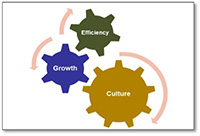
Small business engages a plethora of challenges to graduate to a larger business. Those who successfully craft a sustainable, growing business model often attract the attention of private equity investors. This is a complimentary attestation to an echelon of achievement. However, if a subsequent investment relationship is consummated between a company and a private equity firm, a planning and execution rigor transforms from optional to necessary. For those leaders who have operated without formal planning, the transition may be daunting. The purpose of this article is to present a simple model that has enjoyed some traction in middle market private equity. The model also has practical utility outside of private equity. More… |
| |
|
|
Looking Gift Horses in the Mouth: A Guide for Ethical Leadership and Gifts
Social custom teaches us not to be critical of gifts. In the non-profit world, this is even more important as, in the midst of limited budgets, value seems to be even more elevated in a gift. Gifts are something for nothing. Yet, ethical leadership provides a key consideration in the receipt of gifts: the Other. Gifts ought not to be received uncritically, then, because of this emphasis on the Other and the responsibility of the leader. Ethical leadership provides four key questions when reflecting on receiving gifts. More… |
| Leadership Resources |
|
| |
| Featured Publication |
|
Journal of Transformative Innovation
The Journal of Transformative Innovation (JTI) is an international online refereed journal that explores innovation and next-practices through insightful articles representing new contributions to the understanding of historical and contemporary innovation environments, inclusive of intentionally Christian perspectives.
|
|
| Additional SBL Publications |
|
Submission Guidelines |
Thank you for your interest in the Journal of Strategic Leadership. The final issue of LAO has now been published. Moving forward, LAO will merge with another School of Business & Leadership publication, Journal of Strategic Leadership (JSL), to create an online leadership repository. The goal of this repository is to provide exceptional student, alumni and faculty work, research and resources to disseminate new ideas, spur discussion and advance the field of leadership research and practice. The leadership repository is currently in development. Thank you, again, for your interest in and support of LAO and the School of Business & Leadership.
The submission guidelines are provided for reference purposes only. |
|
Editorial Staff |
|
Julia Mattera, Editor
Sarah Stanfield, Web Production
|
|
|
|
|
| |
|
From the Editor
Over the years, we have been honored to publish relevant articles that offer practical insight into the multidisciplinary field of leadership. As we move forward into the new academic year, we plan to continue that; however, it will be through our new online leadership repository rather than through LAO and the Journal of Strategic Leadership (JSL). The goal of the repository is to provide exceptional student, alumni and faculty work, research and resources to disseminate new ideas, spur discussion and advance the field of leadership research and practice. The leadership repository is currently being developed, so we will notify you as soon as a launch date has been confirmed. We are thankful for our exceptional staff, insightful authors and you, our wonderful readers.
Thank you, again, for your support of LAO. We look forward to continuing our relationship with you via the new leadership repository and hope that you will enjoy this final issue.
Julia Mattera
Editor
|
|
“Too many companies believe people are interchangeable. Truly gifted people never are. They have unique talents. Such people cannot be forced into roles they are not suited for, nor should they be. Effective leaders allow great people to do the work they were born to do.”
Warren G. Bennis
American Scholar, Organizational Consultant & Author
|
|
|
|
Leadership Advance Online(LAO) is published by Regent University's School of Business & Leadership. Views expressed in LAO are not necessarily the views of the School of Business & Leadership or of Regent University. |
|
|
|